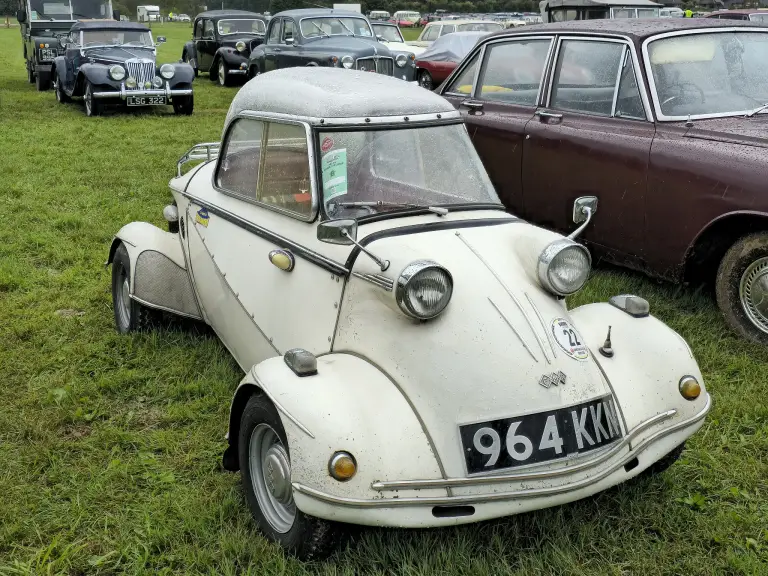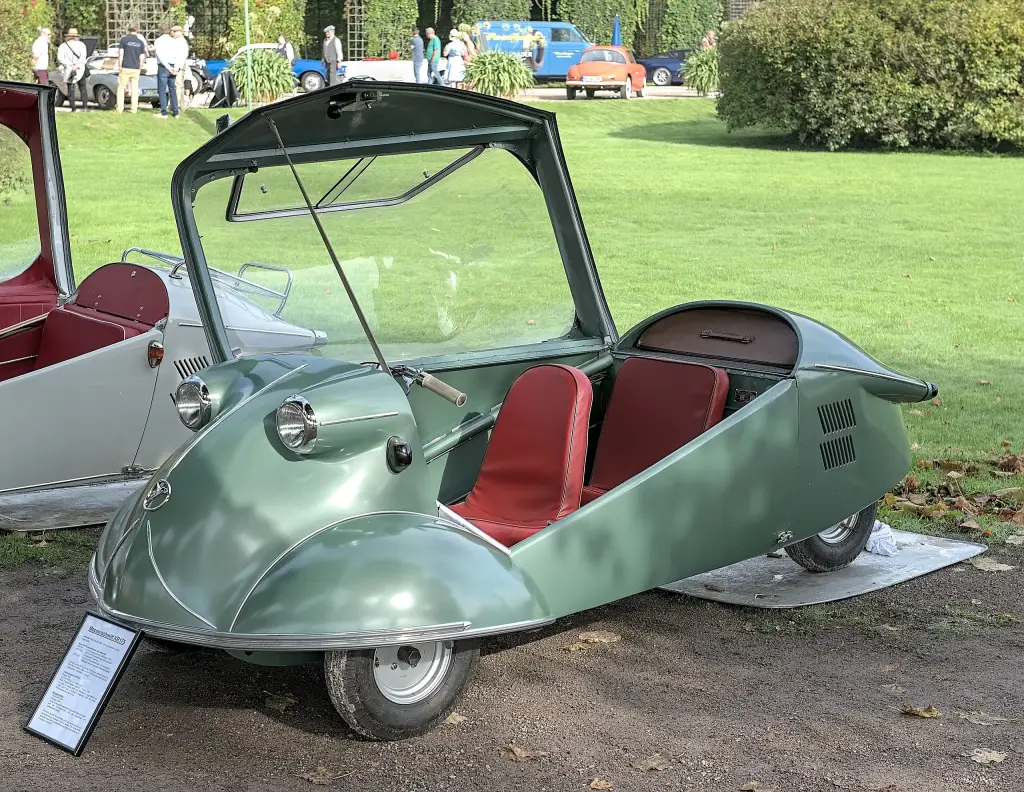
The Messerschmitt KR175 microcar was built from 1953 to 1955 and was the first vehicle produced by Messerschmitt under its 1952 agreement with Fritz Fend. In concept, though not in actual design, it was a development of Fend’s Flitzer invalid carriage. About 15,000 were built before the KR200 replaced it in 1955.
Messerschmitt KR175 at a glance
| Maker | Messerschmitt, Regensburg (Regensburger Stahl- und Metallbau GmbH) |
|---|---|
| Production | 1953–1955 |
| Designer | Fritz Fend |
| Engine | 173 cc Fichtel & Sachs air-cooled single-cylinder two-stroke |
| Power | 9 hp (6.7 kW) at 5,250 rpm |
| Layout | mid (rear) engine, rear-wheel drive, three wheels |
| Seating | two, in tandem |
| Gearbox | four-speed sequential, no reverse, chain final drive |
| Length / width / height | 2,820 / 1,220 / 1,200 mm |
| Wheelbase | 2,030 mm |
| Weight | 210 kg empty |
| Top speed | 80 km/h |
| Price | DM 2,100 |
| Built | about 15,000 |
based on one source: the English Wikipedia article on the KR175.
History of the Messerschmitt KR175
From aircraft factory to bubble car
Messerschmitt, temporarily not allowed to manufacture aircraft after the Second World War, had turned its resources to other products. In 1952 Fritz Fend approached the company with the idea of building small motor vehicles based on his Fend Flitzer invalid carriage. The first of these to enter production at Messerschmitt’s Regensburg factory was the KR175; the prototypes had been designated FK150 — Fend Kabinenroller 150, “scooter with cabin” — and used a 150 cc F&S engine. Although the Messerschmitt name and insignia appeared on the car, a separate company, Regensburger Stahl- und Metallbau GmbH, was created to manufacture and market it.
Sorting out the first cars
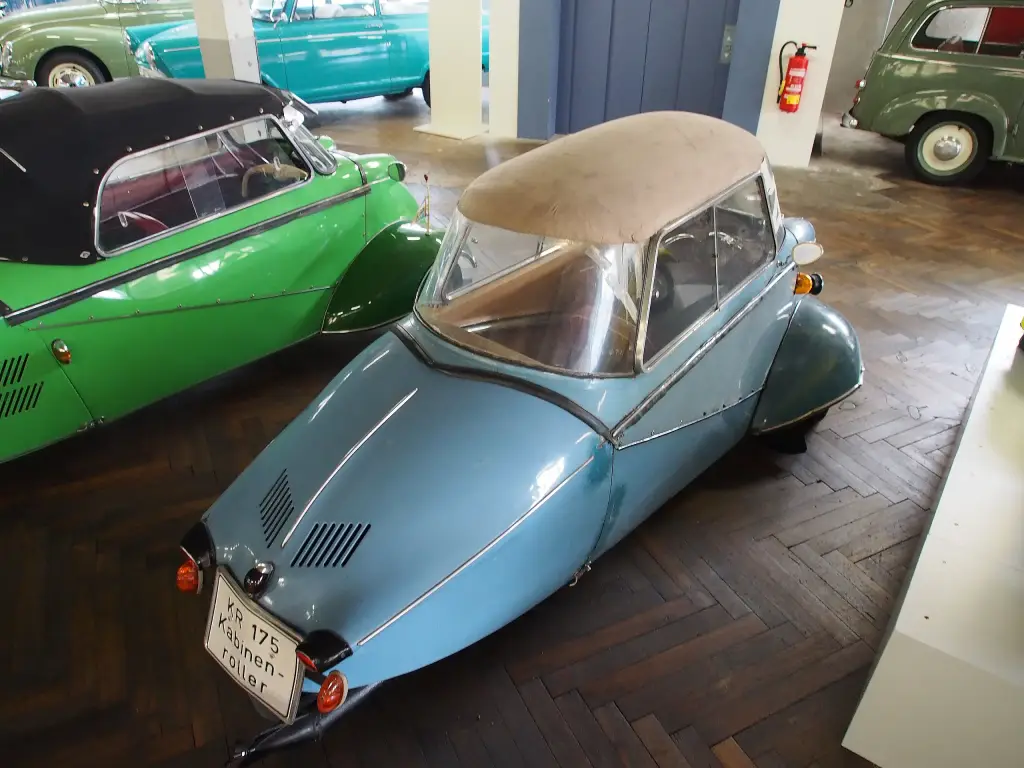
The first KR175s had several problems and needed 70 design modifications between the start of production in February and June 1953. The design was then stable enough to sell in quantity, and the car was developed further into the KR200, which replaced it in 1955. Superficially the two cars looked very similar, but the later model was changed in many fundamental ways.
Built in Italy as well
Italian motorcycle manufacturer Metalmeccanica Italiana Valtrompia, maker of the MI-VAL brand, assembled KR175s in Brescia from components imported from Messerschmitt, fitting its own 172 cc two-stroke engine. These cars were sold as the MI-VAL Mivalino.
Design and features
- Steel space frame: a tubular construction with a floor reinforced by tubes and an indented firewall, behind which the engine sat centrally.
- Bubble canopy: the standard hatch was a large Plexiglas dome with a cutout at the front for a small flat glass windscreen and cutouts at the sides for sliding windows.
- Direct steering: a tubular steel steering bar connected straight to the track rods of the front wheels, giving an extremely direct response suited to small, measured inputs.
- One pedal: the footbrake operated brakes on all three wheels mechanically by cables; the handbrake worked the same way.
- Simple engine: the Fichtel & Sachs single was started with a pull rope as standard, with an electric starter as an option that became standard in 1954.
Messerschmitt KR175 versions
- Standard KR175: the dome-canopy car with sliding side windows.
- Sportster: offered without the dome or the windows, with only the windscreen attached.
- 1954 specification: electric starter standard and the clutch lever replaced by a pedal.
- MI-VAL Mivalino: the Italian-assembled version with a 172 cc engine, built in Brescia.
The KR175 was replaced by the Messerschmitt KR200, which kept the same basic frame but was otherwise an almost total redesign. More cars are in the Messerschmitt collection.
Sources
- Messerschmitt KR175, English Wikipedia: history, design, engine, production