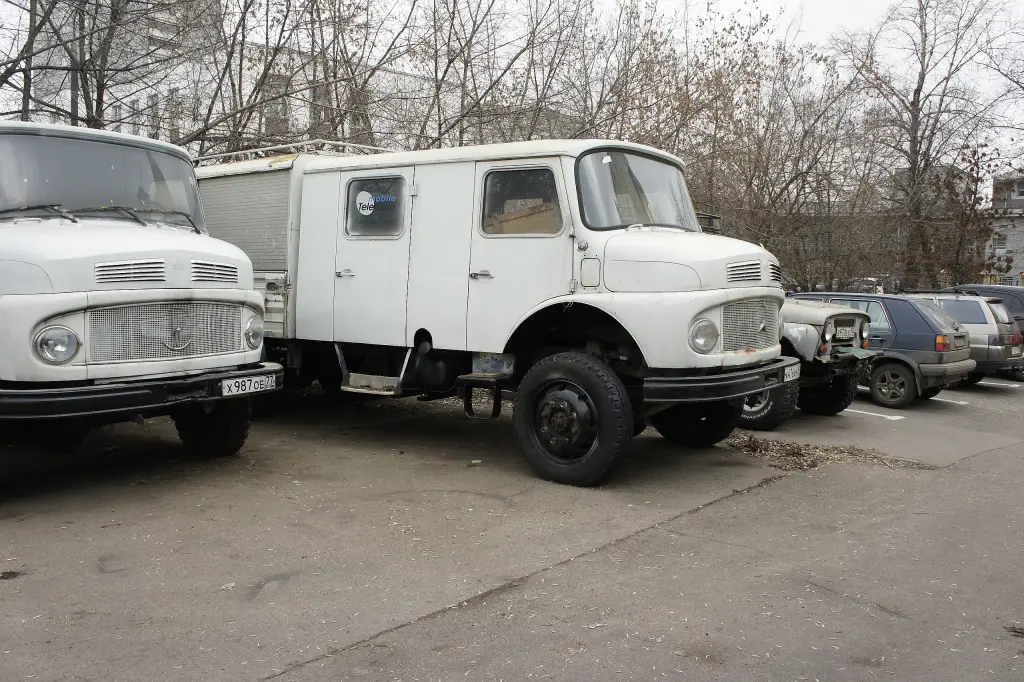
The Mercedes-Benz Kurzhauber, or short-bonnet truck, is a conventional-layout truck with the cab behind the engine, made from 1959 onwards. Its technical successors were built for export until 1995.
Mercedes-Benz short-bonnet trucks at a glance
| First model | L 337, 1959 |
|---|---|
| Layout | cab after the engine, short bonnet |
| Reason for the layout | German Seebohm length laws |
| Medium trucks | L 323 and L 327, 100 PS, built in Mannheim |
| Heavy trucks | L 337, L 332 B and L 334 B, built in Gaggenau |
| Heavy weights | 12 or 19 tonnes, 172 to 180 PS |
| Added in 1962 | the 19-tonne L 334 C, mainly for export |
| New naming | summer 1963, weight and engine power |
| First direct-injection diesel | OM 352 of 5,675 cc, from 1964 |
| Export production | until 1995, and longer in South America |
This article is based on one source, the English Wikipedia article on the Mercedes-Benz short-bonnet trucks.
History of the Mercedes-Benz short-bonnet trucks
German regulations on overall length, the Seebohm laws, pushed the cab forward to cover part of the engine under the windscreen, making the truck shorter while keeping the flatbed long. The first short-bonnet model, the L 337, was produced in Germany from 1959, and its technical successors were built for export until 1995, long after domestic sales had ended. The layout was a big export success and became very popular in the Middle East, Asia Pacific, South America and Africa.
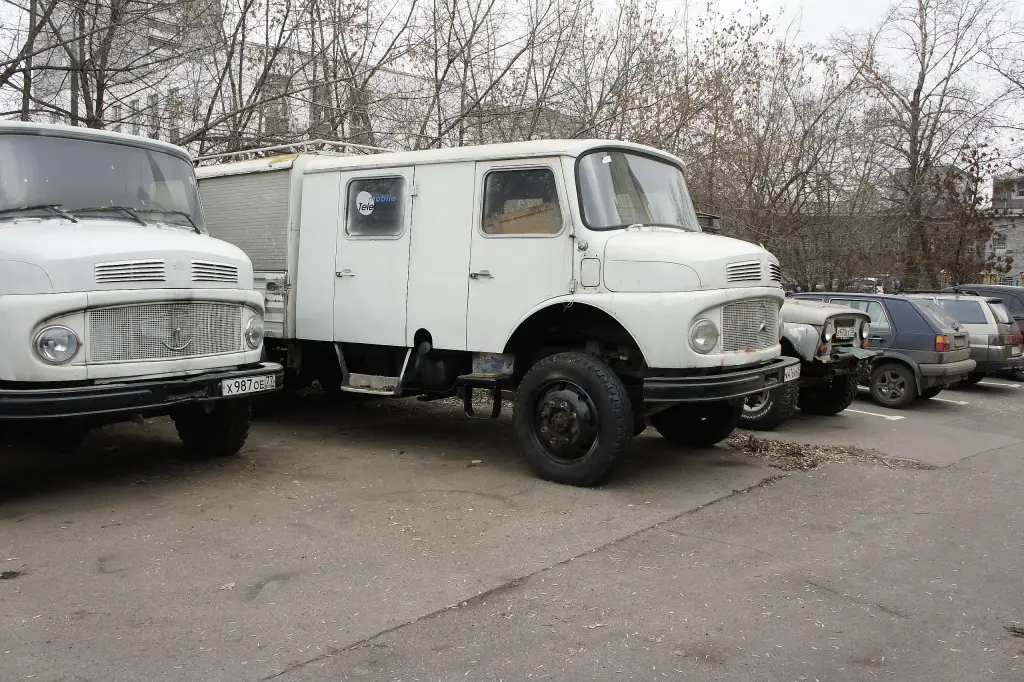
Medium-weight trucks, the L 323 and L 327 with 100 PS inline-six diesels, were built in Mannheim for shorter delivery and construction work, while the heavier trucks for long-distance and heavy construction came from Gaggenau. These were the L 337 and L 332 B, from 1960 the L 334 B, with 12 or 19 tonnes total weight and 172 to 180 PS diesel sixes; in 1962 the more powerful 19-tonne L 334 C was added, mainly for export. Model names were letter combinations reflecting the truck’s intended use until a new system was introduced in the summer of 1963, still in use today, based on gross weight and engine power.
The 5,675 cc OM 352 was Mercedes-Benz’s first direct-injection diesel. After its debut in 1964, a 130 PS version was installed in the Kurzhauber in the 1967 L/LP 1113 B series, where 11 stood for the tonnage and 13 for tens of horsepower; the engine and its versions gradually spread through the range, replacing the earlier indirect-injection units. Just as the Dodge Power Wagon became synonymous with oil exploration in Arabia in the 1950s, the short-bonnet trucks, together with the Kenworth 953, became synonymous with the Arabian exploration boom of the 1960s. Many Arabian roads were not surfaced until the early 1980s and there were no weight or length limits, so the trucks carried up to three times their rated load and earned a reputation for toughness. Nearly all short-bonnet trucks sent to Arabia were orange and those sent to North Africa green. Brazilian-built examples were assembled and sold in North America until 1991.
Design and features
- Short bonnet: the cab moved forward to meet German length rules.
- OM 352: the company’s first direct-injection diesel.
- Export legend: famous on unsurfaced roads in Arabia and Africa.
- Long life: built in Germany until 1959 and for export until 1995.
Mercedes-Benz short-bonnet trucks versions
- L 323 and L 327: medium trucks of 100 PS.
- L 337: the first short-bonnet model.
- L 332 B and L 334 B: heavy trucks of 12 and 19 tonnes.
- L 334 C: the more powerful 19-tonne export model.
- L/LP 1113 B (1967): with the OM 352 diesel.
The short-bonnet trucks were the main Mercedes-Benz export trucks before the NG generation; the L 6600 belongs to the earlier 1950s heavy trucks. More in the Mercedes-Benz collection.
Video: Mercedes-Benz LP LPS 1626
Video by YouTube on YouTube.
Sources
- Mercedes-Benz short-bonnet trucks, English Wikipedia: layout, models, engines, export history