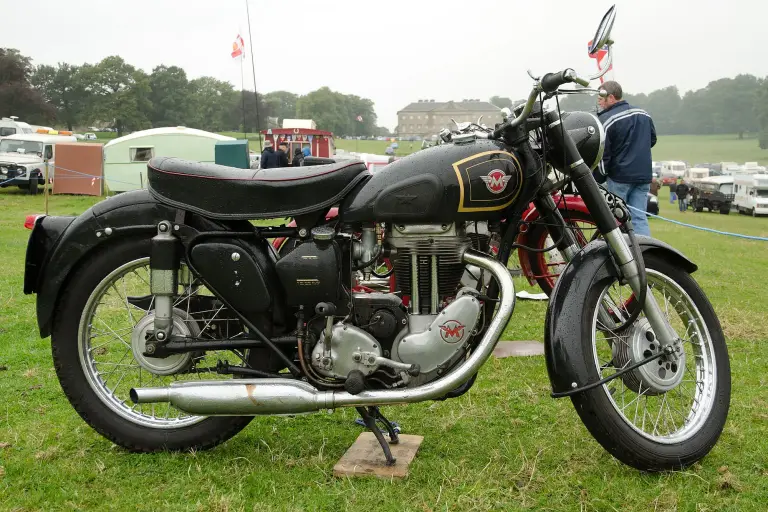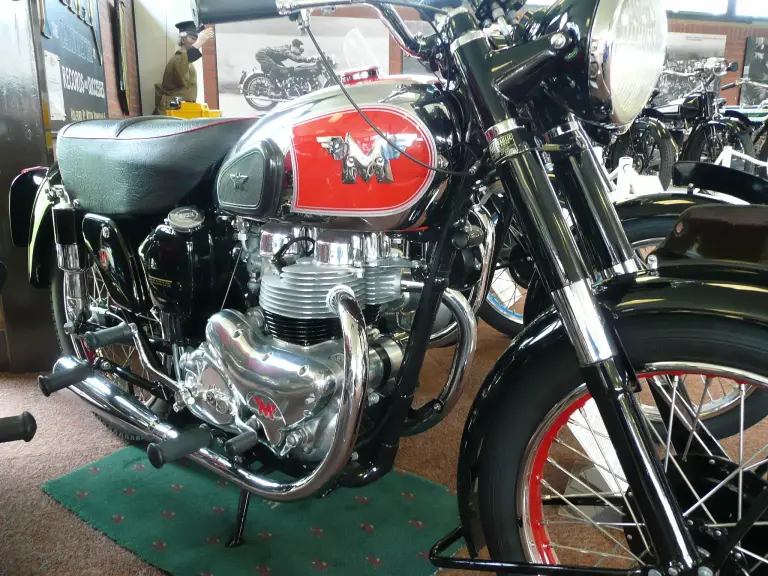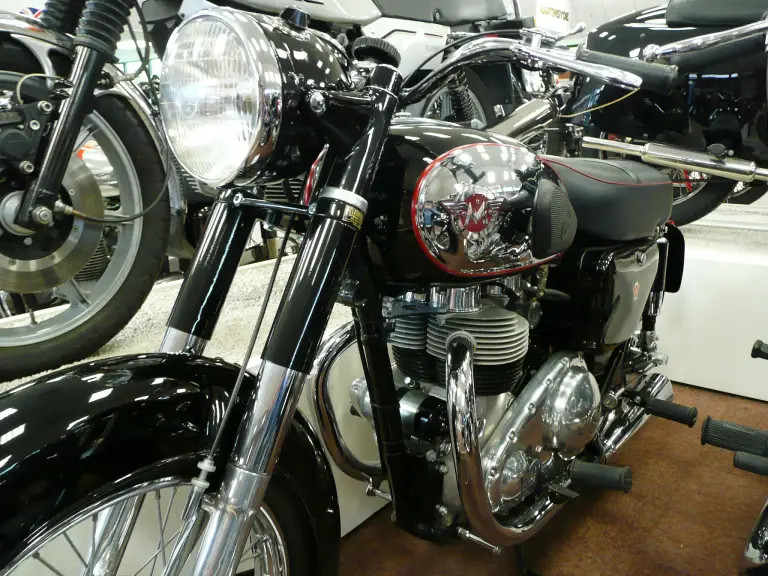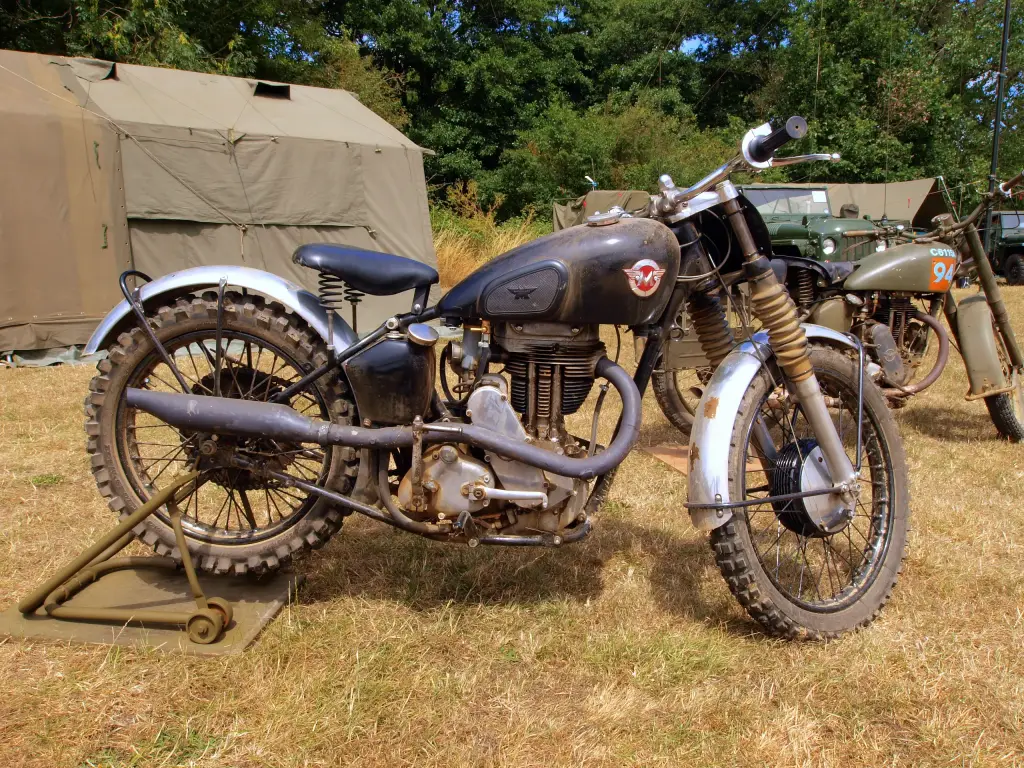
The Matchless G3/L is a motorcycle developed for the British Army during the Second World War, when Matchless built 80,000 G3 and G3/L models. It was the first production motorcycle to replace girder front forks with the oil-damped Teledraulic telescopic suspension, and the Ministry of Defence kept it in service into the 1960s.
Matchless G3/L at a glance
| Maker | Associated Motor Cycles (Matchless), Plumstead, London |
|---|---|
| Built for | British Army, from 1941 |
| Engine | 350 cc single |
| Key innovation | Teledraulic telescopic front fork with oil damping |
| Weight saving | 25 kg (56 lb) on the prototype |
| Combined G3 and G3/L production | 80,000 |
| South African order | 110 machines, 1940 |
| Rear suspension | swinging arm from 1949 |
| Post-war finish | black instead of green or khaki |
| Military service | until 1960, replaced by the BSA W-B40 |
| Value today | up to £5,000 in original WD condition |
Based on one source: the English Wikipedia article on the Matchless G3/L.
History of the Matchless G3/L
Built for the Army
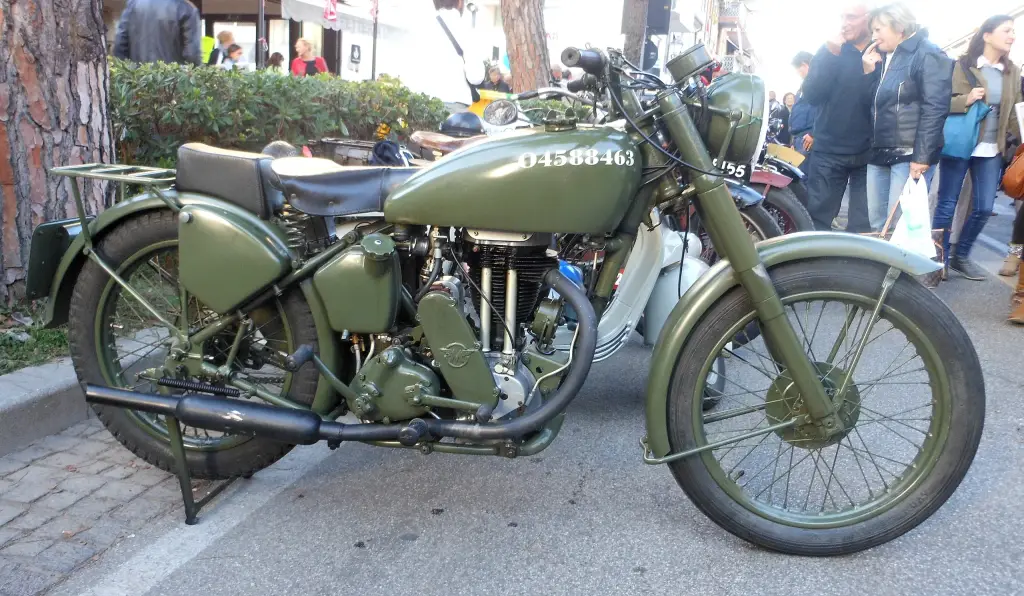
In 1940 the British War Office requisitioned every available Matchless motorcycle to replace machines lost at Dunkirk. The G3/L was developed from the pre-war G3, and its L stood for lightweight: the prototype was 56 lb (25 kg) lighter than its predecessor, although later production bikes gained weight as army equipment was added. Its real innovation was the Teledraulic front fork, the first telescopic design with oil damping and the pattern that almost every motorcycle would follow.
The contract
After exhaustive military testing the G3/L lost the War Office competition for a single standard 350 cc machine to Triumph’s 3TW, which was faster and lighter. In November 1940 German bombers destroyed Triumph’s Priory Street works in Coventry and all its technical records, drawings and designs were lost, so Matchless won the contract instead. Production began in late 1941, and from 1942 the entire output of the Matchless factory was dedicated to the G3/L. In 1940 the South African Army had already ordered 110 as the preferred machine for despatch riders.
At war and after
G3/Ls carried messages too important for radio or telephone, escorted convoys and acted as the advance party into occupied territory, with riders exposed to snipers and working by dimmed headlights. A wartime study by Sir Hugh Cairns identified head injuries as a major cause of death among despatch riders and recommended crash helmets instead of tin helmets or forage caps; compulsory helmets for motorcyclists followed 32 years later. Post-war G3/Ls were the military machine finished in black instead of green or khaki, and the Ministry of Defence kept them until 1960, when the BSA W-B40 replaced them. The type also became a favourite of British trials riders, and the Royal Artillery Motor Cycle Display Team used it from its first performance at St Asaph in July 1949 until it switched to the BSA Gold Star.
Development
The G3 gained swinging-arm rear suspension in 1949, an aluminium cylinder head in 1951, stronger main bearings and an auto-advance magneto in 1955, and an alternator with optional chrome tank panels, steering damper, brake light and air filter in 1958. A wartime G3/L in original condition with the correct WD equipment can cost up to £5,000 today.
Design and features
- Teledraulic fork: the first telescopic front suspension with oil damping, later adopted by almost every motorcycle maker.
- Lightweight build: the prototype was 25 kg lighter than the pre-war G3, though army equipment added weight back.
- Military equipment: built for despatch riding, convoy escort and advance parties in occupied territory.
- Long service: used by the Ministry of Defence until 1960 and by trials champions after the war.
Matchless G3/L versions
- Wartime G3/L: finished in green or khaki for army use.
- Post-war G3/L: the same military machine in black, sold on to civilian riders.
- Trials G3/L: the postwar choice of riders such as Artie Ratcliffe and Ted Usher.
- Display team G3/L: used by the Royal Artillery Motor Cycle Display Team from 1949.
The G3/L was the military ancestor of the civilian Matchless G80, and its engine ideas fed into the racing G50. More Matchless motorcycles are in the Matchless collection.
Video: MATCHLESS G3L
Video on YouTube.
Sources
- Matchless G3/L, English Wikipedia: wartime development, service, post-war use