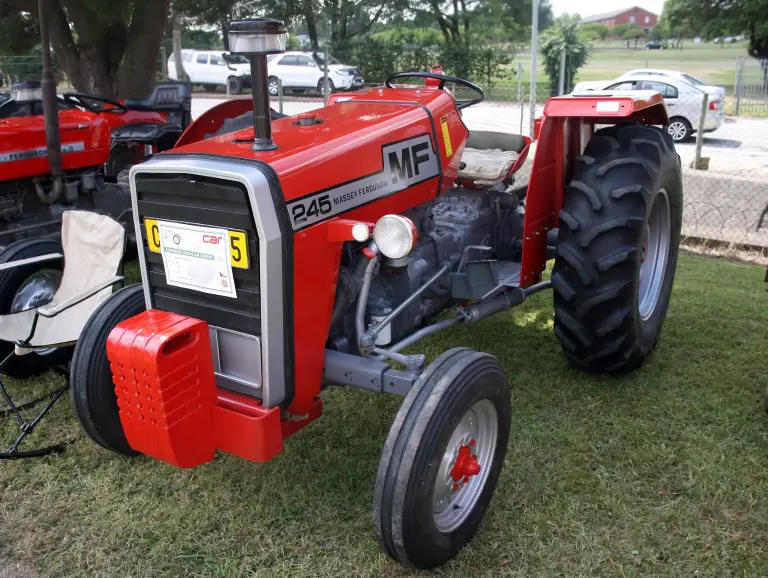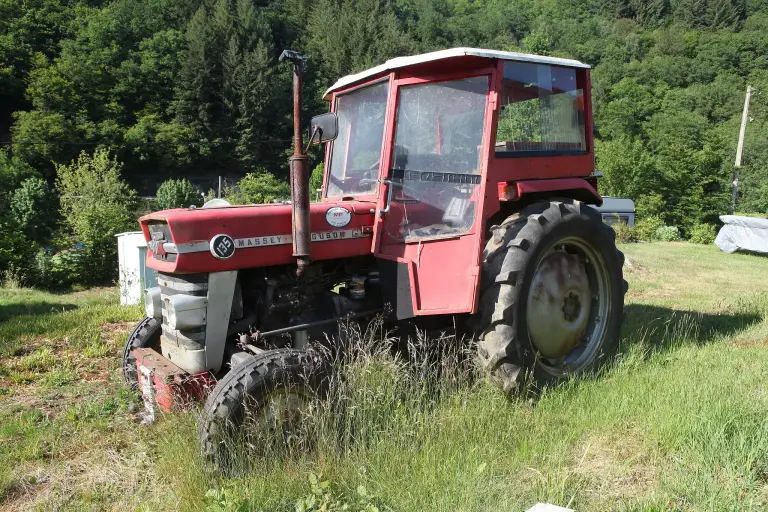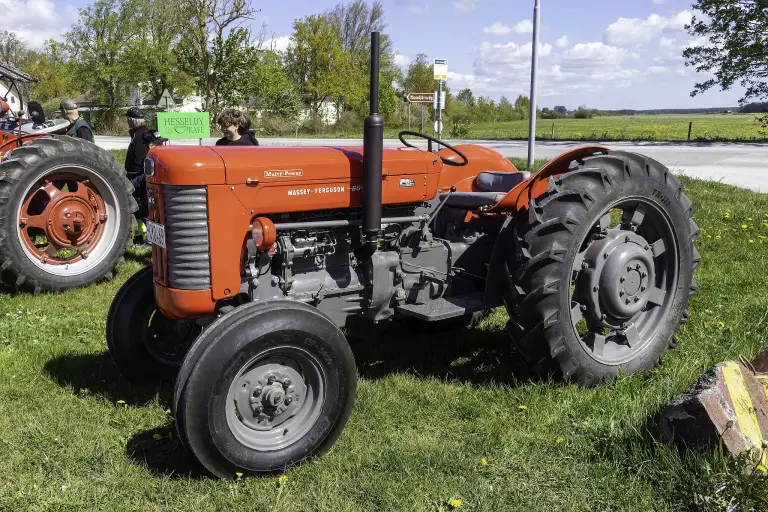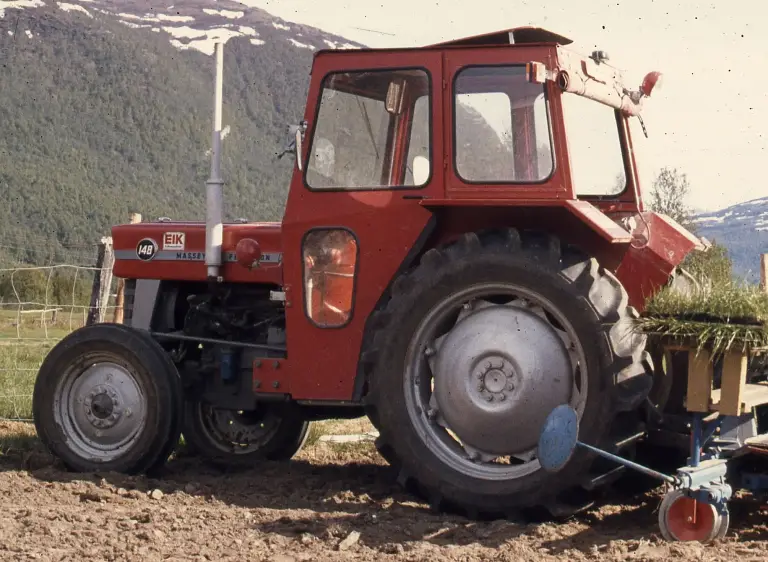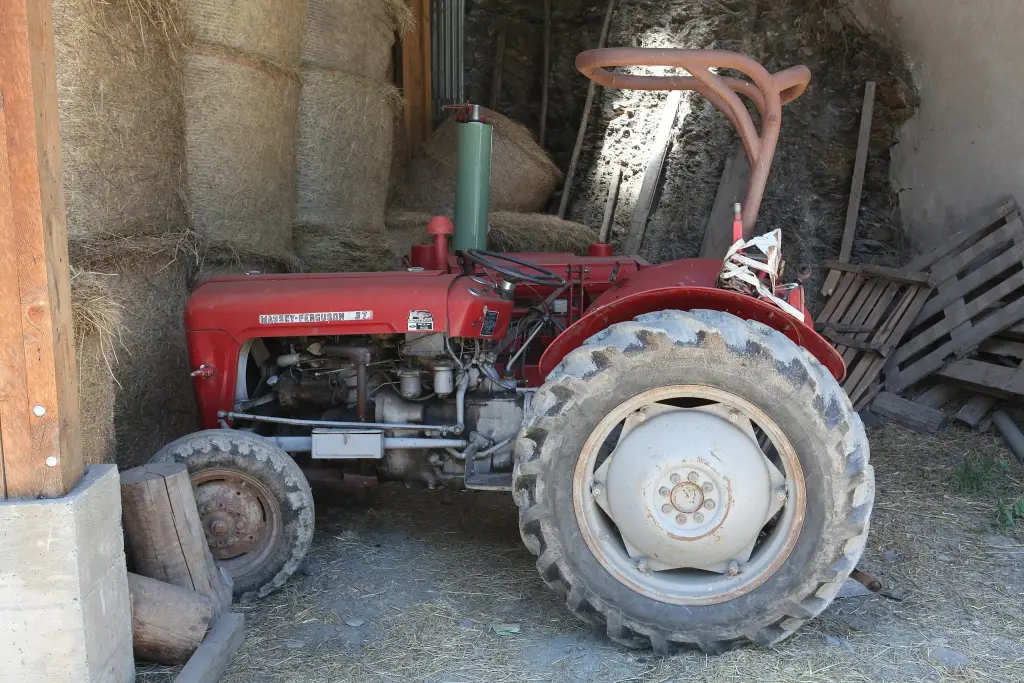
The Massey Ferguson 37 was built at Beauvais in France from 1963 to 1965. It was the last of the transitional tractors made between the merger of Massey Harris and Ferguson and the arrival of the 100 range, combining features of both old marques and correcting several of their faults.
Massey Ferguson 37 at a glance
| Maker | Massey Ferguson |
|---|---|
| Production | 1963–1965 |
| Built at | Beauvais, France |
| Engine | Perkins three-cylinder in-line diesel, direct injection |
| Bore × stroke | 91.44 × 127 mm |
| Displacement | 2,500 cm³ |
| Power | 42 ch SAE at 2,150 rpm |
| Transmission | 6 forward and 2 reverse, doubled by Multi-Power |
| Differential | Locking differential, new for the marque |
| Power take-off | 540 rpm or proportional to ground speed |
Based on one source: the French Wikipedia article on the 37. English Wikipedia has no article on this model.
History of the Massey Ferguson 37
Between two ranges
The administrative merger of Massey Harris and Ferguson in 1953 took much longer to work through in engineering and sales, because the two old marques had different products, dealers and customers. The first tractor of the new company was the Massey Ferguson 35, whose first examples were built in 1960. While waiting for the 100 range of 1964, Massey Ferguson built a few tractors that borrowed from Massey Harris and from Ferguson, and the 37, made at Beauvais from 1963 to 1965, was the last of these transitional machines.
Perkins instead of Hotchkiss
The 37 used a three-cylinder Perkins diesel of 2,500 cc with direct injection, more robust and longer-lived than the Hotchkiss engines of older Ferguson tractors. The gearbox had two ranges of three forward and one reverse speed, doubled by the Multi-Power torque amplifier, which was offered for the first time on a tractor of this power. The 37 also had a locking differential, missing on earlier models, and kept the safety switch that prevented the starter from working unless the range lever was in neutral. Ergonomics were not ideal — the pedals had to be pushed downwards, tiring on long days — but the tractor was easy to drive.
Design and features
- Perkins three-cylinder: 2,500 cc and 42 ch SAE at 2,150 rpm, replacing the older Hotchkiss engines.
- Multi-Power: the first tractor of this power class to offer the torque amplifier as an option.
- Locking differential: a first for Massey Ferguson, and a real gain in the field.
- Two PTO modes: 540 rpm continuous or proportional to forward speed, with trailer equipment optional.
- Starter safety switch: the engine could not be started with the range lever out of neutral.
Massey Ferguson 37 versions
- 37 (1963–1965): the only version built, at Beauvais.
- With or without Multi-Power: six or twelve forward speeds.
- Successor: the 100 range from 1964.
The 37 came before the 135 and the 65 was its larger stablemate of the same years. More tractors are in the Massey Ferguson collection.
Sources
- Massey Ferguson 37, French Wikipedia: history, engine, transmission, equipment