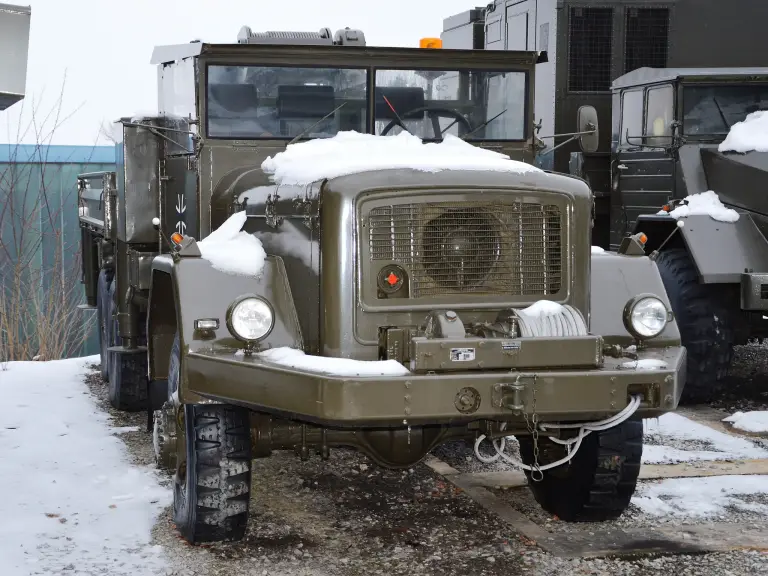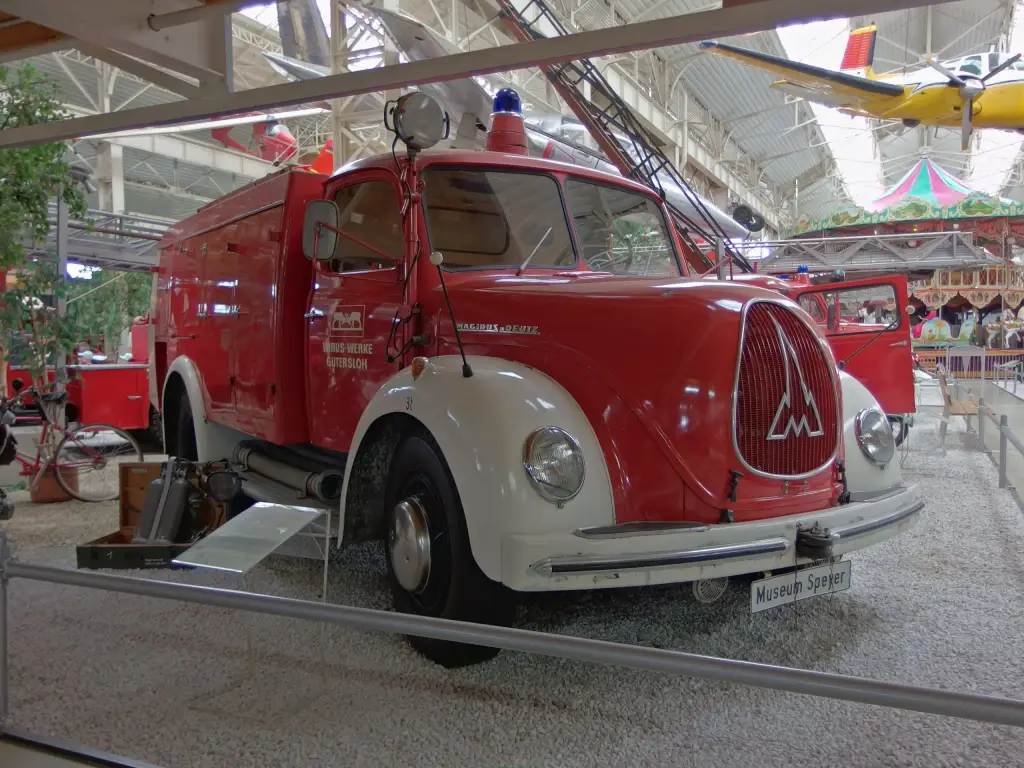
The Rundhauber is the name that stuck to the Magirus-Deutz lorries introduced in 1951 and sold from 1952, whose rounded bonnet was unlike anything else on German roads. Because the engine was air-cooled, there was no large box-shaped water radiator in front of it, and the nose could be shaped into a smooth, almost spherical form. The range was renamed after planets in the mid-1950s and remained in production until 1967.
Magirus-Deutz Rundhauber at a glance
| Maker | Magirus-Deutz, Ulm |
|---|---|
| Production | 1952–1967, parcel post vans until 1971 |
| Design | bonneted lorry with rounded air-cooled nose |
| First designations | S 3500, S 3500/56, S 4500, S 4500/6, S 4500/112, S 5500, S 6500, S 7500 |
| Planet names from 1955 | Mercur (S 4500), Saturn (S 5500), Jupiter (S 7500) |
| Names from 1958 | Sirius, Mercur, Saturn |
| Engines | air-cooled diesels, four, six and eight cylinders, 85–170 PS |
| Payload | 3.5 to 9 tonnes |
| Body codes | L normal chassis, K tipper, S tractor unit |
| Code from 1964 | power, engine type, gross weight, drive and body, e.g. 90 D 7 L |
There is no separate article on the Rundhauber; this page is based on the section on the type in the German Wikipedia article on Magirus-Deutz. Based on one source.
History of the Magirus-Deutz Rundhauber
A new shape in 1951
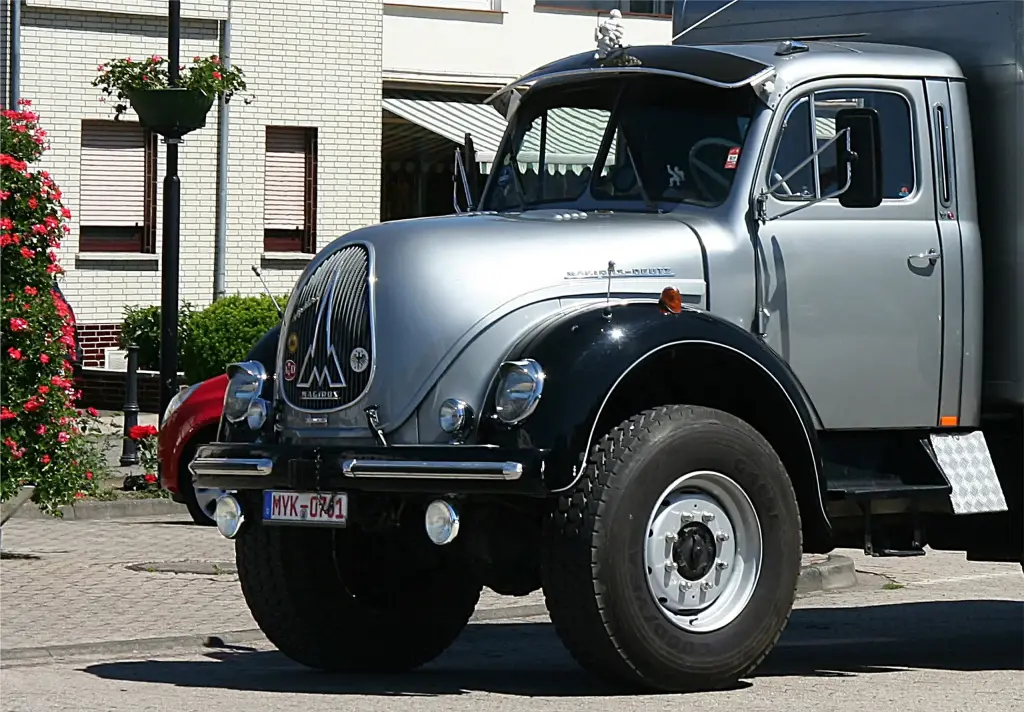
In 1951 Magirus-Deutz presented completely redesigned lorries, and the nickname Rundhauber — round bonnet — soon became the usual way to describe them. The bulbous nose set them apart from rival lorries and was possible only because the air-cooled engine needed no large, box-shaped water radiator ahead of the block. The first model designations were S 3500, S 3500/56, S 4500, S 4500/6, S 4500/112, S 5500, S 6500 and S 7500, and the lorries were sold under these names from 1952.
Planets instead of numbers
Most Magirus-Deutz lorries had planetary gears in their rear axles, and by 1955 the company had the idea of naming the vehicles after planets. The type numbers stayed for a while but were supplemented with planet names: S 4500 Mercur, S 4500/6 Mercur, S 4500/112 Mercur, S 5500 Saturn and S 7500 Jupiter. In 1958 the names changed again, to Sirius (Sirius, Sirius K and Sirius 90 L), Mercur (Mercur L, K, 112 L, 112 K, 120 L, 120 S, 120 K, 126 L and 126 K) and Saturn (Saturn L, S, K, 145 L, 145 S, 145 K and 150 K). Sirius is not a planet but the brightest star in the sky.
Reading the badge
The number in the name gave the engine output in PS, and models without a number were the base version with the smallest engine. A letter after the name described the body: L stood for a normal lorry chassis suitable for many different bodies, K for a tipper and S for a tractor unit. From 1964 a new system combined output, engine type, gross weight, drive and body in one code. The model 90 D 7 L, for example, was a Magirus-Deutz with 90 PS and a gross weight of 7 tonnes; D stood for the Deutz engine and L for a normal bonneted lorry without all-wheel drive.
A quieter cab
The Rundhauber cab was the first from a German maker with meaningful sound insulation inside. Perforated and foam panels were fitted in the roof lining, on the bulkhead between the engine compartment and the cab, and in the doors. The cabs of the Rundhauber and the later Eckhauber were otherwise identical.
The end of the round bonnet
Production of the Rundhauber ended in 1967, as Magirus-Deutz replaced the round bonnets of its two-wheel-drive models with the angular Eckhauber from 1962. At the special request of the Deutsche Bundespost, however, the 110 D 7 L parcel post van stayed in production until 1971, and about 1,000 were built. The Rundhauber had been widespread in post-war Germany, particularly as fire engines, in medium-weight distribution work and on building sites, and before the arrival of the rounded forward-control lorries in 1957 also in long-distance heavy haulage. Payloads ranged from 3.5 to 9 tonnes, and the air-cooled diesels had four, six or eight cylinders with outputs from 85 PS to 170 PS in the S 7500.
Collectors’ items today
The characteristic round and square bonnet lorries of the 1950s and 1960s, including the Rundhauber, are now popular collector’s items, and restored examples appear at vintage vehicle meetings across Europe.
Design and features
- Rounded air-cooled nose: no water radiator in front of the engine allowed the smooth, curved bonnet.
- Planet names: Mercur, Saturn, Jupiter and later Sirius gave the lorries memorable identities.
- Quiet cab: the first German lorry cab with substantial sound insulation.
- Wide range: payloads from 3.5 to 9 tonnes and engines from 85 to 170 PS.
- Long service: fire brigades and building firms kept the type in use for decades.
Magirus-Deutz Rundhauber versions
- S-series (1952): S 3500 to S 7500, sold under type numbers only.
- Planet-named models (1955–1958): Mercur, Saturn and Jupiter versions of the S-series.
- Named models (1958–1964): Sirius, Mercur and Saturn in L, K and S forms.
- Coded models (1964–1967): designations such as 90 D 7 L.
- 110 D 7 L parcel post van: about 1,000 built for the Deutsche Bundespost until 1971.
The largest of the round-bonnet lorries was the Magirus-Deutz Jupiter 6×6, which served with the Bundeswehr. More vehicles of the make are in the Magirus collection.
Sources
- Magirus-Deutz, German Wikipedia: design, model names, engines, payloads and production history