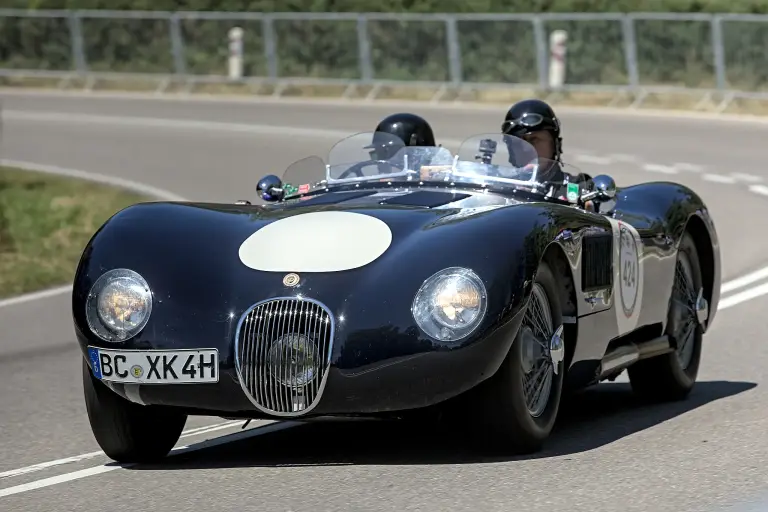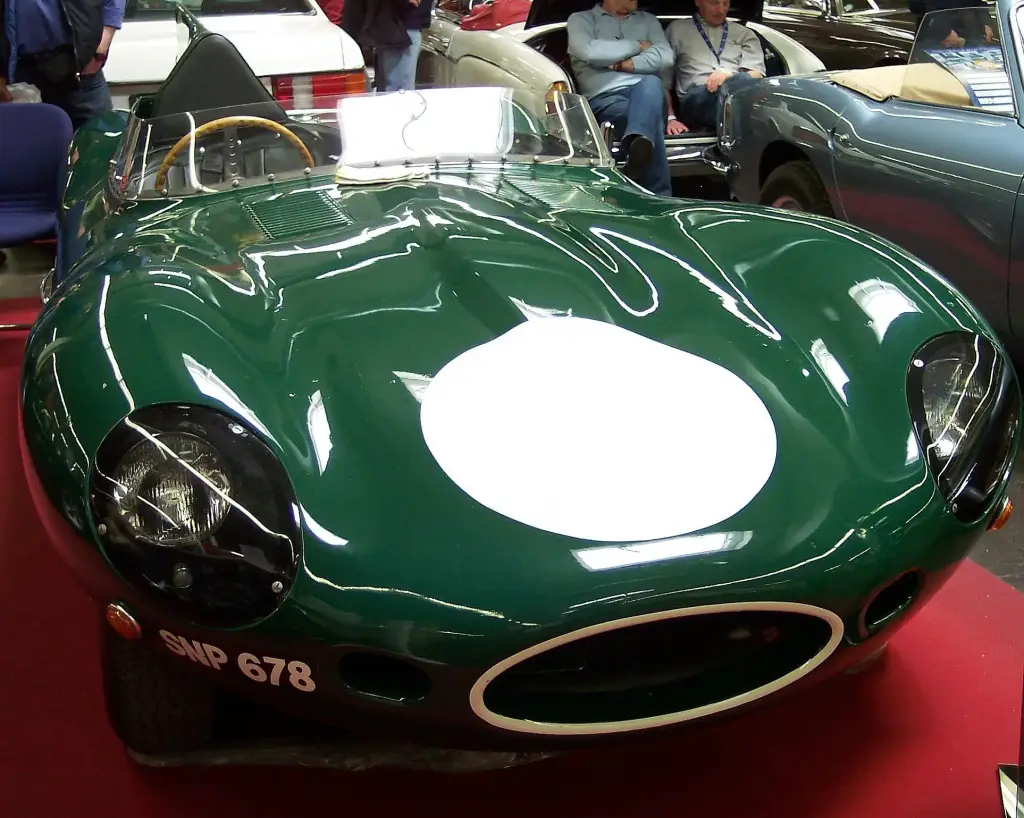
The Lynx D-Type is a British hand-built replica of the Jaguar D-Type sports racer, produced by the Lynx firm in a modernised form suitable for public roads. The first car was completed around 1974 and shown in 1975, and more than fifty have been built since.
Lynx D-Type at a glance
| Maker | Lynx, Britain (Lynx Automobile Manufacturing Ltd, Coventry, since 2023) |
|---|---|
| Type | road-legal replica of the Jaguar D-Type |
| Original D-Type | 71 cars built between 1954 and 1957 |
| First Lynx D-Type | built from 1972, completed around 1974, shown in 1975 |
| Body | hand-formed aluminium, short or long nose, with or without tail fin |
| Chassis | light-alloy structure with Jaguar E-Type longitudinal members and subframes |
| Wheelbase | 2,440 mm, 20 mm longer than the original |
| Rear suspension | independent, from the E-Type, instead of the original live axle |
| Engines | Jaguar 3.4, 3.8 or 4.2-litre straight-six, three Weber carburettors |
| 4.2-litre output (2016) | 274 PS (201 kW) at 4,500 rpm, 410 Nm at 4,000 rpm |
| Gearbox | four- or five-speed manual, three final drive ratios |
| Built | more than 50, five of them as XKSS |
The Lynx D-Type is described in a section of the German Wikipedia article on the Lynx marque; there is no English Wikipedia article on the model. Based on one source.
History of the Lynx D-Type
A Jaguar specialist
Lynx was founded in 1968 by Guy Black and Roger Ludgate and spent its first years repairing, maintaining and preparing Jaguar sports and racing cars, above all C-Types and D-Types. In 1972 the firm began building a D-Type completely from scratch, using chassis and suspension components from the Jaguar E-Type. The car was finished around 1974 and made its debut in 1975 at a British trade show as the Lynx D-Type, shown at the Racing Car Show in London.
Aluminium and a longer wheelbase
The bodies were shaped by hand from aluminium sheet, in the manner of the original works cars. The D-Type and XKSS used a central light-alloy structure fitted with the longitudinal members and the front and rear subframes of a Jaguar E-Type; the wheelbase grew by 20 mm over the historic car, to 2,440 mm. Front and rear suspension also came from the E-Type, so these Lynx cars had independent rear suspension instead of the original live axle, which gave better road behaviour and more comfort. The body was available with a short or a long nose, with or without the tail fin behind the driver, and with either a full windscreen or a small racing screen.
Engines and the later years
All Lynx models used Jaguar straight-six engines, reworked by the firm to suit the use: 3.4, 3.8 or 4.2 litres, each with three Weber carburettors. Buyers could choose normal pressure lubrication or a dry-sump system intended for racing, a four- or five-speed gearbox and one of three final drive ratios. In 2016 the usual engine was the 4.2-litre, rated at 274 PS at 4,500 rpm and 410 Nm at 4,000 rpm. More than fifty Lynx D-Types were built, five of them as XKSS. Production under John Mayston-Taylor ended in 2009, restarted in 2014, and in spring 2021, after talks with Jaguar, Lynx stopped building its classic Jaguar replicas.
Design and features
- Hand-formed aluminium: the body is shaped and riveted by hand, as on the works cars.
- Modern running gear: E-Type subframes and independent rear suspension make the car usable on the road.
- Choice of engines: 3.4, 3.8 or 4.2-litre Jaguar sixes with three Weber carburettors, dry sump optional.
- Body options: short or long nose, tail fin or clean tail, full or racing windscreen.
- Licensed replica: built with the approval of Jaguar until production of the classic models stopped in 2021.
Lynx D-Type versions
- Lynx D-Type (from 1974): the standard road-legal replica.
- Short-nose and long-nose: two front-end shapes.
- Fin and no-fin bodies: with or without the tail fin behind the driver.
- Lynx XKSS (from 1990): the road-going version of the D-Type, five of the Lynx cars built in this form.
The D-Type was the first of Lynx’s Jaguar replicas; its stablemate was the Lynx C-Type. More cars are in the Lynx collection.
Sources
- Lynx (Automarke), German Wikipedia: history, construction, engines, body options, production numbers