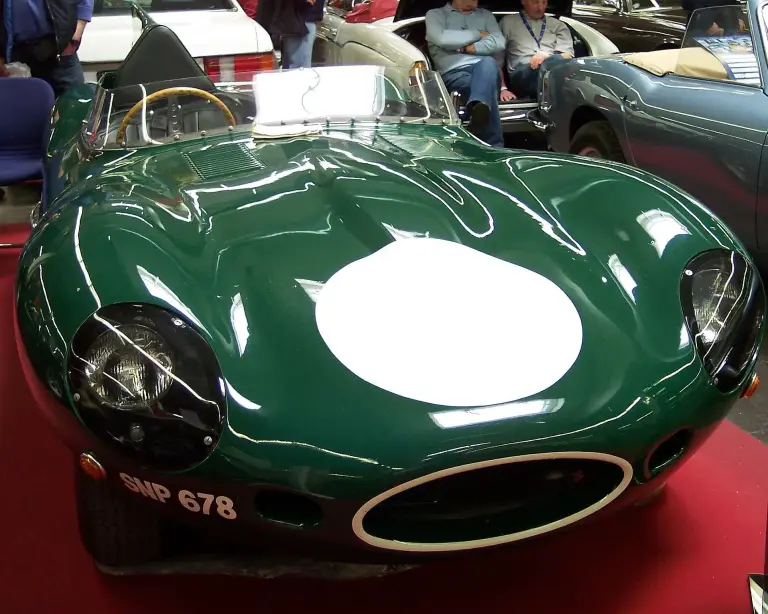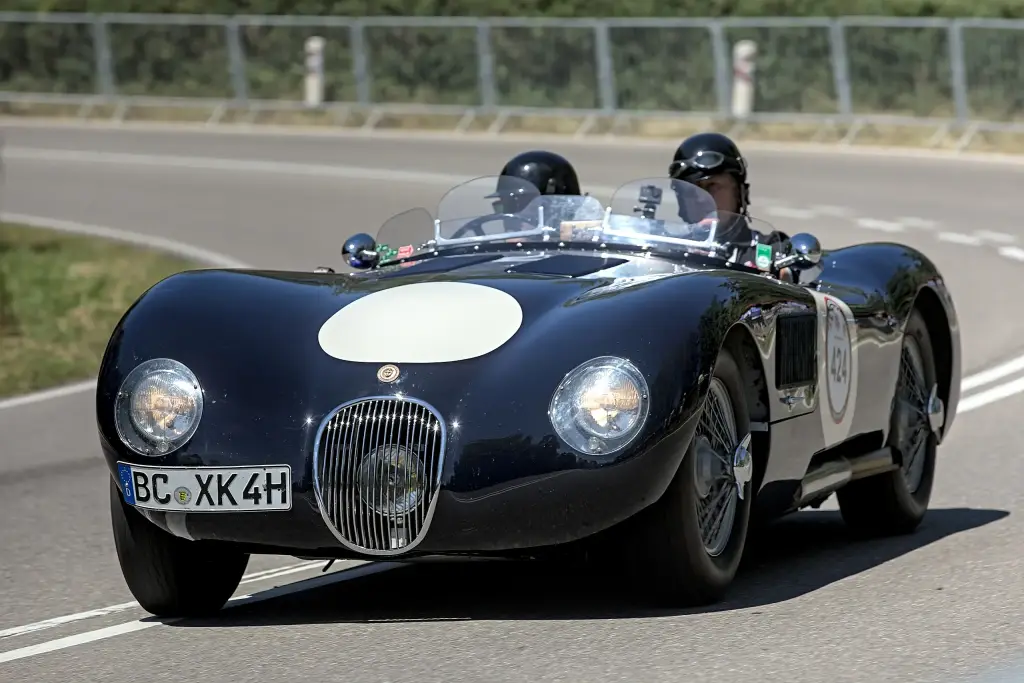
The Lynx C-Type is a British hand-built replica of the Jaguar C-Type sports racer. Lynx first offered complete C-Type replicas in the mid-1990s, alongside its better-known D-Type, and has built them again as new cars since 2014.
Lynx C-Type at a glance
| Maker | Lynx, Britain (Lynx Automobile Manufacturing Ltd, Coventry, since 2023) |
|---|---|
| Type | replica of the Jaguar C-Type sports racer |
| First offered | full C-Type replicas mentioned from the 1995 model year |
| Built again from | 2014, when Lynx returned to the classic Jaguar models |
| Body | hand-formed aluminium, riveted like the originals |
| Chassis | space frame, unlike the D-Type-based cars |
| Engines | Jaguar 3.4, 3.8 or 4.2-litre straight-six, three Weber carburettors |
| C-Type detail | special cylinder heads and exhaust manifolds modelled on the original |
| Gearbox | four- or five-speed manual, three final drive ratios |
| Classic replicas stopped | spring 2021, after talks with Jaguar |
| Price of a genuine Lynx | roughly $400,000 to $680,000 |
The Lynx C-Type is described in a section of the German Wikipedia article on the Lynx marque; there is no English Wikipedia article on the model. Based on one source.
History of the Lynx C-Type
From Jaguar repairs to replicas
Lynx was founded in 1968 by Guy Black and Roger Ludgate and began by repairing, maintaining and preparing Jaguar sports and racing cars, especially C-Types and D-Types. Its first complete replica, a D-Type, appeared in the mid-1970s. When John Mayston-Taylor took over the business in 1992 he brought the firm back to its Jaguar roots, and full C-Type replicas were first mentioned in the 1995 model year, alongside the D-Type, the XKSS and the E-Type Lightweight.
Built like the original
Lynx bodies were shaped by hand from aluminium sheet, and the new cars were riveted in the manner of the originals. The C-Type differed from the D-Type and XKSS in its chassis: its aluminium body sat on a space frame, while the other models used a central light-alloy structure with Jaguar E-Type subframes. All Lynx models had Jaguar straight-six engines with three Weber carburettors, in 3.4, 3.8 or 4.2 litres; the C-Type engines received special cylinder heads and exhaust manifolds modelled on the historic original. Buyers could also choose an ordinary pressure-lubricated engine or a dry-sump unit intended for motorsport, a four- or five-speed gearbox and one of three final drive ratios.
The later years
Production under Mayston-Taylor ended in 2009. Nigel Forsyth took over the name and tooling, and from 2014 Lynx built C-Type, D-Type, XKSS and E-Type Lightweight replicas as new cars again, with the bodies still formed by hand in England; part of the European approval work was handled through the German TUV. In spring 2021, in agreement with Jaguar, Lynx stopped producing the classic Jaguar models and turned to new projects. A genuine Lynx is a costly car: the firm’s replicas have been quoted at roughly $400,000 to $680,000.
Design and features
- Space-frame chassis: the C-Type body sits on a tubular frame, as on the original design.
- Period engine detail: special cylinder heads and exhaust manifolds in the style of the historic car.
- Hand-formed aluminium: bodies shaped and riveted by hand in England.
- Choice of specification: three engine sizes, dry sump optional, four- or five-speed gearbox.
- Built as a new car: a replica made from scratch, not a converted Jaguar.
Lynx C-Type versions
- Lynx C-Type (from 1995): the original run of complete replicas.
- C-Type from 2014: production resumed after the change of ownership.
- Lynx D-Type and XKSS: the related replicas on the E-Type-based chassis.
- Lynx E-Type Lightweight: the later addition to the range, from 1994.
The C-Type was Lynx’s second Jaguar replica after the Lynx D-Type. More cars are in the Lynx collection.
Sources
- Lynx (Automarke), German Wikipedia: history, chassis, engines, production dates, prices