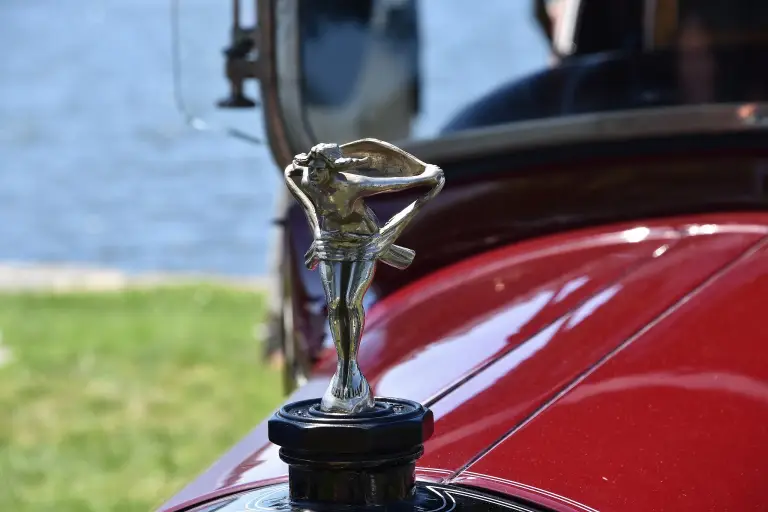
The Locomobile steamer was the product that started the Locomobile Company of America in 1899. Built to the design of the Stanley twins and sold from $600, these small steam runabouts brought motoring within reach of middle-class Americans and made Locomobile one of the earliest car makers in the United States.
Locomobile steamer at a glance
| Maker | Locomobile Company of America |
|---|---|
| Founded | 1899, Watertown, Massachusetts |
| Works | Bridgeport, Connecticut, from 1900 |
| Design | bought from the Stanley brothers |
| Price in 1899 | $600 for the standard runabout |
| Body styles | one in 1899; seven by 1901, $600 to $1,400 |
| Engine | twin-cylinder steam, 3 in × 4 in, 927 cc |
| Boiler | wire-wrapped, 300 psi |
| Fuel | liquid naphtha |
| Range | about 20 miles (32 km) per water tank |
| Built | more than 4,000, 1899–1902 |
| Replaced by | petrol cars from 1903 |
There is no separate English Wikipedia page for the steam models; this article is based on the history section of the company article (one source).
History of the Locomobile steamer
The company was founded in 1899 under a name coined from “locomotive” and “automobile”. John B. Walker, editor and publisher of Cosmopolitan, bought the plans for an early steam vehicle from Francis and Freelan Stanley for $250,000 — a price they could not resist. At the time one car had been built and 199 more had been ordered. Walker quickly sold half of his interest to the paving contractor Amzi L. Barber for the same sum he had paid for the whole company; the partnership lasted two weeks. Walker went on to found the Mobile Company of America, while Barber moved to Bridgeport, Connecticut, where Locomobile was established and the Stanley twins were named general managers.
The first Locomobiles were steam cars, and they were far from perfect. The English writer Rudyard Kipling called one example a “nickel-plated fraud”. They were unreliable and finicky to operate, prone to kerosene fires, carried small water tanks that gave only about 20 miles per fill and took time to raise steam. Even so, they were a novelty that middle-class Americans wanted: salesmen, doctors and anyone who needed to move quickly found them useful, and more than 4,000 were built between 1899 and 1902.
In 1901 the range grew to seven body styles priced between $600 and $1,400. Most cars had a simple twin-cylinder engine of 3 in by 4 in bore and stroke, displacing 56.6 cu in (927 cc), fed by a wire-wrapped boiler working at 300 psi and burning liquid naphtha. The engine sat amidships in a wood-framed chassis. Typical of the later cars was the 1904 Runabout, a two-seater selling for $750, by which time improved boilers and a new water pump were supplied by the Overman Wheel Company of Chicopee Falls, Massachusetts.
The steam Locomobile also acquired an unexpected military distinction. During the Boer War it became the first automobile used in war, serving as a generator and searchlight tractor that helped dismantle the Klein Nek minefield; it also worked as a catering vehicle, able to brew tea by tapping the boiler. That was not enough to guarantee commercial success, and in 1902 Locomobile began experimenting with petrol engines, starting with a four-cylinder, steel-chassis model designed by Andrew L. Riker. The experiment persuaded the firm to drop steam the following year, selling the rights back to the Stanley brothers for $20,000.
Design and features
- Stanley design: the business began with plans bought outright from the Stanley twins, who stayed on as general managers.
- Low price: the 1899 runabout cost $600, the entry point of American motoring.
- Simple technology: a twin-cylinder engine, a 300-psi boiler and naphtha fuel — cheap, but demanding to run.
- Real drawbacks: a short range, a long wait for steam and a reputation for fires.
Locomobile steamer versions
- 1899 Runabout: the single body style offered at launch, at $600.
- 1901 range: seven body styles from $600 to $1,400.
- 1904 Runabout: two seats, $750, with an improved boiler and water pump.
- Boer War tractor: a military generator and searchlight vehicle, also used as a mobile canteen.
The steam cars gave way to the petrol-powered Locomobile Model 48, the luxury car that carried the marque into the 1920s. More history is in the Locomobile collection.
Sources
- Locomobile Company of America, English Wikipedia: history, models, prices, production