The Liebherr LTM 11200-9.1 is the most powerful mobile crane in the world. Built by Liebherr in Ehingen, Germany, it was presented at the Bauma fair in Munich in April 2007 and combines a nominal capacity of 1,200 tonnes with a road-legal nine-axle chassis.
Liebherr LTM 11200 at a glance
| Maker | Liebherr, Ehingen (Germany) |
|---|---|
| Public debut | April 2007, Bauma Munich |
| Type | all-terrain telescopic mobile crane |
| Max. capacity | 1,200 t at 2.5 m radius, with 202 t ballast |
| Capacity without special equipment | 363 t at 3.5 m |
| Axles | 9 |
| Chassis engine | Liebherr D9508 A7, 8-cylinder, 505 kW |
| Superstructure engine | Liebherr D936L A6, 6-cylinder, 270 kW |
| Telescopic boom | 8 sections, hook height 100 m |
| Max. system height | 195 m with jib |
| Dimensions | 19.939 m long, 3.00 m wide |
| Transport weight of base unit | 108 t |
Based on one source: the German Wikipedia article on the LTM 11200-9.1. No free photographs of this model were available, so the page uses the photograph already attached to the record.
History of the Liebherr LTM 11200
Debut
The LTM 11200-9.1 was officially presented in April 2007 at Bauma in Munich, the world’s largest construction machinery fair. It was conceived as an all-terrain crane, able to travel both on the road and on site. The type designation explains the machine: LTM stands for Liebherr Teleskop Mobilkran, the leading 1 marks the product line, 1200 is the capacity in tonnes, and 9.1 refers to the nine axles of the chassis and the first version.
Chassis, steering and drive
The nine-axle chassis has a newly developed rear-axle steering system that reacts to speed and steers actively. Axles 6 to 9 are steered electro-hydraulically up to 30 km/h; between 30 and 60 km/h axles 6 and 7 are locked straight ahead while axles 8 and 9 continue to steer, and above 60 km/h the whole rear steering is locked. The two-circuit hydraulic steering comes from ZF, the suspension is hydro-pneumatic with automatic levelling, and all axles run on single 14.00 R 25 tyres. Four outriggers are swung out and extended hydraulically to support the crane.
The carrier is driven by Liebherr’s own 8-cylinder turbocharged diesel, type D9508 A7, with up to 505 kW and 3,000 Nm, through a ZF TC-TRONIC automatic gearbox with twelve forward and two reverse gears; the drive goes to axles 1, 2, 4 and 5. All nine axles have disc brakes, backed by exhaust flap brakes and eddy-current brakes, and the parking brake acts on axles 3 to 9.
Superstructure and boom
The superstructure has its own Liebherr six-cylinder diesel, type D936L A6, rated at 270 kW and 1,720 Nm. Power reaches the crane drives through axial piston pumps, in a closed circuit for hoisting, slewing and adjusting the lattice tip, and in an open circuit for luffing and telescoping.
The crane has the longest telescopic boom available on a roadable mobile crane, with a hook height of 100 m on the telescope and a maximum system height of 195 m with the jib fitted. The manufacturer quotes 106 tonnes at 80 m height and 12 m radius. The boom consists of eight sections that extend fully automatically to the required length, and the sections are pinned automatically as well. It can be used either as the four-section 55 m boom (type T3) or as the eight-section 100 m boom (type T7); the T3 is made from the base section and the lower three extensions of the T7. Y-guying of the telescopic boom raises capacity further, especially with lattice mast elements.
Road transport
For road transport the boom is removed, because the base unit alone weighs 108 tonnes and would otherwise exceed the 12-tonne axle load limit. The boom is dismantled without an auxiliary crane: four hydraulic telescopic supports let it rest on the ground while the carrier drives out from under it. The boom is then lowered onto a transport vehicle with special saddles, with a transport weight of up to 104 tonnes; in Germany the 100 m mast is usually not moved on public roads together with its guying.
Design and features
- 1,200-tonne capacity: the highest rating of any wheeled mobile crane, at 2.5 m radius with 202 tonnes of ballast.
- Nine-axle chassis: speed-dependent active rear-axle steering and hydro-pneumatic suspension.
- 100 m telescopic boom: eight sections that extend and pin fully automatically.
- 195 m system height: with the jib fitted, and 106 tonnes liftable to 80 m at 12 m radius.
- Self-demounting boom: four hydraulic supports let the boom be separated without a helper crane.
Liebherr LTM 11200 versions
- LTM 11200-9.1 (2007): the standard machine with the nine-axle carrier.
- T3 boom: four-section, 55 m telescopic boom.
- T7 boom: eight-section, 100 m telescopic boom.
- Y-guying: boom guying that increases capacity with lattice mast elements.
- Transport configuration: base unit and boom carried separately, boom up to 104 tonnes.
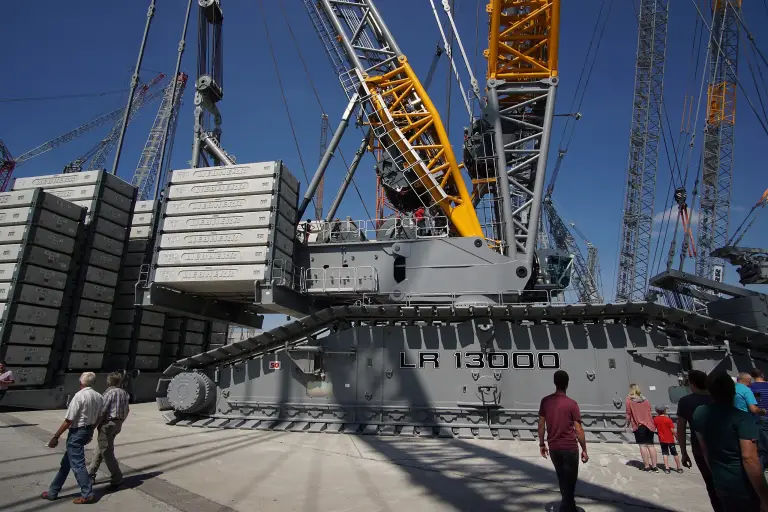
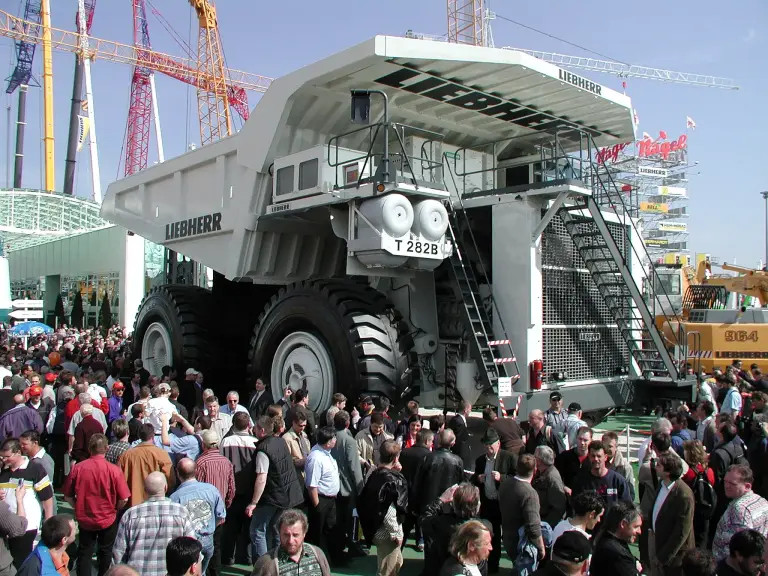
The LTM 11200 is the largest mobile crane in the Liebherr range, alongside the LR 13000 crawler crane and the T 282 mining truck. More machines are in the Liebherr collection.
Sources
- Liebherr LTM 11200, German Wikipedia: capacity, chassis, engines, boom, transport