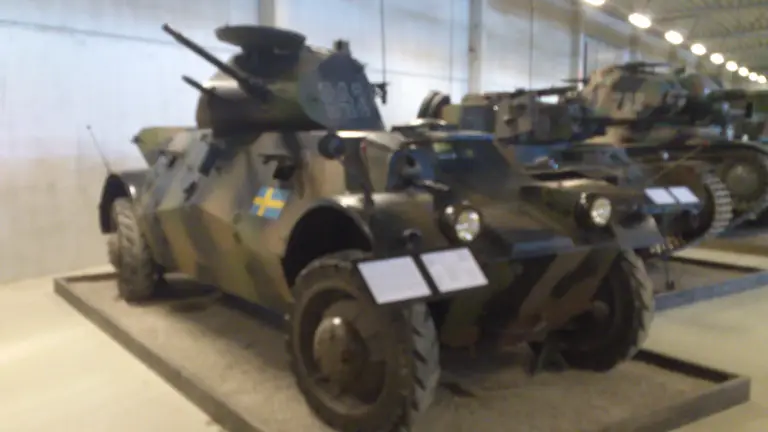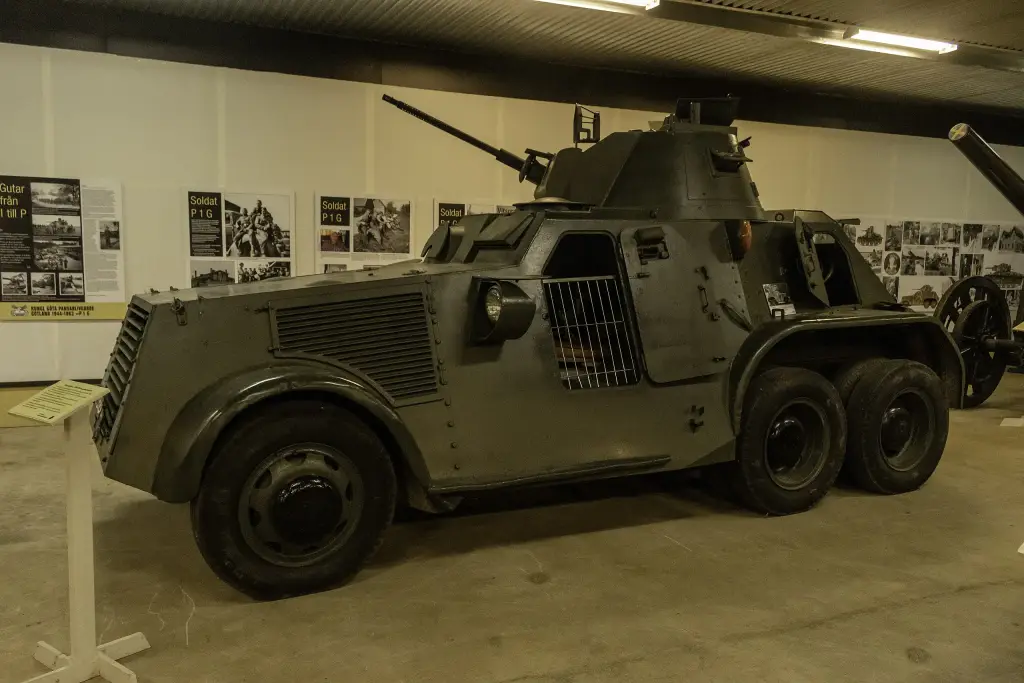
The Landsverk L-180, L-181 and L-182 were a family of armoured cars built by the Swedish company AB Landsverk between the wars. They earned a good international reputation for being fast, robust and reliable and were bought in small numbers by Denmark, Estonia, Ireland and the Netherlands, among others.
Landsverk L-180 at a glance
| Maker | AB Landsverk, Sweden |
|---|---|
| Type | armoured car family: L-180, L-181, L-182 |
| Built | 1930s; total production 49 vehicles |
| Chassis | Büssing-NAG (L-180), Daimler-Benz (L-181 and L-182) |
| Engines | Büssing-NAG V8 of about 160 hp in the L-180; Daimler-Benz six-cylinder of about 80 hp in the L-181 |
| Armour | 5 mm minimum, 15 mm maximum |
| Armament | Bofors 37 mm or Madsen 20 mm autocannon, plus machine guns |
| Drive | 6×4, with track girdles available for soft ground |
| Crew | five |
| Swedish designation | Pansarbil m/41 (pbil m/41) |
| Dutch designations | Pantserwagen M-38 (L-180) and M-36 (L-181) |
| German designation | Panzerspähwagen L 202 (h) for captured L-180s |
History of the Landsverk L-180
AB Landsverk developed the L-180 and its sisters in the middle of the 1930s, on truck chassis bought in Germany: Büssing-NAG for the L-180, Daimler-Benz for the L-181 and the single L-182. The three looked much alike; the differences lay in chassis, engine and armament. The hull carried armour between 5 and 15 mm thick, and the turret sat above the rear wheels with a 20 mm or 37 mm cannon and a machine gun. A second machine gun was mounted in the front of the hull and a third at the rear. Drive went to the four rear wheels only, and in difficult ground track girdles could be wrapped around them to turn the car into a half-track. The crew of five had three doors for getting in and out quickly.
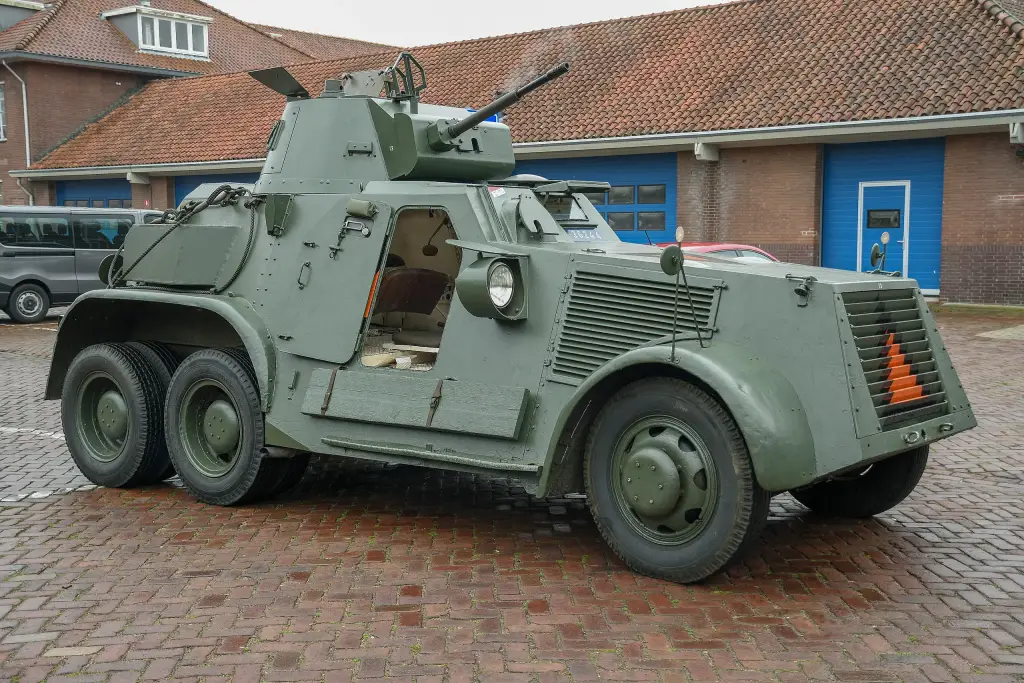
The largest customer was the Netherlands, which bought twelve L-181 cars in December 1934, delivered in 1936 as the Pantserwagen M.36, and then in 1937 ordered fourteen more vehicles: twelve L-180 plus two command cars without a main gun, delivered as the M.38. When the German invasion came in May 1940 the Dutch had two squadrons of Landsverks in service. The 1st squadron, with the M.36 cars, was split between the airfields at Ypenburg and Schiphol, and the first six cars at Ypenburg fought hard to help repel the German air landing on 10 May 1940. The 2nd squadron, with the M.38, worked with the field army on the central front and carried out a long series of aggressive reconnaissance missions. No Landsverk was knocked out in combat; the losses came from accidents, engine trouble and bomb damage at Ypenburg.
Ireland ordered two L-180s in 1937, delivered in 1938, and six more in 1939. A further five could not be delivered once the war broke out and were taken over by Sweden as the Pansarbil m/41, fitted with the turret of the Lynx and a Bofors 20 mm automatic cannon. The Irish cars carried a Madsen 20 mm cannon and two Madsen .303 machine guns; in the 1950s the machine guns gave way to .30 Browning guns and the engines to Lincoln 317 V8 petrol units of 155 hp, and in the 1970s the Madsen was replaced by a Hispano-Suiza 20 mm cannon taken from retired de Havilland Vampire jets. All Irish Landsverks served with the 1st Armoured Squadron until the unit re-equipped with Panhard AML cars in 1972; the survivors then passed to reserve FCA units and were retired in the 1980s.
Denmark took two L-180s in 1935, delivered in 1936 as FP-7 and FP-8, Estonia bought one in 1937 for the Tallinn police, and Lithuania received six L-181s ordered in 1933 and delivered in 1934. Finland bought a single L-182 for trials in 1936, armed with a 13.2 mm L-35/36 machine gun instead of a cannon; it saw limited service in the Winter War and, with a 20 mm Lahti L-39 anti-tank rifle fitted, in the Continuation War of 1941, before being scrapped in 1945. The cars captured by Germany in Denmark and the Netherlands were used for reconnaissance, patrol and training as the Panzerspähwagen L 202 (h), while the Dutch L-181s went to the Ordnungspolizei. The Dutch Cavalry Museum in Amersfoort keeps an L-180, an original Irish-built example.
Design and features
- German truck chassis: Büssing-NAG, Mercedes-Benz and Daimler-Benz chassis and engines were used across the family.
- 5 to 15 mm of armour: enough against small arms, but the joints around the turret, hatches and doors proved vulnerable.
- Mixed armament: a Bofors 37 mm or a Madsen 20 mm autocannon in the turret, with machine guns front and rear.
- Half-track option: track girdles could be fitted around the rear wheels for soft ground.
- Proven in service: the Dutch cars came through the fighting of May 1940 without a single loss in combat.
Landsverk L-180 versions
- L-180: Büssing-NAG chassis and a 160 hp V8, 30 built, the most numerous version.
- L-181: Daimler-Benz chassis and an 80 hp six-cylinder engine, 18 built.
- L-182: a single car for Finland on a Daimler-Benz chassis, with a turret and armament to Finnish requirements.
- Command cars: two Dutch L-180s with special twin turrets and a dummy gun in place of the cannon.
- Swedish Pansarbil m/41: the five Irish cars not delivered, re-armed with a Bofors 20 mm cannon.
The Lynx was the next step in the same line of Landsverk armoured cars: see the Landsverk Lynx. More vehicles of the maker are in the Landsverk collection.
Video: LANDSVERK L180 / PANTSERWAGEN M38 YPENBURG
Video on YouTube.
Sources
- Landsverk L-180, English Wikipedia: design, service by country
- Landsverk L-180, L-181 e L-182, Italian Wikipedia: service details, Irish re-armament
- Landsverk L-180, Dutch Wikipedia: production total, armour, engines, Dutch service