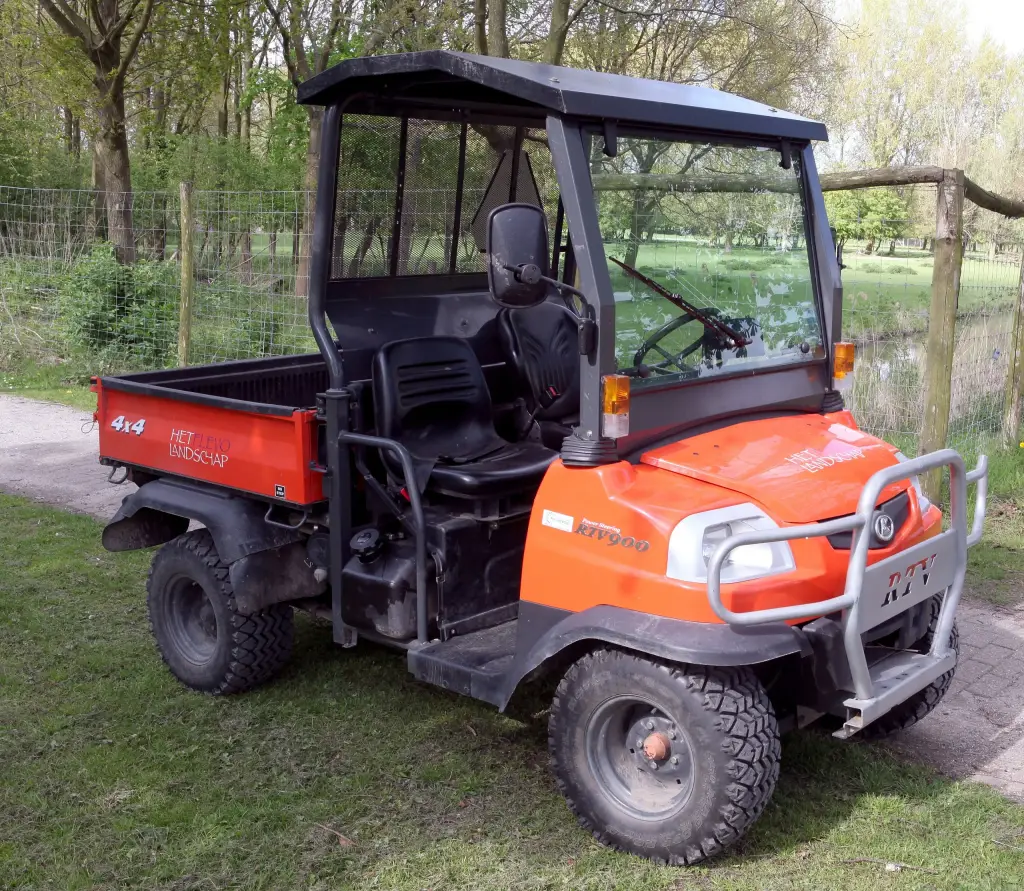
Kubota’s RTV is the utility vehicle branch of a company that has spent more than a century building farm machinery, engines and excavators. The line is aimed mainly at North America, where Kubota has sold tractors since 1969 and has assembled machinery in Georgia since 1988.
Kubota RTV at a glance
| Maker | Kubota Corporation, Osaka, Japan |
|---|---|
| Founded | 1890, as the Ōde iron foundry of Gonshiro Ōde |
| Product group | utility vehicles, sold mainly in North America |
| Tractor arm in the USA | Kubota Tractor Corporation, Torrance, California, since 1972 |
| First American factory | Kubota Manufacturing of America, Gainesville, Georgia, since 1988 |
| Engines | Kubota’s own diesels, from single-cylinder units to straight-six turbocharged tractor engines |
| Engine sales | crate engines supplied to other makers of agricultural, construction and marine equipment |
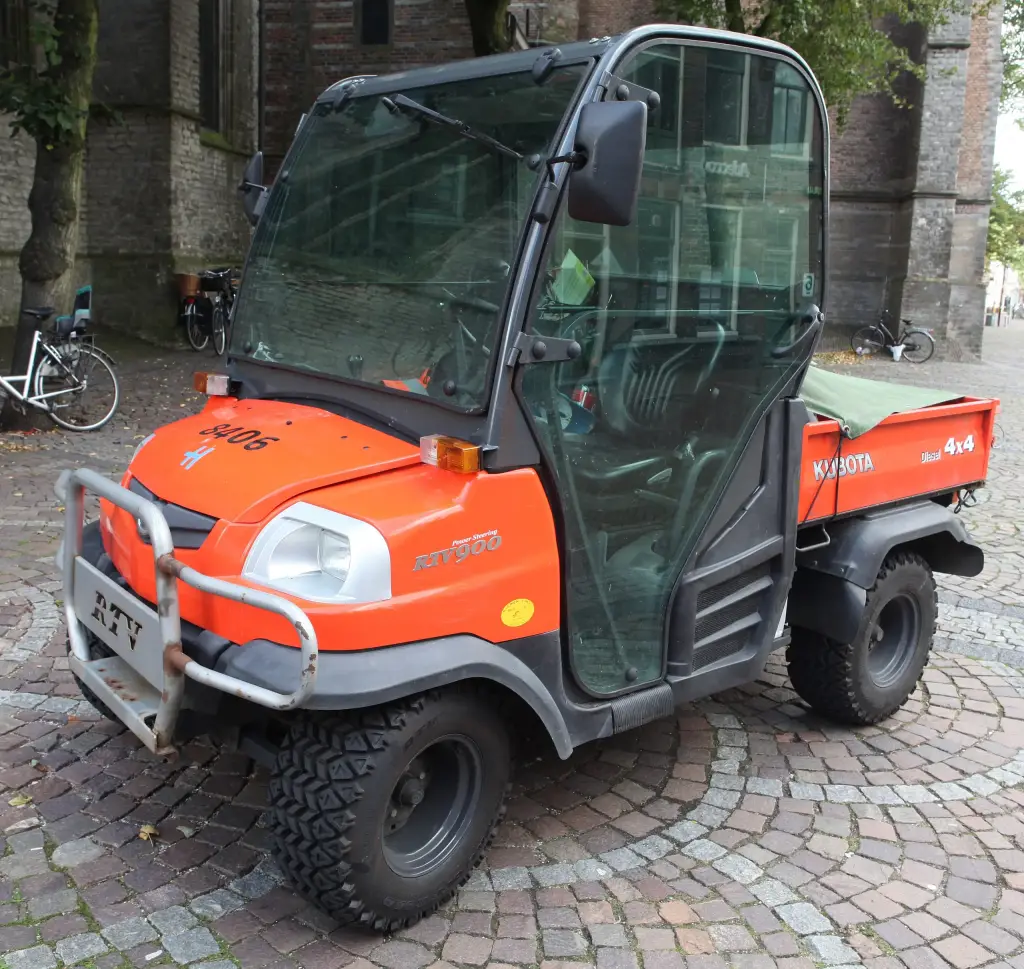
| Models in this collection | RTV 900 4×4, RTV 1100 and RTV X-1110 |
| Stock exchange | Tokyo, since 1949; now part of the Nikkei 225 and the TOPIX 100 |
| Group | tens of thousands of employees in more than 120 countries |
Kubota has no Wikipedia article for the RTV itself. This page uses the company articles in five languages, which describe the group and its product lines but give no model-level specifications for the RTV.
History of the Kubota RTV
Foundry, pipes and engines
Kubota began in 1890 as an iron foundry in Osaka. Its founder, Gonshiro Ōde, was the first Japanese manufacturer of cast-iron pipes for waterworks, and in 1897 the business took the name of his adoptive family, Kubota. A petroleum engine for driving farm machinery such as stationary threshing machines followed in 1922, and in 1937 the company opened its Sakai plant in Osaka Prefecture, where engines were the first product. Diesel engines were added in the mid-1940s, and the shares have been traded on the Tokyo Stock Exchange since 1949.
Vehicles, tractors and the American market
Kubota’s first motor vehicles were not tractors. In 1919 it set up the subsidiary Jitsuyō Jidōsha Seizō to build cars, and from 1920 the Jitsuyō plant turned out three-wheeled cars with air-cooled 8 PS two-cylinder engines designed by the chief engineer William R. Gorham, followed by a four-wheeled 10 PS model that could also serve as a light lorry. About 250 were built before production ended in 1923, and the successor Lila reached some 200 cars by 1926. That year Kubota took over the struggling Kaishinsha company and merged it with Jitsuyō to form DAT Jidōsha Seizō, the business from which Datsun later grew. Tractors came later: the T15 of 1960 was the first Japanese riding tractor for upland fields, the L15R of 1962 was made for paddy fields, and in 1969 Kubota began exporting the 21 hp L200 to the United States. The success of that tractor led to the Kubota Tractor Corporation at Torrance, California, in 1972, and in 1988 to Kubota Manufacturing of America at Gainesville, Georgia, which began with tractor parts.
The utility vehicle line
Utility vehicles are one of the product groups listed by Kubota, alongside tractors, combine harvesters, mini excavators, ductile iron pipes, water treatment equipment and industrial diesel engines, and the company notes that they are aimed mainly at the North American market. That is where the machines in this collection, the RTV 900 4×4, the RTV 1100 and the RTV X-1110, do their work: on farms, estates and building sites, where a tractor is too big for the job. Kubota’s own diesel engines, built at plants such as Sakai in Japan and Rodgau in Germany, are the natural power source for such machines, and the same engine range is sold as crate engines to other manufacturers of agricultural, construction and marine equipment.
Design and features
- Diesel power from inside the group: Kubota builds its own engines, from single-cylinder naturally aspirated units for pumps to straight-six turbocharged tractor engines, and supplies them to other makers as crate engines.
- Four driven wheels: the RTV 900 in this collection is the 4×4 version of the model.
- Built where the market is: Kubota has made agricultural machinery in Georgia since 1988 and sells through its own company in California, so the utility vehicle line sits inside an established North American network.
- One group, many products: the same company builds tractors, combine harvesters, mini excavators, ductile iron water pipes and water treatment plants.
Kubota RTV versions
- RTV 900 4×4: the four-wheel-drive model shown in the photographs on this page.
- RTV 1100: another machine of the line, seen here away from a working site.
- RTV X-1110: a further model of the Kubota utility vehicle family photographed at work on a farm.
The RTV line shares its engines with the rest of the range: see the Kubota diesel engines, the L series tractors and the M series. More Kubota machines are in the Kubota collection.
Sources
- Kubota, English Wikipedia: company profile, engine range, American subsidiaries
- Kubota (Unternehmen), German Wikipedia: founding, plants, product lines
- Kubota, Japanese Wikipedia: product groups and utility vehicles
- Kubota, Italian Wikipedia: American sales company and factory
- Kubota, French Wikipedia: early history