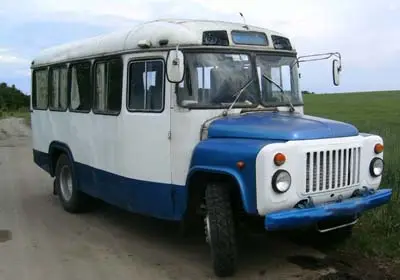
The KAvZ-3270 was the Kurgan Bus Plant’s KAvZ-685M given a new index under the industry standard ON 025 270-66. It was built from 1986 to 1991 on the GAZ-53-12 chassis with the ZMZ-53-11 engine, and it is recognised by windscreen wipers mounted at the top of the glass.
KAvZ-3270 at a glance
| Maker | Kurgan Bus Plant (KAvZ) |
|---|---|
| Production | 1986–1991 |
| Based on | KAvZ-685M |
| Index standard | ON 025 270-66 |
| Chassis | GAZ-53-12 |
| Engine | ZMZ-53-11 V8, carburettor |
| Compartment | bonneted, engine ahead of the driver |
| Windscreen wipers | mounted at the top of the glass |
| Started with | KAvZ-685M in 1984 |
| Followed by | KAvZ-3271 (1991–1993), then the KAvZ-3976 |
The Russian Wikipedia describes the KAvZ-3270 in the article on the KAvZ-685, as a re-indexed KAvZ-685M; this page uses that article. Based on one source.
History of the KAvZ-3270
The KAvZ-685 was designed as the successor to the KAvZ-651A. The first prototypes appeared in the late 1960s, the work was led by the deputy chief designers S. V. Maltsev and I. F. Basov with the designer V. V. Fomenko, and from 1971 the bus was built in pilot batches. Those early machines had a windscreen in four pieces, replaced by two separate panes on the production buses, series output starting in 1973. In 1975 the round rear lamps and stop lights gave way to rectangular units and the front indicators became two-coloured, and at the end of 1977 the bus received the Soviet quality mark.
In 1984 the plant modernised the design as the KAvZ-685M, now on the Gorky GAZ-53-12 chassis and with the ZMZ-53-11 engine. Two years later the same bus was re-indexed under the industry standard ON 025 270-66 and sold as the KAvZ-3270. The new index came with a detail that makes the car recognisable: the windscreen wipers were moved to the top of the glass. The KAvZ-3270 was built until 1991.
The 685 family was aimed mainly at the countryside, where a bonneted bus could use the same spares and the same rough roads as the GAZ lorries around it. Its cabin was heated and fitted with soft seats with small grab handles, the driver’s place was partly separated from the passengers, and ventilation came from sliding side windows and roof hatches. The average distance between overhauls was put at 260,000 km. In 1991 the transitional KAvZ-3271 took over, and the plant then moved to the KAvZ-3976.
Design and features
- New index: the 3270 was the 685M renamed under the ON 025 270-66 standard, not a new body.
- GAZ-53-12 chassis: a strengthened frame and suspension with the ZMZ-53-11 V8.
- Top-mounted wipers: the easiest way to tell a 3270 from an earlier 685.
- Country specification: a warm cabin, soft seats and a partly separated driver’s place.
- Two-circuit brakes: from 1975 the 685 family had a split hydraulic system with two servo units.
KAvZ-3270 versions
- KAvZ-3270 (1986–1991): the 685M under the new index, with top-mounted wipers.
- KAvZ-3271 (1991–1993): the transitional model on the way to the KAvZ-3976.
- KAvZ-685S: the northern version, for temperatures down to −60°C, with extra insulation and double glazing.
- KAvZ-685G: the mountain version, for work at 3,000–4,000 m.
The KAvZ-3270 followed the KAvZ-651 at Kurgan and gave way to the KAvZ-3976. More buses are in the KAvZ collection.
Video: KAvZ-3270 Vello bus
Video on YouTube.
Sources
- КАвЗ-685, Russian Wikipedia: 685 family history, 685M, KAvZ-3270 entry, construction, versions