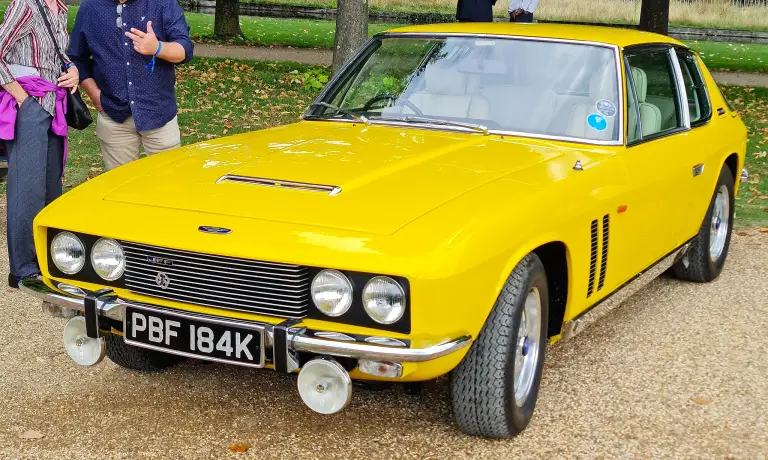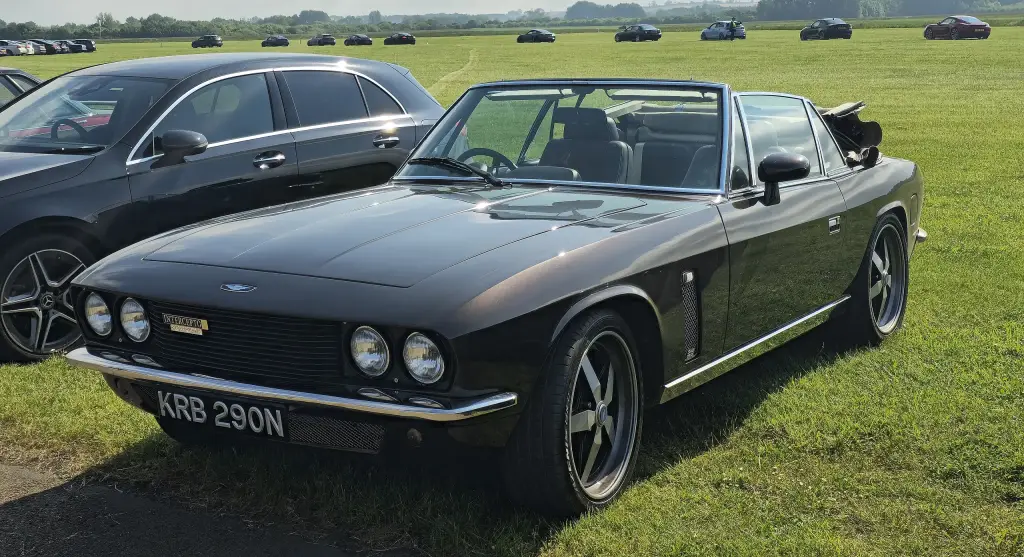
The Jensen Interceptor is a grand tourer that Jensen Motors hand-built at its Kelvin Way factory in West Bromwich, near Birmingham, between 1966 and 1976. Its steel body was designed by Carrozzeria Touring of Italy rather than in-house, and it used Chrysler V8 engines throughout.
Jensen Interceptor at a glance
| Maker | Jensen Motors, West Bromwich |
|---|---|
| Produced | 1966–1976 |
| Body | steel, designed by Carrozzeria Touring |
| Early bodywork | built in Italy by Vignale |
| Engine | Chrysler 6.3 L 383 cu in, then 7.2 L 440 cu in |
| Gearbox | TorqueFlite automatic; manual available on the Mark I |
| Mark I manual | 22 cars built |
| Power steering | standard from September 1968 |
| Mark II | October 1969, revised front and US-market interior |
| Mark III | 1971, GKN alloy wheels and air conditioning standard |
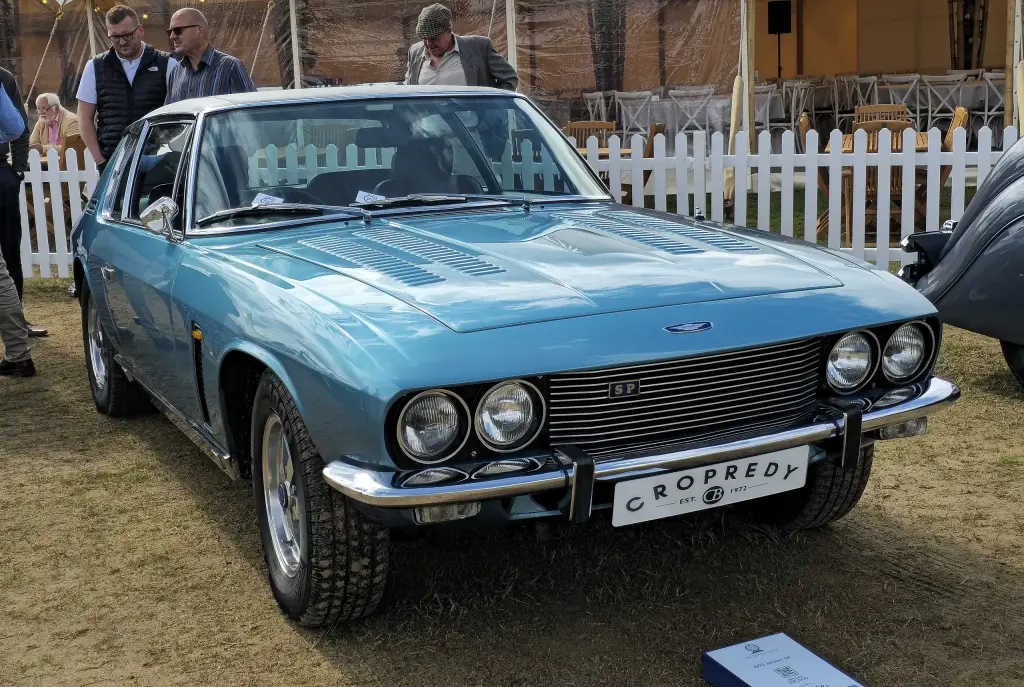
| SP | 1971, three two-barrel carburettors, 385 bhp, 232 built |
| Series 4 | late 1980s revival with a 5.9-litre 360 cu in engine |
Based on one source: the English Wikipedia article on the Jensen Interceptor.
History of the Jensen Interceptor
Italian design, American power
Jensen had used the Interceptor name before, on a model built between 1950 and 1957 at the Carters Green factory. The 1966 car was a return to a steel body shell after two decades of glass-reinforced plastic panels, and the body was designed by Carrozzeria Touring of Italy. The early bodies were built in Italy by Vignale before Jensen took production in-house and made some subtle modifications. Power came from Chrysler: the 6.3-litre (383 cu in) V8 with an optional manual gearbox, of which 22 Mark I cars were built, or a TorqueFlite automatic. Drive went to the rear wheels through a limited-slip differential in a conventional Salisbury axle.
Engines through the years
In 1970 the 383 produced 335 hp SAE gross, or 270 hp SAE net. Because Chrysler detuned the engine for low-octane petrol and it produced only 250 hp net in 1971, Jensen switched to the 440 cu in (7.2-litre) engine for that year. Two versions were offered for 1971: one with a four-barrel carburettor and 305 hp net, and another with three two-barrel carburettors and 330 hp net that was available for one year only. The latter was fitted to 232 cars called the Jensen SP, with no Interceptor badging, and it was the most powerful car Jensen ever made. For 1972 Chrysler stopped producing the three-carburettor 440, and the remaining engine was detuned to 280 hp net.
Marks II and III
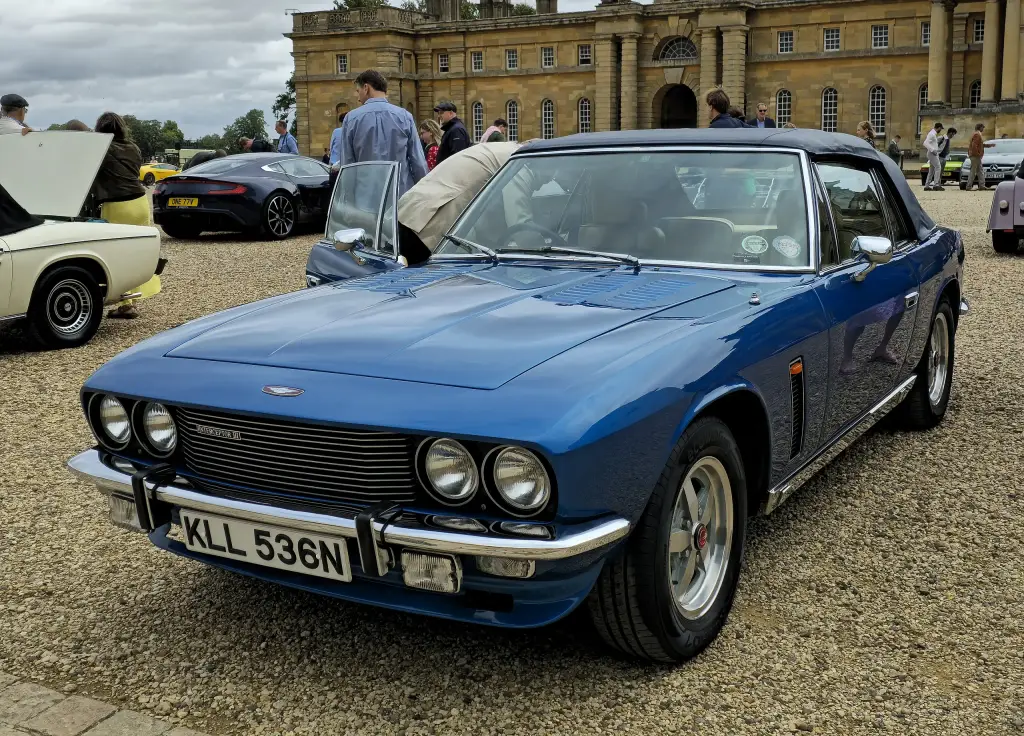
The original specification included electric windows, reclining front seats, a wood-rimmed steering wheel, a radio with twin speakers, reversing lights and an electric clock. Power steering became standard in September 1968. The Mark II was announced in October 1969 with slightly revised styling around the headlamps, grille and bumper and new rear lights; the interior was substantially revised to meet US regulations, and air conditioning became an option. The Mark III of 1971 revised the grille, headlamp finishers and bumpers again, and added GKN alloy wheels, air conditioning as standard and revised seats. It was divided into G-, H- and J-series depending on the production year. The styling included a large wrap-around rear window that doubled as a tailgate.
Receivership and revival
Jensen had fallen on hard times by 1975 because of the world recession and problems with the Jensen-Healey, and the company went into receivership. Production continued until the stock of parts ran out and ended in 1976. In the late 1980s a group of investors trading as Jensen Cars Limited relaunched the car as the Series 4, an updated version of the original V8 with a smaller Chrysler 360 cu in (5.9-litre) engine of about 250 bhp, modern sports front seats, a revised dashboard and a price of £70,000. The company changed hands in 1990 and built roughly 36 cars before 1993; work on a Series 5 ended when the receivers were called in again.
Design and features
- Touring body: a steel shell designed by Carrozzeria Touring, with early cars built by Vignale.
- Chrysler V8: 6.3-litre and later 7.2-litre engines, with automatic transmission as standard.
- Wrap-around window: a large curving rear window that doubled as a tailgate.
- Equipment: electric windows, reclining seats, wood-rimmed wheel and an electric clock from the start.
Jensen Interceptor versions
- Mark I (1966–1969): 383 cu in engine, 22 manual cars among the automatic ones.
- Mark II (1969–1971): revised nose and a US-compliant interior.
- Mark III (1971–1976): GKN alloy wheels, standard air conditioning, G-, H- and J-series.
- SP (1971): 385 bhp six-carburettor flagship with a vinyl roof and louvred bonnet, 232 built.
- Convertible (1974): a powered soft-top version.
- Series 4 (late 1980s): revival with a 5.9-litre engine, about 36 built by 1993.
The four-wheel-drive derivative was the Jensen FF, and the sports car built alongside it was the Jensen-Healey. More cars are in the Jensen collection.
Video: The Ultimate Jensen Interceptor
Video on YouTube.
Sources
- Jensen Interceptor, English Wikipedia: engines, Mark I to Mark III, SP, convertible and Series 4