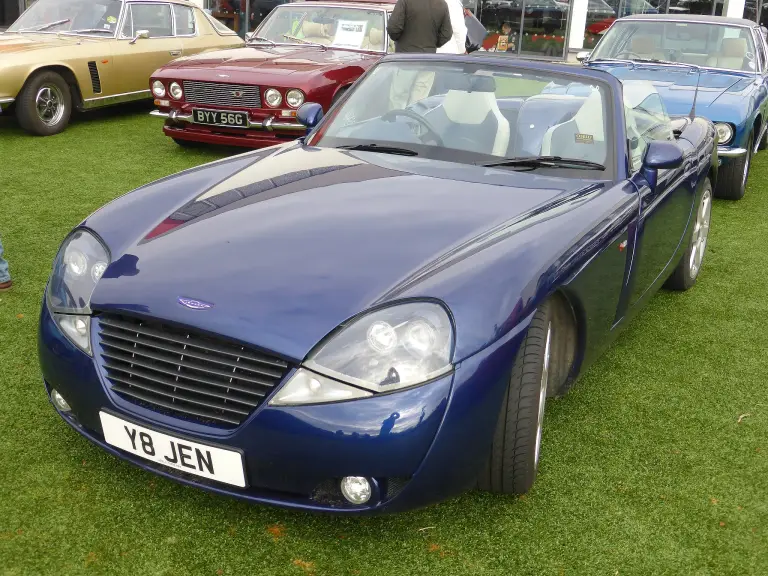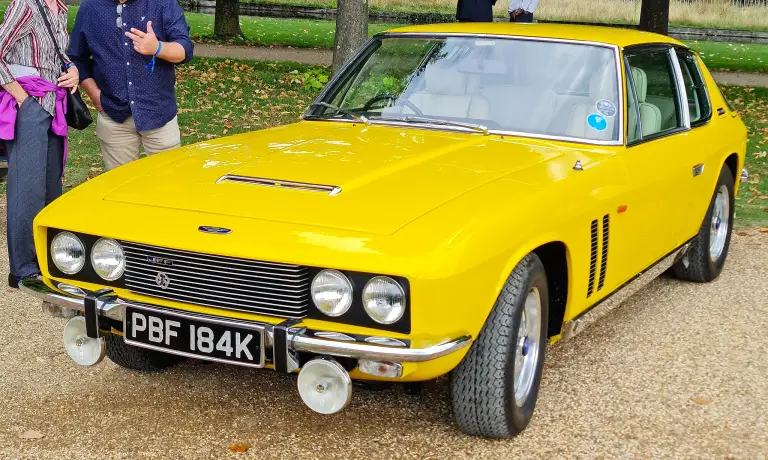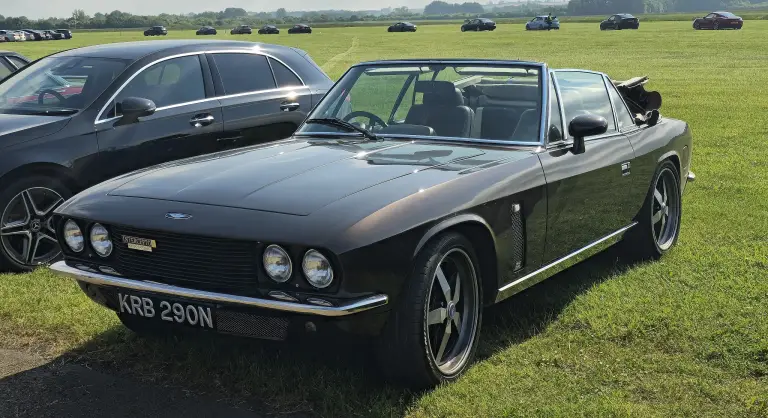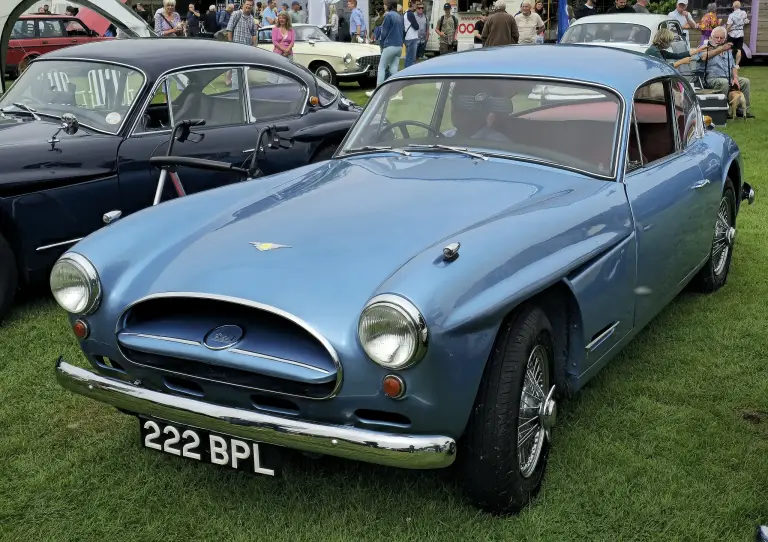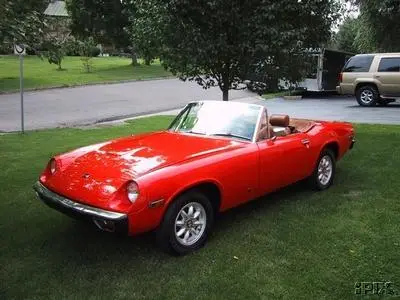
The Jensen-Healey was a British two-seater convertible sports car that Jensen Motors built in West Bromwich from 1972 until 1976. It was developed with Donald Healey, used a Lotus sixteen-valve engine and was positioned in the market between the Triumph TR6 and the Jaguar E-Type.
Jensen-Healey at a glance
| Maker | Jensen Motors, West Bromwich |
|---|---|
| Produced | 1972–1976 |
| Body | two-seater convertible, unitary steel |
| Engine | Lotus 907, 1973 cc, 16-valve alloy twin-cam |
| Power | about 144 bhp (107 kW) |
| Top speed | 119 mph (192 km/h) |
| 0–60 mph | 7.8 seconds |
| Gearbox | four-speed Chrysler, five-speed Getrag from 1975 |
| Suspension | double wishbones front, live axle rear |
| Brakes | discs front, drums rear |
| Related model | Jensen GT fastback, 1975 |
| Position in market | between the Triumph TR6 and the Jaguar E-Type |
Based on one source: the English Wikipedia article on the Jensen-Healey.
History of the Jensen-Healey
Donald Healey joins Jensen
When production of the Austin-Healey 3000 ended, Donald Healey opened discussions with Jensen Motors, which had built the bodies for his Austin-Healey cars. The largest Austin-Healey dealer in the United States, San Francisco-based Kjell Qvale, was also keen to find a replacement for the 3000; Qvale became a major shareholder of Jensen, making Donald Healey chairman. The Jensen-Healey was developed as a joint venture by Donald Healey, his son Geoffrey and Jensen Motors.
Design
Hugo Poole did the styling of the body, whose front and rear were later modified by William Towns to take advantage of the low-profile engine and to fit bumpers that met stricter US safety regulations. The unitary body understructure was designed by Barry Bilbie, who had been responsible for the Austin-Healey 100, 100-6 and 3000 as well as the Sprite. It was designed to be easy to repair, with bolt-on panels, to keep insurance premiums down. Early cars from 1973 to mid-1974 had two-piece steel-and-chrome bumpers; later cars used redesigned black rubber bumpers to meet the new 5 mph US crash standard.
The Lotus engine
Various engines were tried in the prototype stage, including Vauxhall, Ford and BMW units. The Vauxhall 2.3-litre met US emission requirements but not the 130 hp power target, a German Ford V6 was considered but industrial action crippled supply, and BMW could not supply the required number of engines. Colin Chapman of Lotus offered the new 1973 cc Lotus 907 twin-cam, 16-valve all-alloy engine, and Jensen accepted. It was the first modern four-valve-per-cylinder twin-cam engine to be mass-produced on an assembly line, and it produced about 144 bhp, reaching 119 mph and 60 mph in 7.8 seconds, or 8.1 seconds in emission-controlled US form. European cars had twin side-draught Dellorto DHLA carburettors, while cars for the United States used Zenith Stromberg units to meet emissions rules.
Chassis and interior
Suspension was by double wishbones and coil springs at the front, with a live rear axle on trailing arms and coils at the rear. Brakes were discs at the front and drums at the back, and the suspension, steering, brakes and rear axle were adapted from the Vauxhall Firenza apart from the Girling Type 14 front calipers. The initial transmission was a four-speed Chrysler unit, also used in the Sunbeam Rapier; the Mk 2 cars from 1975 used a close-ratio Getrag 235/5 five-speed in which fifth was a direct 1:1 ratio. Interiors started out austere and black, and in August 1973 a clock, wood-grain dashboard trim, padding and optional air conditioning were added; the related 1976 Jensen GT offered a burr walnut dashboard and paisley-patterned cloth seats.
Racing and the end
Jensen Motors ran a factory team in the SCCA D Production Championship with Huffaker Engineering in California. The Jensen-Healey won a championship in its first year of racing in 1973 and eventually took five SCCA national D Production titles. The oil crisis of the 1970s hit Jensen hard by damaging sales of the big Interceptor, and the hurried Jensen GT added further cost. Production reached 86 cars a week by 1974, but amid strike action, component shortages and inflation the company was liquidated in 1975 and closed in May 1976.
Design and features
- Lotus engine: the 1973 cc Lotus 907 was the first mass-produced four-valve-per-cylinder twin-cam.
- Easy repair: bolt-on body panels were chosen to keep insurance premiums down.
- Handling package: double-wishbone front suspension and Vauxhall Firenza-derived running gear.
- Racing record: five SCCA national D Production championships in the United States.
Jensen-Healey versions
- Jensen-Healey (1972–1976): the original two-seater with a four-speed Chrysler gearbox.
- Chrome-bumper cars (1973 to mid-1974): two-piece steel-and-chrome bumpers.
- Rubber-bumper cars: black bumpers for the US 5 mph crash standard.
- Mk 2 (from 1975): Getrag five-speed close-ratio gearbox.
- Jensen GT (1975): a related fastback with a walnut dashboard and cloth seats.
The Jensen-Healey was built alongside the Jensen Interceptor, and it was the last front-engined sports car before the Jensen S-V8. More cars are in the Jensen collection.
Video: Jensen Healey Restoration
Video on YouTube.
Sources
- Jensen-Healey, English Wikipedia: design, engine, chassis, interior, racing and end of production