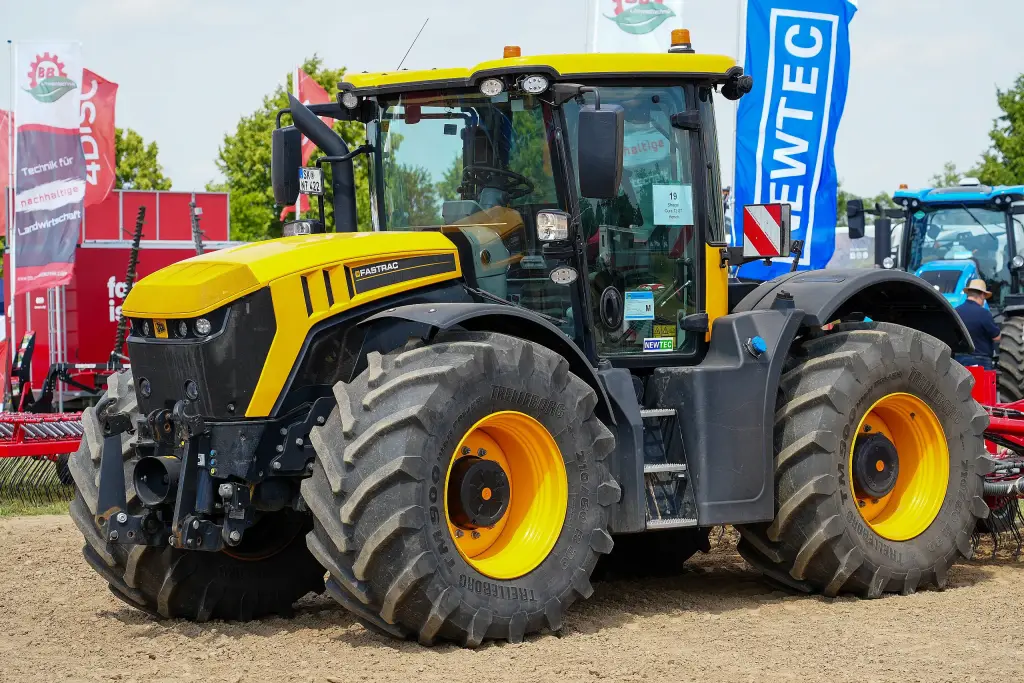
The JCB Fastrac is a high-speed agricultural tractor series built by JCB Landpower, part of the JCB group. It was designed for farms where transport on the road takes up a large part of the working year: full suspension on both axles, four equal wheels and a truck-like layout let it travel far faster than a conventional tractor. The first prototype was built in 1987 and production began in 1991.
JCB Fastrac at a glance
| Maker | JCB Landpower, part of JCB (Cheadle, Staffordshire) |
|---|---|
| Production | since 1991; first shown at the Smithfield Show in 1990 |
| Type | high-speed agricultural tractor |
| Maximum speed | usually 65 km/h; 40 km/h and 80 km/h versions also built |
| Engines | six-cylinder diesel: Perkins, later Cummins, now AGCO Power and FPT |
| Transmission | 18/6 manual at first, later 36/12 and 54/18 powershift; CVT on 4000, 6000 and 8000 |
| Drive | selectable four-wheel drive, rear axle driven as standard |
| Suspension | multi-link with hydropneumatic units at the rear; front too on 4000 and 7000 |
| Brakes | large external disc brakes on every wheel, ABS on some models |
| Steering | hydrostatic on 1000, 2000 and 4000; mechanical power steering on 100, 3000, 7000 and 8000 |
| Rear steering | option on 2000 and 4000, five modes, only below 20 km/h |
| Hydraulics | three-point hitch and two-speed PTO, front PTO as an option |
The English article covers the design in detail; the German one supplies the model history and dates.
History of the JCB Fastrac
A tractor for the road
European studies suggested that road transport could account for up to 70 per cent of all tractor work, and that figure shaped the Fastrac. JCB began experimenting with a “High Mobility Vehicle” in 1986, built the first prototype in 1987 and set up JCB Landpower Ltd in 1989 so that the tractor could be assembled in its own factory at Cheadle. The first Fastrac was shown at the Smithfield Show in London in 1990, reaching up to 64 km/h, and it went on sale in 1991; from 1992 it was offered outside Britain as well. In effect it filled the gap left when Mercedes-Benz stopped building the MB-trac. By 1995 there were four models, of 115, 148, 168 and 188 PS.
New series and new gearboxes
In 1996 JCB introduced the Quadtronic system on the Fastrac 1115 of 123 PS and the 1135 of 148 PS, which changed automatically between two- and four-wheel steering. The 1100 series was upgraded in 1998 and renamed the 2000, and the 2150 with 198 PS joined it, while the 3000 series replaced the 100 and brought a three-stage powershift section that raised the count to 54 forward and 18 reverse gears, changeable in every gear without the clutch. The Smoothshift transmission with automatic shuttle arrived in 2000 on the 2000 and 3000 series, in the 3155 of 155 PS and the 3185 of 185 PS, and from 2001 anti-lock brakes were available across the range.
The modern range
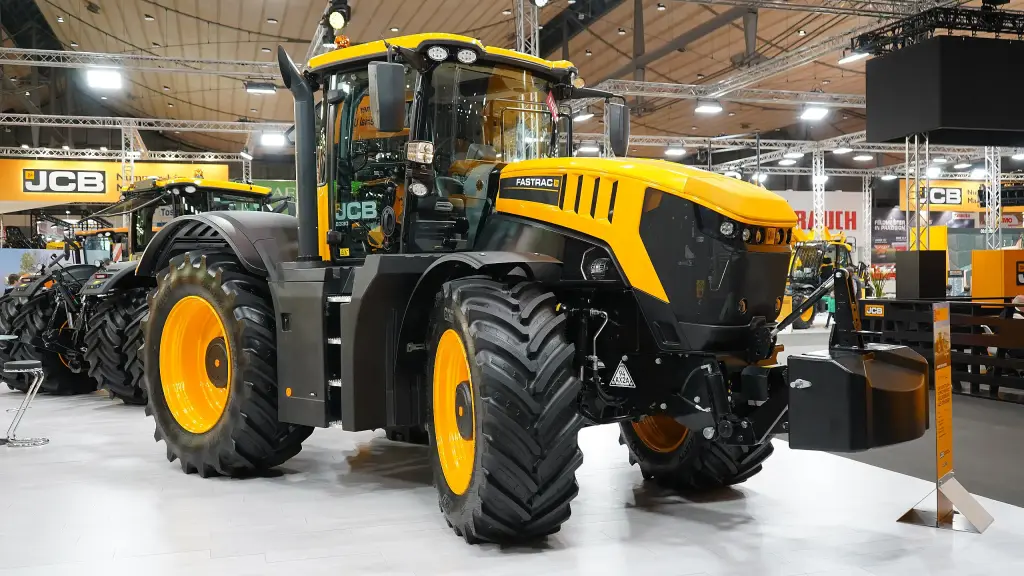
The Fastrac 8250 of 2005 used a 250 PS 8.3-litre Cummins engine and a continuously variable, power-split transmission, and on this machine the rear wheels were larger than the front ones. In 2006 the 3000 series was renewed with the 3200 and 3230 and 6.7-litre Cummins engines. The 7000 series appeared at Agritechnica in Hanover in 2007 with a powershift gearbox of 24 forward and 12 reverse gears and a power range from 170 to 270 PS, and a new 2000 series followed with the 2155 and 2170. The 3000 was revised in September 2010 with the P-Tronic transmission of 24/9 gears and three driving modes, and in 2011 the 8000 series received an 8.6-litre AGCO Sisu engine with SCR exhaust treatment, in the 8280 of 280 PS and the 8310 of 310 PS. The 4000 series was presented at Agritechnica in 2013 and replaced the 2000 from 2015; since 2019 a version legal on German motorways has been offered.
Design and features
- Full suspension: multi-link suspension sits between the chassis and both beam axles, with hydropneumatic units at the rear on every model and at the front on the 4000 and 7000 series, similar in principle to some Citroën cars.
- Selectable four-wheel drive: the rear axle is driven as standard and the front axle is engaged through a hydraulically controlled clutch that is sprung on, so the tractor runs in two-wheel drive only when the driver disengages it.
- Road-speed steering: hydrostatic steering limits the 1000, 2000 and 4000 series to 50 km/h, while the mechanical power steering of the 100, 3000, 7000 and 8000 machines allows 65 km/h, and some 100 and 3000 models 75 km/h.
- Brakes and axles: large external disc brakes are fitted individually at each wheel, every machine has a locking rear differential, and the 3000, 7000 and 8000 series use a driver-controlled clutch-pack lock at the front.
- Work equipment: a three-point hitch and a two-speed PTO are standard at the rear, a front hitch and PTO are options, and GPS-controlled steering is available on the 3000, 4000, 7000 and 8000 series.
JCB Fastrac versions
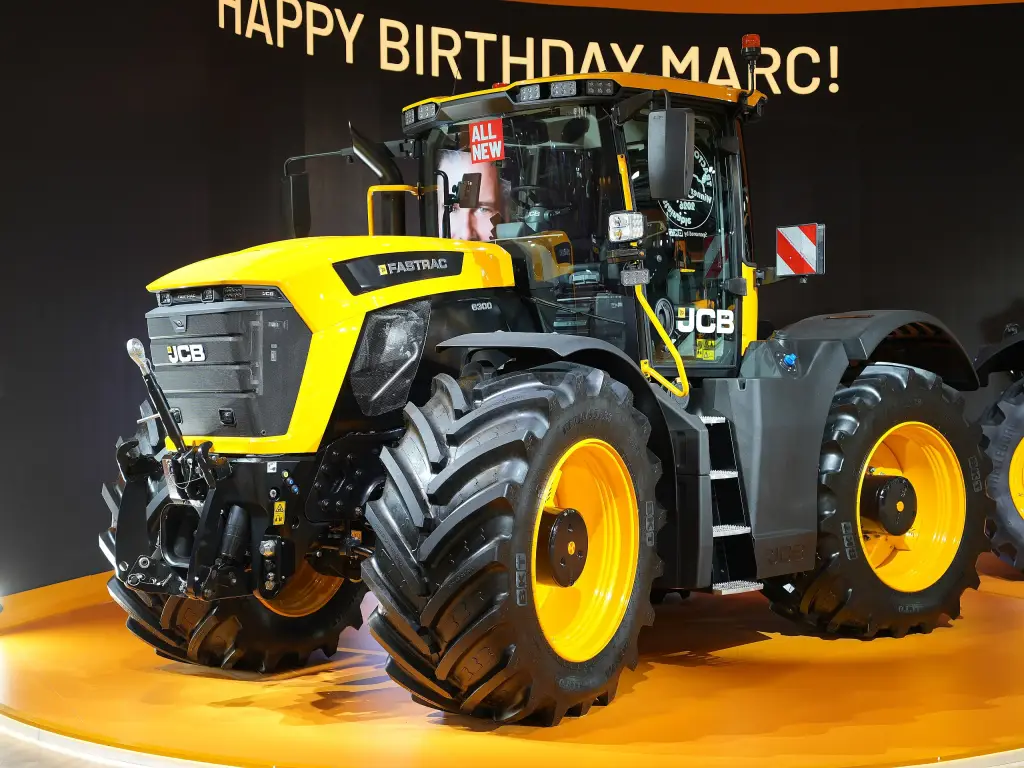
- 100 and 1000 series: the original layout with hydrostatic steering and the 18/6 gearbox, later with a powershift section.
- 2000 series: the renamed 1100, with Smoothshift and optional four-wheel steering.
- 3000 series: three-stage powershift with 54/18 gears, later the P-Tronic transmission of 24/9.
- 4000 series: the forward-sloping cab of a combine harvester, front hydropneumatic suspension and a CVT option.
- 7000 series: 170 to 270 PS, a wet clutch and 24/12 powershift, with the cab at the rear of the tractor.
- 8000 series: the largest machines, up to 310 PS from an 8.6-litre AGCO Sisu engine.
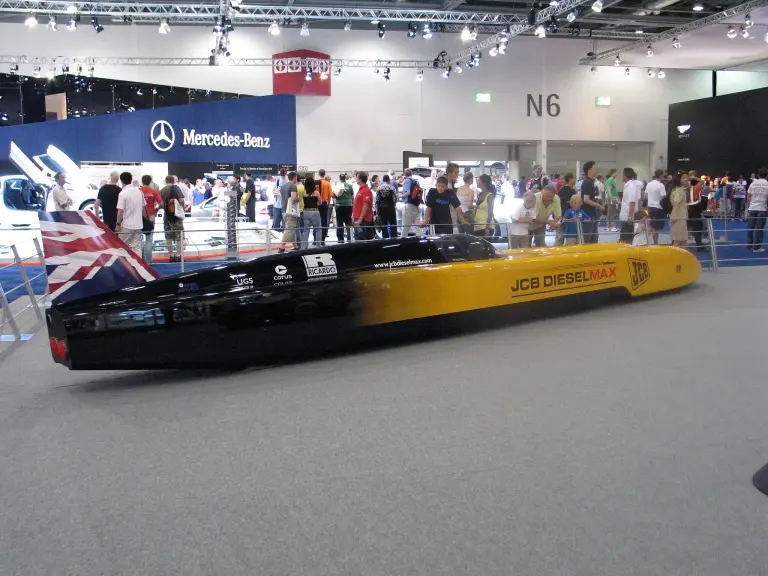
The Fastrac was used to push the JCB Dieselmax land-speed car up to 48 km/h before its first gear engaged. More machines are in the JCB collection.
Sources
- JCB Fastrac, English Wikipedia: design, transmission, steering, suspension
- Fastrac, German Wikipedia: history, series, models and years