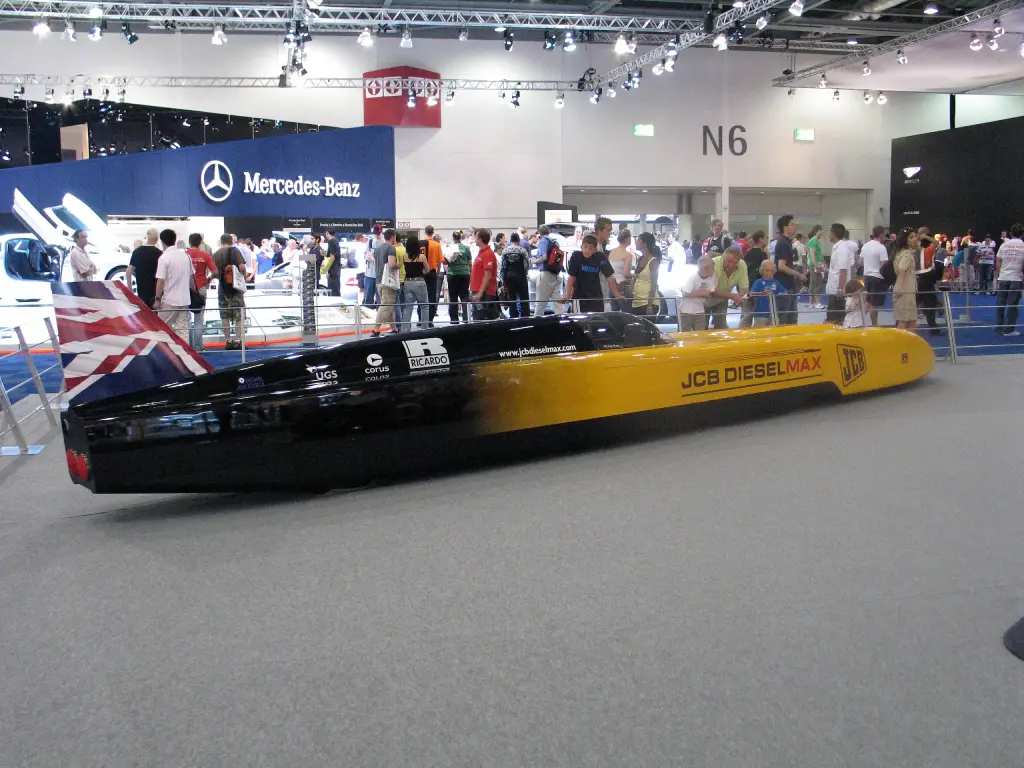
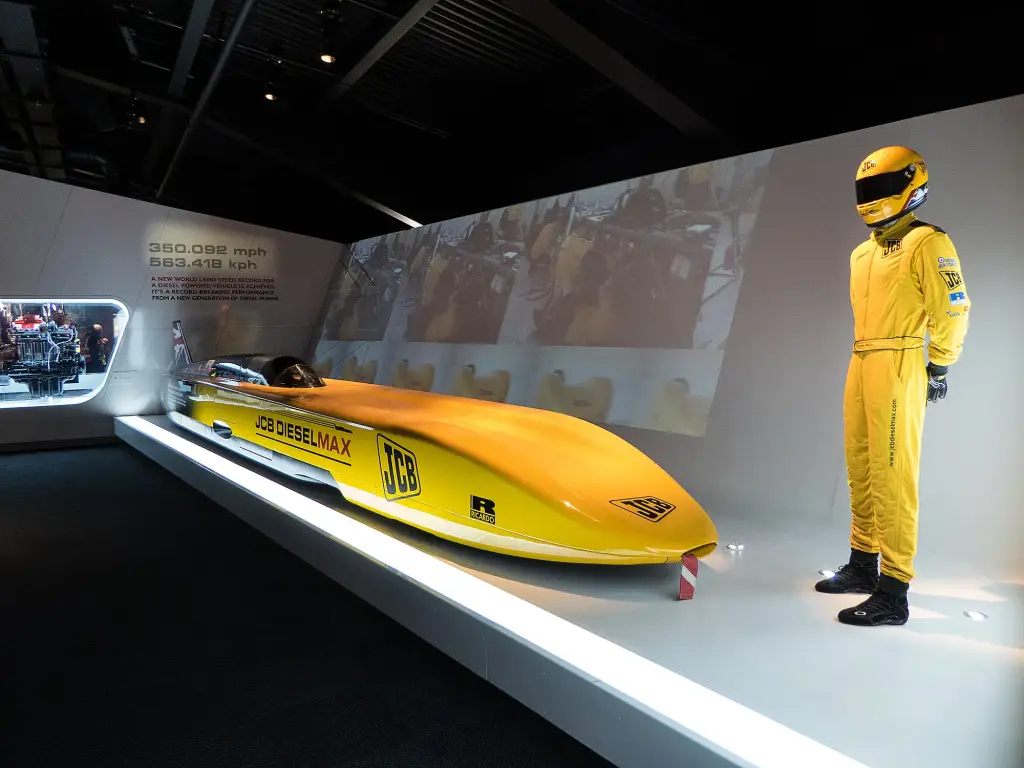
The JCB Dieselmax is a streamliner built for one purpose: to take the land speed record for a diesel-engined car. JCB commissioned it in the mid-2000s, and in August 2006 Wing Commander Andy Green drove it to 563.418 km/h on the salt at Bonneville, beating a record that had stood since 1973.
JCB Dieselmax at a glance
| Purpose | diesel land speed record car |
|---|---|
| Built for | JCB |
| Engines | two JCB444 four-cylinder diesels of 5 litres, two-stage turbocharged |
| Power | up to 560 kW (750 bhp) each, about five times the production output |
| Rev limit | 3,800 rpm per engine |
| Drive | one engine on the front axle, one on the rear |
| Drag coefficient | 0.147, with a CdA of 0.129 m² |
| Fuel tank | 9 litres, behind the carbon fibre cockpit |
| Weight | slightly under 2,700 kg with driver and fluids |
| Chassis | built by Visioneering of Coventry |
| Aerodynamics | refined by CFD at MIRA, led by Ron Ayers |
| Driver | Andy Green |
| Record | 563.418 km/h at Bonneville, 23 August 2006 |
Both articles describe the same car; the Italian page adds its dimensions and the size of the previous record.
History of the JCB Dieselmax
The record it had to beat
The previous diesel record recognised by the FIA stood at 379.413 km/h, set by the American Virgil W. Snyder on 25 August 1973 at the Bonneville Salt Flats in a streamliner entered as “Thermo King-Wynn’s”. There was also a Southern California Timing Association mark of 438.844 km/h held by Carl Heap in a 1947 International K-7 truck with a 16V92 Detroit Diesel. The Dieselmax raised the official figure by about 50 per cent.
Two engines and a very small tank
The car is powered by two specially tuned versions of the production JCB444 engine, each of four cylinders and 5 litres, with two-stage turbocharging, intercooler and aftercooler, and each producing up to 560 kW (750 bhp) against about a fifth of that in production form, thanks to 6 bar of boost. One engine drives the front wheels and the other the rear, and both are limited to 3,800 rpm. Because the car was too large for meaningful wind tunnel work, its shape was developed entirely with computational fluid dynamics by MIRA Ltd, which brought the drag coefficient down to 0.147, with a CdA of 0.129 m². The fuel tank holds only 9 litres and sits directly behind the carbon fibre cockpit, and the fully laden weight, with fuel, oil, ice, coolant and driver, is just under 2,700 kg. Visioneering of Coventry built the chassis, Ricardo of Sussex developed the engines, R&D Vehicle Systems supplied the electrics, and Ron Ayers, who had worked on ThrustSSC, led the aerodynamics.
Bonneville, August 2006
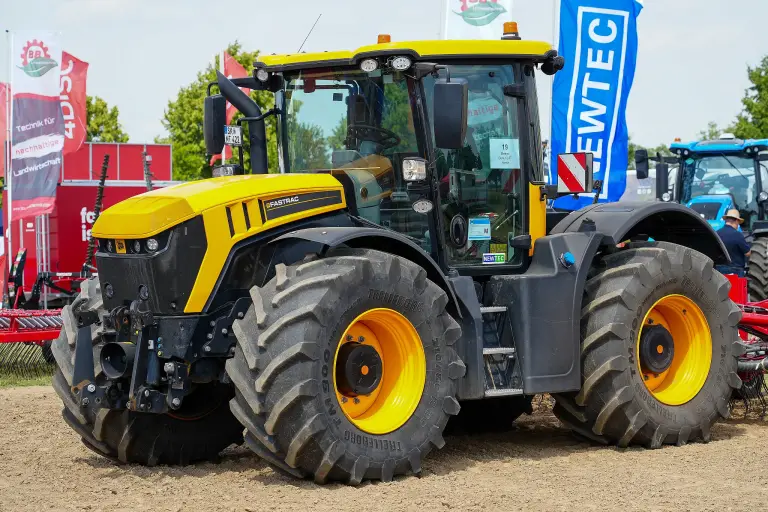
Testing began on 20 July 2006 on the runway at RAF Wittering with the lower-powered 450 kW (600 bhp) version of the engine, and by 30 July the car had passed 320 km/h. It was then dismantled and flown to Wendover Airport in Utah, and on 13 August, after reassembly, it made its first official run at Bonneville during Speed Week, averaging 510 km/h for the SCTA-BNI record in the AA/DS diesel streamliner class. On 22 August, with the 560 kW “LSR” engines fitted, it took the FIA diesel record at 529.099 km/h, and 24 hours later it beat its own mark with 563.418 km/h over a measured kilometre. Before each run the car was pushed from behind by a JCB Fastrac until it reached 48 km/h, where first gear engaged. It ran on Goodyear 23×15 racing tyres; larger ones were rejected to keep the frontal area small.
Design and features
- One engine per axle: two JCB444 units drive the front and rear wheels separately, so no propshaft or centre differential is needed.
- Extreme state of tune: 6 bar of boost and two-stage turbocharging take each 5-litre engine to about five times its production power.
- Computational aerodynamics: the body was shaped by CFD at MIRA to a drag coefficient of 0.147, since the car was too big for a wind tunnel.
- Minimal fuel: the tank holds 9 litres, and Green reported covering 18 km on about one US gallon during the record runs.
- Push start: a Fastrac tractor pushed the Dieselmax to 48 km/h before the driver engaged first gear.
JCB Dieselmax versions
- Test specification: the 450 kW (600 bhp) engines used at RAF Wittering in July 2006.
- Record specification: the 560 kW (750 bhp) “LSR” engines fitted for the FIA runs.
- Speed Week run: 13 August 2006, averaging 510 km/h for the SCTA-BNI AA/DS class record.
- FIA runs: 22 and 23 August 2006, at 529.099 and then 563.418 km/h.
The car was push-started by a JCB Fastrac tractor. More machines are in the JCB collection.
Sources
- JCB Dieselmax, English Wikipedia: design, engines, testing and record runs
- JCB Dieselmax, Italian Wikipedia: dimensions, previous record, driver