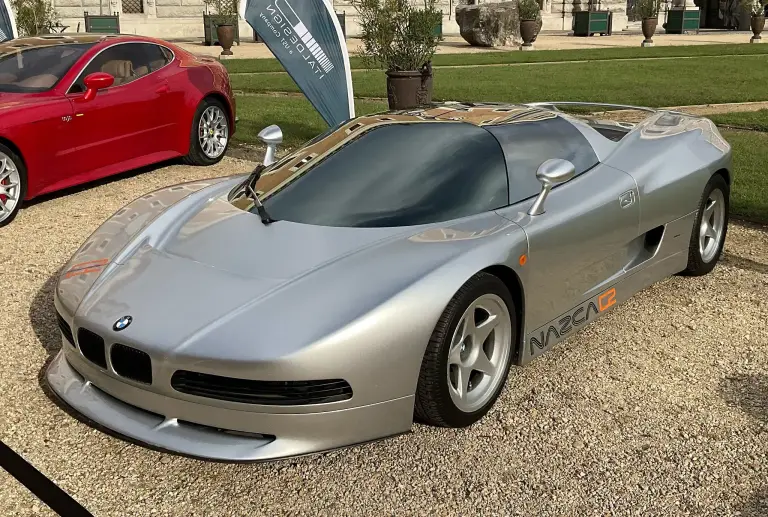
The Italdesign Aztec is a sports car unveiled at the 1988 Turin Motor Show to mark the twentieth anniversary of the design house. Its most unusual feature is that driver and passenger sit apart, in separate cockpits, and must communicate electronically. The body is a speedster with removable visor sections that open in a gull-wing arrangement.
Italdesign Aztec at a glance
| Shown | 1988 Turin Motor Show |
|---|---|
| Built for | Italdesign’s twentieth anniversary |
| Seating | two, in separate cockpits |
| Body | speedster with removable gull-wing visor sections |
| Panels | aluminium |
| Engine | Audi five-cylinder DOHC, turbocharged, 200 PS (147 kW) |
| Drive | four-wheel drive derived from the Lancia Delta HF Integrale |
| Planned run | 50 cars for Japan |
| Contractor | Carrozzeria Savio |
| Built | about 18 (some sources say fewer than 25) |
Based on one source, the English Wikipedia article on the Aztec.
History of the Italdesign Aztec
Italdesign presented the Aztec at the Turin Motor Show in 1988, twenty years after the studio was founded. The design was inspired by space technology rather than the organic shapes common at the time, and the wing mirrors took their cue from Le Mans racing cars. The car was a two-seater, but instead of a shared cabin it had two separate cockpits; the occupants could only speak to one another by radio.
The plan was to power the car with Audi’s new 3.6-litre V8. That engine was not ready in time, so the Aztec received an Audi-sourced five-cylinder double-overhead-camshaft unit instead, turbocharged to a nominal 200 PS (147 kW). Many cars were fitted with boosted engines closer to the “250 HP” claimed by the prominent badge on the flank. The four-wheel-drive system came from the Lancia Delta HF Integrale.
A Turin trading company, Compact srl, bought the rights and intended to build 50 examples for sale in Japan alone, with Carrozzeria Savio contracted to assemble them. Production fell far short of that: most sources put the total at 18 cars, and some simply describe it as fewer than 25. The Aztec went on to appear in the 1990 film Frankenstein Unbound as the computer-controlled car of the protagonist, and in the 1996 Italian comedy A spasso nel tempo.
Design and features
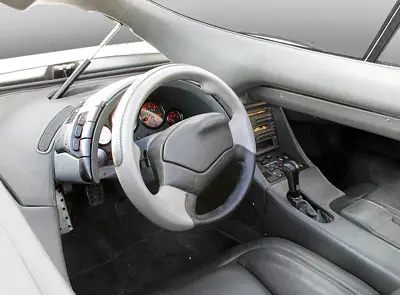
- Separate cockpits: driver and passenger sit apart and communicate by radio, with a passenger instrument cluster shaped like a steering wheel.
- Voice message panel: control panels on the rear aluminium body sides released a hydraulic jack, a fire extinguisher, a tyre compressor, a flashlight and extra lights after a code was entered.
- Satellite navigation: a navigation system sat in the centre of the dashboard, angled towards the driver.
- Gull-wing visors: the speedster body had removable visor panels that opened upwards.
- Carbon fibre wing: a rear wing optimised for downforce, with roll-bars for the occupants.
Italdesign Aztec versions
- Show car (1988): the Turin Motor Show prototype with the Audi five-cylinder.
- Production cars: about 18 built by Carrozzeria Savio for Compact srl.
- Boosted cars: examples with engines tuned closer to the 250 hp of the badge.
- Film car: the example used in Frankenstein Unbound (1990).
The Aztec was one of several Italdesign show cars of the period; the later Nazca C2 shared a film appearance with it. More designs are in the Italdesign collection.
Video: Italdesign Aztec Batman Style
Video on YouTube.
Sources
- Italdesign Aztec, English Wikipedia: design, engine, production, film appearances