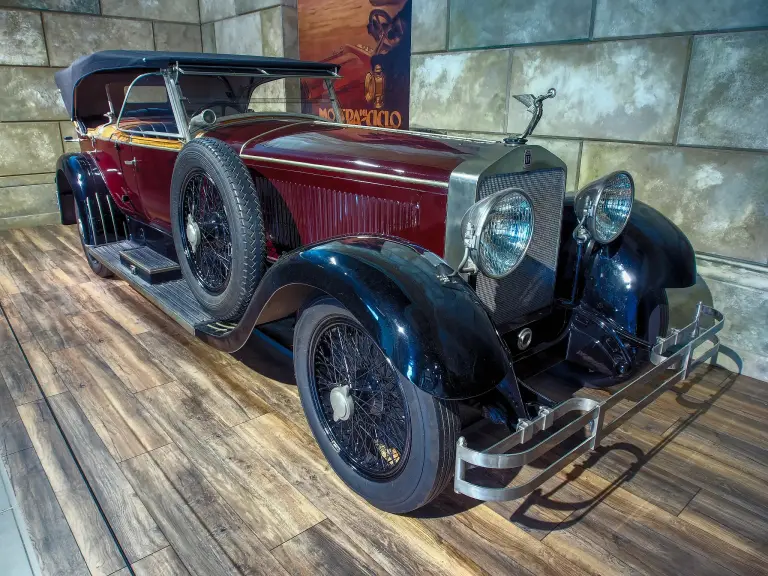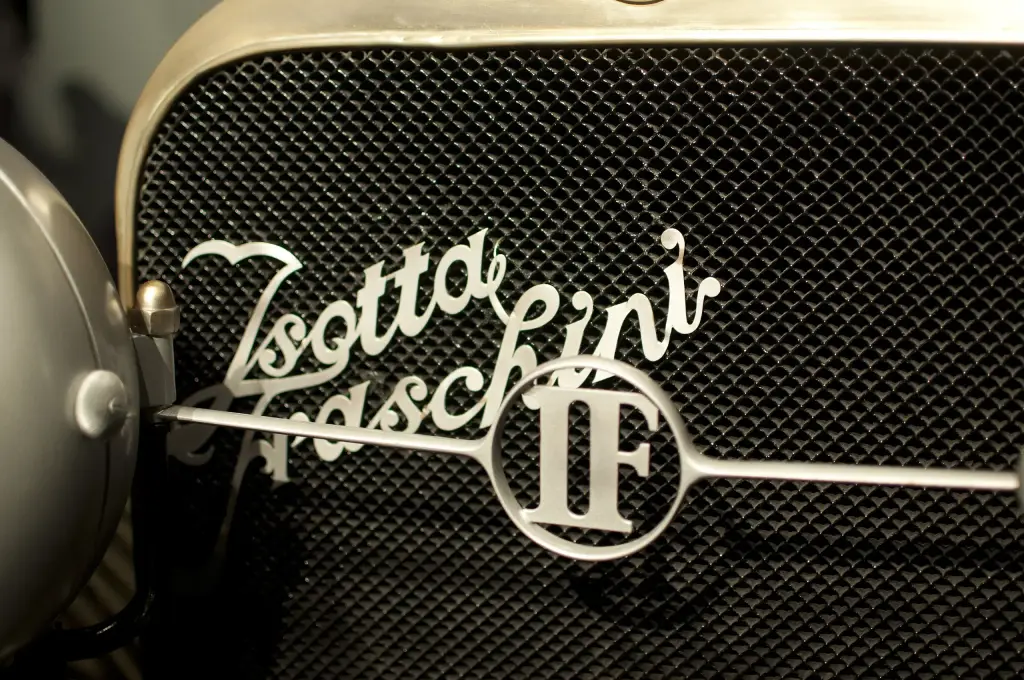
The Isotta Fraschini Tipo 8 was the Italian firm’s luxury car of 1919 to 1924 and the first series-production automobile in the world to use a straight-eight engine. Sold as a chassis and engine only, it was finished by coachbuilders such as Castagna and Cesare Sala, and it made Isotta Fraschini’s name as a builder of luxury cars.
Isotta Fraschini Tipo 8 at a glance
| Maker | Isotta Fraschini, Milan |
|---|---|
| Production | 1919–1924 |
| Engine | 5,901 cc straight-eight, overhead camshaft |
| Bore and stroke | 85 × 130 mm |
| Power | 75–80 hp at first, later 90 hp |
| Transmission | three-speed manual, four-speed offered later |
| Top speed | about 125 km/h, later about 140 km/h |
| Brakes | four-wheel mechanical, pedal and hand lever |
| Suspension | rigid axles, semi-elliptic springs, Houdaille dampers at the rear |
| Coachwork | chassis supplied to coachbuilders |
| Price | about 150,000 lire |
| Main market | the United States |
History of the Isotta Fraschini Tipo 8
Isotta Fraschini came out of the First World War a changed company. Having built a wide variety of models before 1914, it adopted a single-series policy, and the Tipo 8 was that series. Like most expensive cars of the day it left the factory as a chassis with engine and radiator; bodies came from Italy’s leading coachbuilders, Carrozzeria Castagna and Cesare Sala, though European and American firms also supplied them. The car cost about 150,000 lire and found its main market in the United States, and its principal rival was Rolls-Royce.
The engine was the car’s claim to fame: a 5,901 cc straight-eight with overhead valves and an overhead camshaft, on a crankshaft with nine main bearings. Early cars gave between 75 and 80 hp at about 2,200 rpm for a top speed of roughly 125 km/h; later the output rose to 90 hp and the maximum speed to about 140 km/h. There was no external intake manifold — the twin carburettors were bolted directly to the block. Mixture and ignition were adjusted by three levers on the steering wheel, one for advance, one for mixture and one for throttle.
Drive went to the rear wheels through a three-speed manual gearbox with a multi-plate clutch; a four-speed gearbox was offered later. The car had four-wheel mechanical brakes worked by pedal and by hand lever, rigid axles on semi-elliptic springs and Houdaille hydraulic dampers at the rear. The Tipo 8 and its straight-eight were the basis for the two successors, the Tipo 8A and the Tipo 8B.
Design and features
- First production straight-eight: the Tipo 8 was the first series-built car in the world with an eight-cylinder engine in line.
- Chassis only: buyers chose their own coachbuilder, usually Castagna or Sala.
- Hand-adjusted engine: three levers on the steering wheel controlled ignition advance, mixture and throttle.
- Luxury rival to Rolls-Royce: the car established Isotta Fraschini as a maker of luxury automobiles.
Isotta Fraschini Tipo 8 versions
- Early Tipo 8 (1919–): 75–80 hp, three-speed gearbox, about 125 km/h.
- Later Tipo 8: 90 hp, about 140 km/h, four-speed gearbox offered.
- Coachbuilt bodies: Castagna, Cesare Sala and other Italian, European and American firms.
The Tipo 8 was replaced by the more powerful Tipo 8A, and its straight-eight was developed into the Tipo 8B. More cars are in the Isotta Fraschini collection.
Sources
- Isotta Fraschini Tipo 8, English Wikipedia: history, engine, production years
- Isotta Fraschini Tipo 8, Italian Wikipedia: specifications, price, market