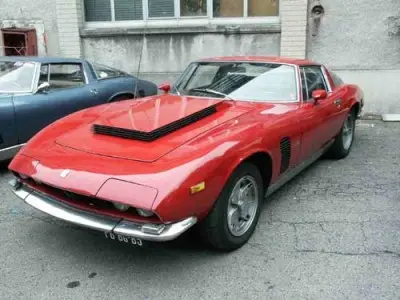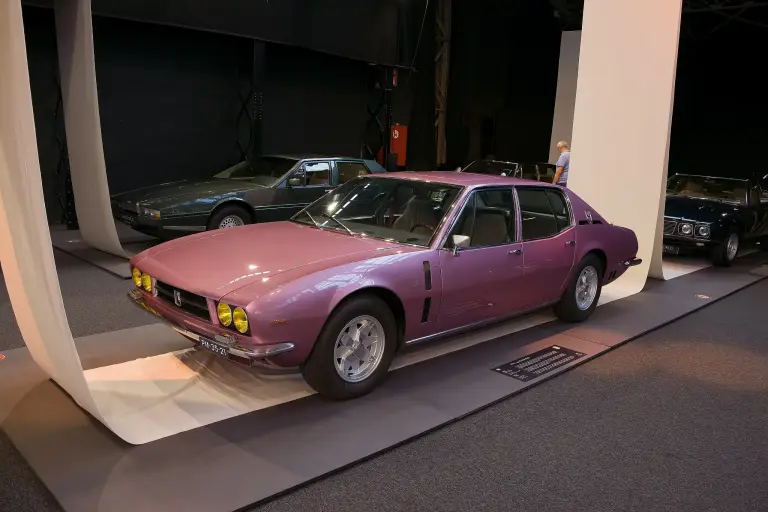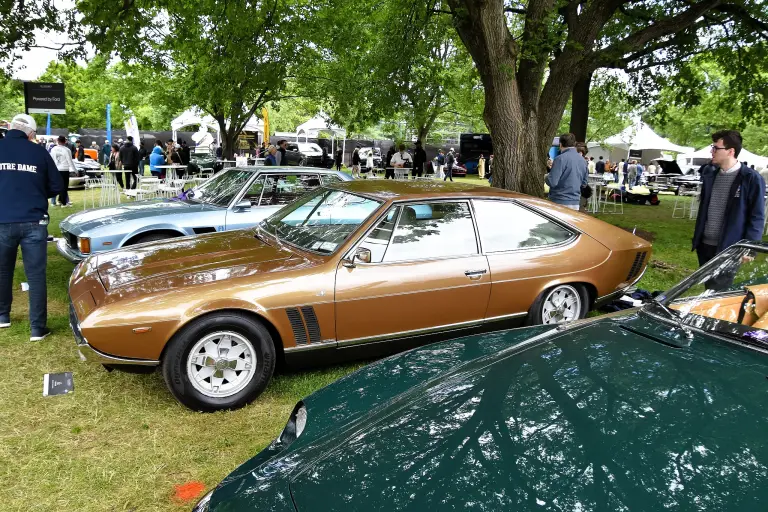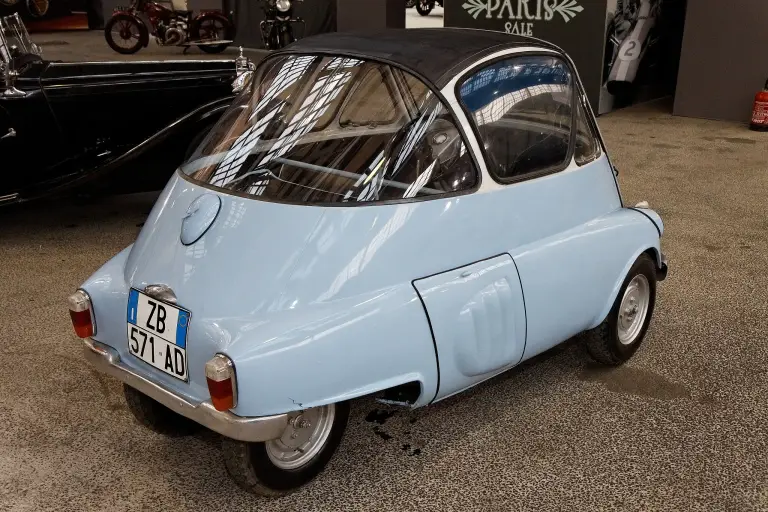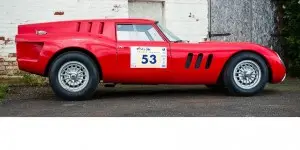
Iso Rivolta was the grand touring arm of Renzo Rivolta’s company, created after the Isetta microcar and a range of motorcycles. From the IR 300 of 1962 it built a line of luxury coupés and saloons powered by American V8 engines, and the name covers the whole GT era of the marque.
Iso Rivolta at a glance
| Founded | Isothermos of Bolzaneto, bought by Renzo Rivolta in 1939 |
|---|---|
| Factory | Bresso, near Milan, from 1942 |
| Motorcycles | ISO Scooter, Isomoto, Isocarro, Iso GT, Iso Sport and Iso Ciclo |
| Scooter model | ISO F/150, built from 1957 to 1962 |
| First car | Iso Isetta, 1953 |
| Company name | ISO Rivolta from 1962 |
| First GT | Iso Rivolta IR 300, 1962 |
| Body | Bertone, from sketches by Giorgetto Giugiaro |
| Chassis | designed by Giulio Alfieri |
| Engine | Chevrolet Corvette V8, 300 hp |
| Racing | Iso A3/C of 1963, developed by Giotto Bizzarrini |
| Later models | Grifo 1965, Fidia 1968, Lele 1969 |
This page covers the marque and its GT era; the English Wikipedia article is about the company rather than a single model.
History of the Iso Rivolta
The company began as Isothermos of Bolzaneto, a factory making electric heaters and chillers, which the engineer Renzo Rivolta bought in 1939 and moved to Bresso in 1942 after a bombing raid destroyed the offices in Genoa. Immediately after the Second World War Rivolta turned to motorbikes, a market that offered good commercial profits at the time. The ISO Scooter had a twin-cylinder engine inspired by the 125 Puch, and with the Isomoto it encouraged the company to add models such as the Isocarro, Iso GT, Iso Sport and Iso Ciclo. In 1957 a project created on behalf of Maserati became the ISO F/150, which replaced the obsolete Iso 125 and stayed in production until 1962, when Iso limited itself to cars. A final 500 cc boxer-engined motorbike was presented in 1961 but never went into production.
In the early 1950s Rivolta developed the idea of a vehicle halfway between a car and a motorbike, to bridge the gap between the classic motorcycle and the cheapest Italian car, the Fiat 500 Topolino. The company register changed to ISO Autoveicoli and in 1953 the Isetta was launched, with its egg-shaped body, 236 cc engine and single front door. It was not a great success in Italy, so Rivolta licensed the design abroad: the VELAM Isetta for France, the ROMI Isetta for Brazil and South America, and the BMW Isetta, which proved far more successful than the Italian original. In total 160,000 units were produced and sold. Italian production of the Isetta ended at the end of 1956, and at the beginning of 1957 ISO left microcars and motorbikes behind.
From the ashes of ISO Autoveicoli, Rivolta founded ISO Rivolta, aimed at the narrow market of high-end grand tourers, halfway between the GTs of the German or American school and those of the Italian school. The real move to passenger cars came in 1962 with the public presentation of the ISO Rivolta IR 300, a luxury coupé designed by Bertone through Giorgetto Giugiaro’s sketches, with a chassis developed by Giulio Alfieri and a Chevrolet Corvette V8 of 300 hp — the number in the name stood for the engine output. From that moment it was clear what kind of cars Iso would make: high-performance grand tourers with top-level finishes.
In 1963 the Iso A3 was exhibited on the Iso Rivolta stand at the Turin Motor Show. Intended for racing as the A3/C, it was entrusted to Giotto Bizzarrini, who had been hired as a track engineer, while the body was made at Piero Drogo’s Carrozzeria Sports Cars in Modena using 1,700 rivets; the car was therefore nicknamed millechiodi. In 1965 the berlinetta version of the A3 was sold to the actor and singer Johnny Hallyday. The GT 300 chassis then produced the Grifo coupé of 1965 with engines from 5.4 to 7 litres, the Fidia saloon of 1968 and the Lele 2+2 of 1969 designed by Marcello Gandini. By the end of 1971 General Motors was demanding advance payment for engines, so Iso adopted Ford Cleveland units, and competition from Maserati and Aston Martin together with the oil crisis of 1973 put the company in financial jeopardy.
Design and features
- From scooters to GTs: the company moved from motorcycles and the Isetta to luxury cars in barely a decade.
- American power: Chevrolet Corvette V8 engines gave the early cars 300 hp and more.
- Italian design: Bertone, Giugiaro, Gandini and Bizzarrini all worked on Iso projects.
- Racing link: the A3/C “millechiodi” was built with 1,700 rivets and raced before the road cars.
Iso Rivolta versions
- Motorcycle years: ISO Scooter, Isomoto, Isocarro, Iso GT, Iso Sport, Iso Ciclo and the ISO F/150 scooter.
- Iso Isetta (1953): the microcar that paid for the move into cars.
- IR 300 (1962): the first Iso Rivolta GT, with a Bertone body and a 300 hp Chevrolet V8.
- Iso A3/C (1963): the Bizzarrini-developed competition car, bodied by Drogo.
- Later GTs: the Grifo in 1965, the Fidia saloon in 1968 and the Lele 2+2 in 1969.
The story starts with the Iso Isetta and continues with the Grifo, the Fidia and the Lele. More cars are in the Iso collection.
Sources
- Iso (automobile), English Wikipedia: company history, models, engines