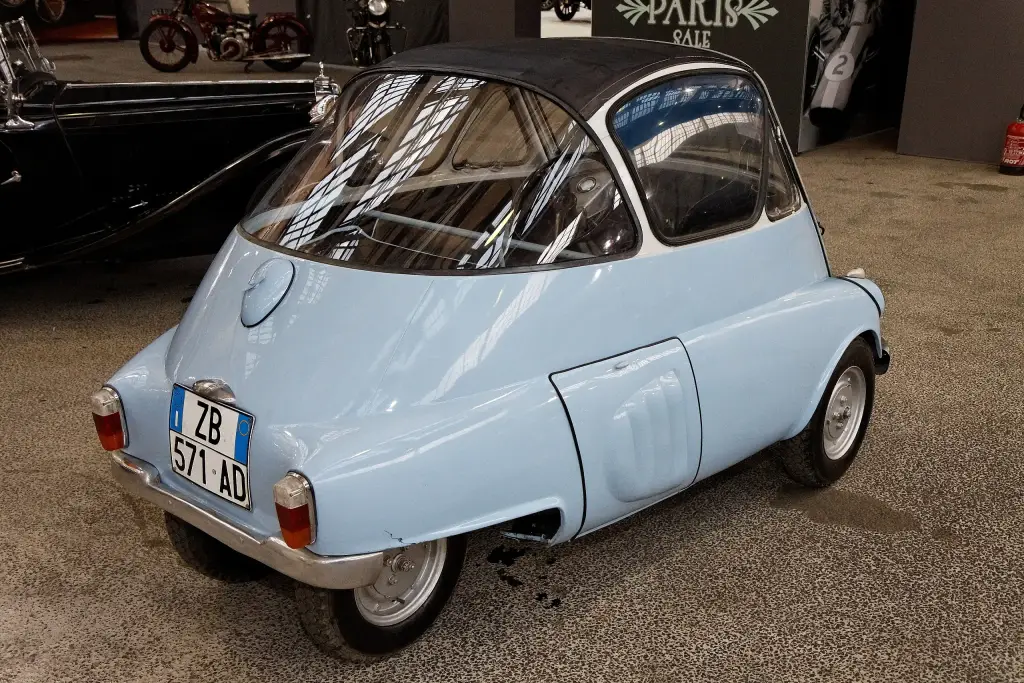
The Isetta was designed and first built by the Italian firm Iso SpA in 1953. Its egg-shaped body, bubble windows and single front-hinged door made it one of the best-known microcars of the 1950s, but Italy built only about a thousand before the licence and the body tooling went to BMW.
Iso Isetta at a glance
| Maker | Iso SpA, Bresso (Milan) |
|---|---|
| Production | 1953–1955 in Italy; Spain until 1958 |
| Designers | Ermenegildo Preti and Pierluigi Raggi |
| Body | egg-shaped two-seater with a single front door |
| Engine | 236 cc two-stroke split-single |
| Power | 7.0 kW (9.5 hp) |
| Gearbox | four-speed manual with reverse |
| Drive | chain drive to a solid rear axle |
| Length | 2.29 m |
| Width | 1.37 m |
| Top speed | about 75 km/h |
| Fuel tank | 13 litres |
The Iso Isetta is described in a section of the English Wikipedia article on the Isetta, which also covers the licensed BMW, VELAM and other versions.
History of the Iso Isetta
Iso SpA began in the 1940s as a maker of refrigerators, motor scooters and small three-wheeled trucks. Its owner, Renzo Rivolta, wanted a small car for mass distribution, and by 1952 the engineers Ermenegildo Preti and Pierluigi Raggi had designed one around the motorcycle engine of the Iso Moto 200. The name Isetta is the Italian diminutive of Iso: “little Iso”. The car was shown to the motoring press in Turin in November 1953 and caused a sensation, because nothing like it had been seen before.
The Isetta was only 2.29 m long and 1.37 m wide, with an egg-shaped body and bubble-type windows. The entire front end hinged outwards as the only door, and the steering wheel and instrument panel swung out with it, which made access to the single bench seat simple. The bench was comfortable for two occupants, perhaps with a small child. Behind it was a large parcel shelf with the spare wheel underneath, and a heater was optional. Ventilation came from turning out the front triangle windows or opening the fabric sunroof, through which the occupants were also meant to leave the car in an accident.
Power came from a 236 cc two-stroke split-single engine of 7.0 kW, started by a combined generator–starter known as Dynastart. A manual gearbox gave four forward speeds and reverse, and a chain drove a solid rear axle with a pair of closely spaced 250 mm wheels set 480 mm apart. That narrow track removed the need for a differential, while the front axle was a modified Dubonnet independent suspension. The car took over 30 seconds to reach 50 km/h and topped out at about 75 km/h, with a 13-litre tank and consumption of between 5.6 and 4.0 L/100 km.
In 1954 several Isettas ran in the Mille Miglia and took the top three places in the economy classification, averaging over 70 km/h across 1,600 km. At home, however, the car was slipping against the new Fiat 500C, and Rivolta wanted to concentrate on his new Iso Rivolta sports car. Plants in Spain and Belgium were already assembling Isettas from Italian components, and in mid-1954 BMW bought not only a licence but the complete Isetta body tooling. Rivolta also licensed the design in France and Brazil. After some 1,000 cars, Italian production of the Isetta ended in 1955, though Iso continued to build it in Spain until 1958.
Design and features
- One front door: the whole nose of the car, with the steering wheel and instruments, hinged outwards.
- Bubble shape: an egg-like body with curved windows made the Isetta the archetypal bubble car.
- Dynastart: a combined generator and starter replaced a separate starter motor.
- Economy run: Isettas took the top three places in the economy class of the 1954 Mille Miglia.
Iso Isetta versions
- Iso Isetta (1953–1955): the Italian-built original, with a 236 cc engine.
- Iso Autocarro: a commercial version with a full-width rear axle and a 500 kg load, offered as a pickup, enclosed truck, tilt-bed or even a fire engine; more than 4,000 are thought to have been built between 1954 and 1958.
- Spanish and Belgian assembly: cars put together from Italian-made Iso components; Spain kept building the Isetta until 1958.
- Licensed versions: BMW bought the licence and the body tooling in 1954, while VELAM in France and a Brazilian maker built their own versions.
The Isetta was Iso’s first car, and it paid for the move into grand touring: see the Iso Rivolta and the later Lele 2+2. More cars from the marque are in the Iso collection.
Sources
- Isetta, English Wikipedia: design, engine, production and licensing