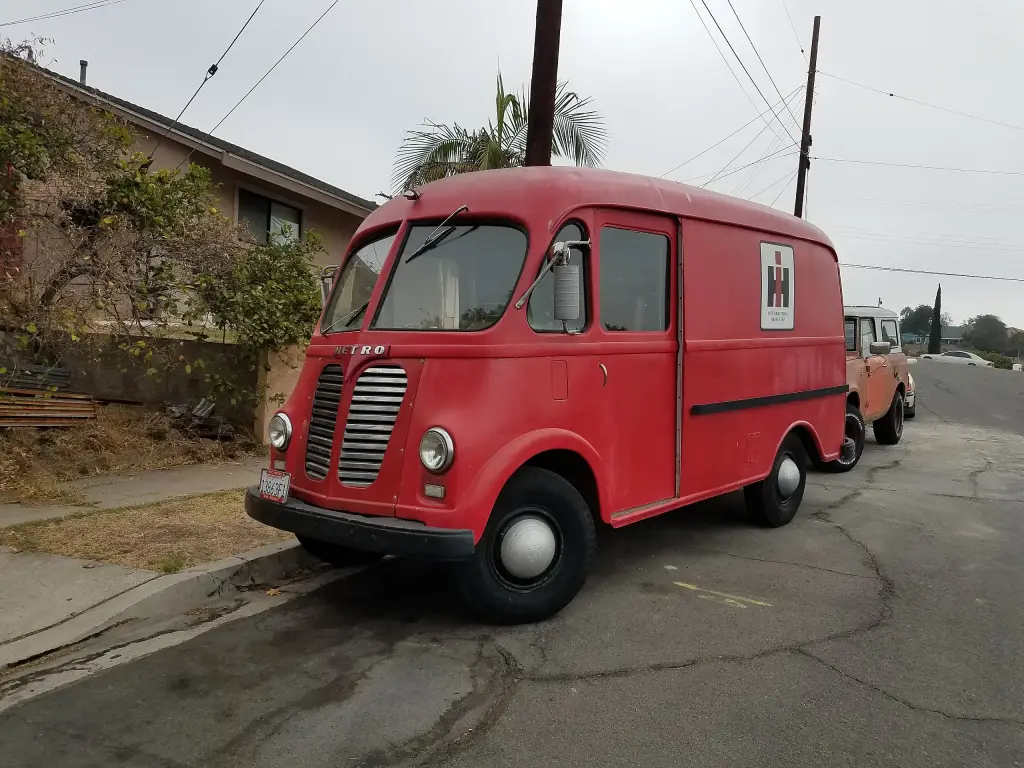
The International Metro Van was a multi-stop delivery truck made by International Harvester from 1938 to 1975. One of the earliest mass-produced forward-control vehicles, it was designed by Raymond Loewy and used for everything from milk and bread delivery to ambulances, mobile offices and buses.
International Metro Van at a glance
| Maker | International Harvester, with bodies by the Metropolitan Body Company |
|---|---|
| Production | 1938–1975 in the United States |
| Type | forward-control multi-stop panel truck |
| Sizes | half-ton, three-quarter-ton and one-ton |
| Designer | Raymond Loewy |
| Body plant | Bridgeport, Connecticut; bought by International Harvester in 1948 |
| Bodies | panel van, Metro Coach bus, partial cab-chassis, walk-in cab |
| Redesign | 1964, with squared corners and an opening hood |
| Later models | Metro-Lite and Metro-Multi-Stop in the 1950s, Metro Mite in 1959 |
| End | 1975 |
Based on one source (English Wikipedia).
History of the International Metro Van
A Loewy design
The Metro Van was one of the earlier mass-produced forward-control vehicles. It was typically a half-ton, three-quarter-ton or one-ton panel truck in which the driver could stand or sit, and it was commonly used for milk and bakery delivery as well as ambulances, mobile offices and radio transmitter vans. The original design was by Raymond Loewy, the industrial designer also responsible for Studebaker cars and the Coca-Cola bottle, and it was one of several vehicles he worked on for International Harvester. The earliest models, known as the D or D-M series, stayed closest to his design, with teardrop headlights, rear fender skirts carrying Art Deco “Metro” badges, the triple diamond grille emblem and a more streamlined nose than later versions; the shape has been nicknamed the “giant scarab”. The drivetrain was originally based on the 1937–40 D-series trucks.
Bridgeport and the war
Unlike International’s other trucks, the Metro bodies were built by the Metropolitan Body Company on Grand Street in Bridgeport, Connecticut, with final assembly at an International Harvester plant. The body company sold bodies to all major truck makers until 1947, when it began producing exclusively for International Harvester after switching back from wartime work on gun turrets and bomb blast shields, and it became a wholly owned subsidiary in January 1948. One of the first Metros was sold to the Czechoslovak Army and destroyed by the German army during the Second World War; the United States Armed Forces used the van as an ambulance and for personnel transport.
Changes and the end
The Metro kept its basic shape until 1964, when it was redesigned in-house at the Chicago plant to compete with Boyertown and Hackney vans: the corners were squared, an opening hood was added for access to the coolant and oil dipstick, and a V8 engine became available. In the 1950s International added the Metro-Lite and Metro-Multi-Stop, and in 1959 the Metro Mite, a small van on Scout running gear with a Nash Metropolitan engine; it was underpowered, and in 1961 International’s own new four-cylinder engine replaced it. A Bookmobile was built on an International chassis in 1960. By 1972 all Metro Vans were stripped chassis for other manufacturers, and in 1975 the line was discontinued along with International’s other light trucks except the Scout. Navistar revived the name in 2000 for an unrelated medium delivery truck, and for a short time the Workhorse MetroStar echoed the original idea.
Design and features
- Loewy styling: teardrop headlights, fender skirts and a streamlined nose on the early D series.
- Forward control: the driver could stand or sit, and the body was easy to load from the kerb.
- Many bodies: panel van, bus, cab-chassis and walk-in cab versions.
- 1964 redesign: squared corners, an opening hood and an optional V8.
- Long life: built for 37 years and used by armies, bakeries and ambulance services.
International Metro Van versions
- D and D-M series: the earliest vans, closest to the Loewy design.
- Metro Coach: passenger bus version.
- Metro-Lite and Metro-Multi-Stop: 1950s delivery versions.
- Metro Mite (1959): small van on Scout running gear.
- Walk-in cab and cab-chassis: versions for box bodies, compactors and stake beds.
The Metro’s drivetrain came from the International L series and earlier D-series trucks, and its body was built alongside International’s other commercial vehicles in the International collection.
Sources
- International Metro Van, English Wikipedia: design, bodies, history, models