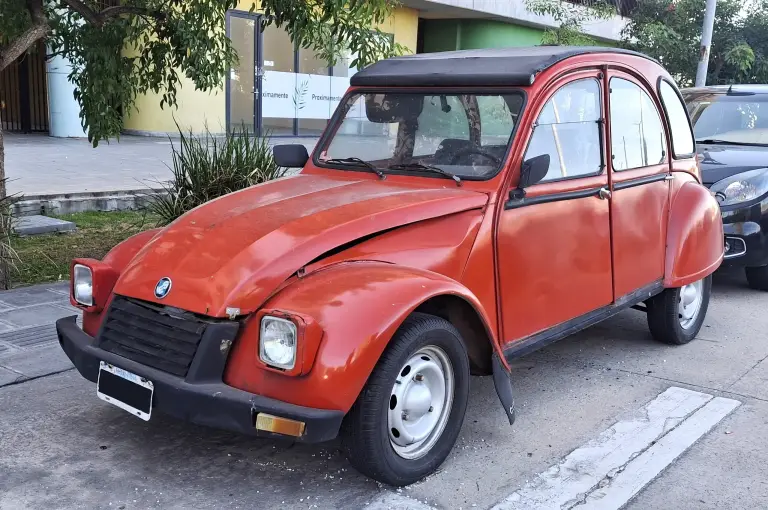
The IES Safari was the Citroën Méhari built in Argentina by Industrias Eduardo Sal-Lari. When the company took over Citroën’s local operation and renamed itself in 1983, production of the Méhari continued under the Safari name, and the model stayed in the range until the firm went bankrupt in 1990.
IES Safari at a glance
| Maker | Industrias Eduardo Sal-Lari S.A., Argentina |
|---|---|
| Production | from 1983 until the bankruptcy of 1990 |
| Original model | Citroën Méhari |
| Renamed | 1983, when Citroën Argentina became Industrias Eduardo Sal Lari |
| Plant | Mercedes, Buenos Aires Province, from 1985 |
| Built alongside | IES 3CV and IES Carga (AK 400 van) |
| Company fate | bankruptcy in 1990 |
Based on one source: the Spanish Wikipedia article on Industrias Eduardo Sal-Lari, which mentions the Safari in a single sentence on the continuation of Méhari production; the rest of the page describes the company.
History of the IES Safari
Citroën leaves Argentina
Around 1980 Citroën decided to withdraw from the Argentine market and sold the shares of its local subsidiary to the engineer Eduardo Sal Lari, who already supplied the company with shock absorbers through his firm Daher Boge. For a while the business, still called Citroën Argentina, went on building Citroën cars from the parts it had acquired and also sold French-built cars in Argentina.
The Safari name
In 1982, with the market depressed and closed, Sal Lari decided to build the cars entirely in Argentina, and in 1983 the company was renamed Industrias Eduardo Sal Lari. The 3CV became the IES 3CV, the AK 400 van became the IES Carga, and the Méhari carried on as the Safari — a continuation of an existing model under a new badge rather than a new design.
Mercedes and the end of the company
A new plant was begun at Mercedes in Buenos Aires Province in 1983 and took over all production from 1985. The Safari stayed in the range while IES modernised the 3CV into the América in 1986 and the Súper América in 1987, and added the Gringa pickup in 1988 and the Gringo in 1989. The economic crisis of February 1990 ended the story: Industrias Eduardo Sal-Lari went bankrupt, and with it the last Argentine maker of cars in series with entirely local capital.
Design and features
- A renamed Méhari: the Safari was the Citroën model continued under the IES name from 1983.
- One of three models: it was built alongside the IES 3CV car and the IES Carga van.
- Mercedes plant: from 1985 all IES vehicles, the Safari included, were assembled in Buenos Aires Province.
- End of an era: production stopped with the bankruptcy of the company in 1990.
IES Safari versions
- Safari (from 1983): the Méhari continued under the IES name.
- IES 3CV: the company’s car, modernised as the América and Súper América.
- IES Carga: the AK 400 van, the third model in the range.
The Safari was sold next to the IES 3CV and the IES Gringa pickup. More cars of the make are in the IES collection.
Sources
- Industrias Eduardo Sal-Lari, Spanish Wikipedia: Safari, company history, models