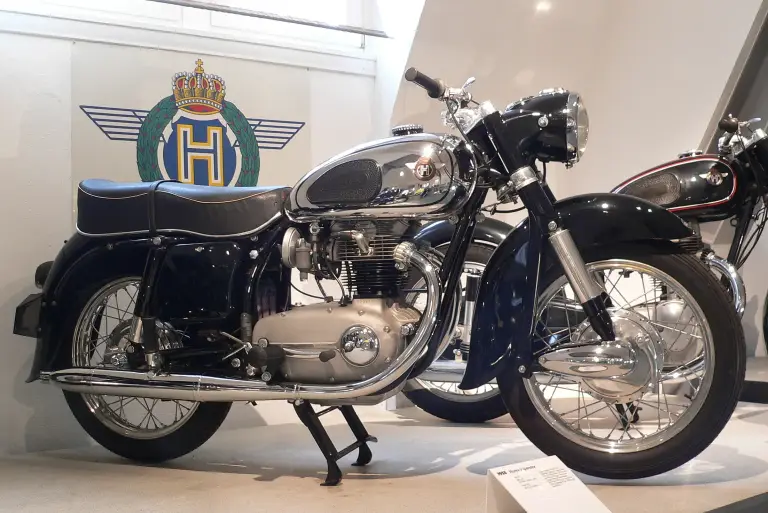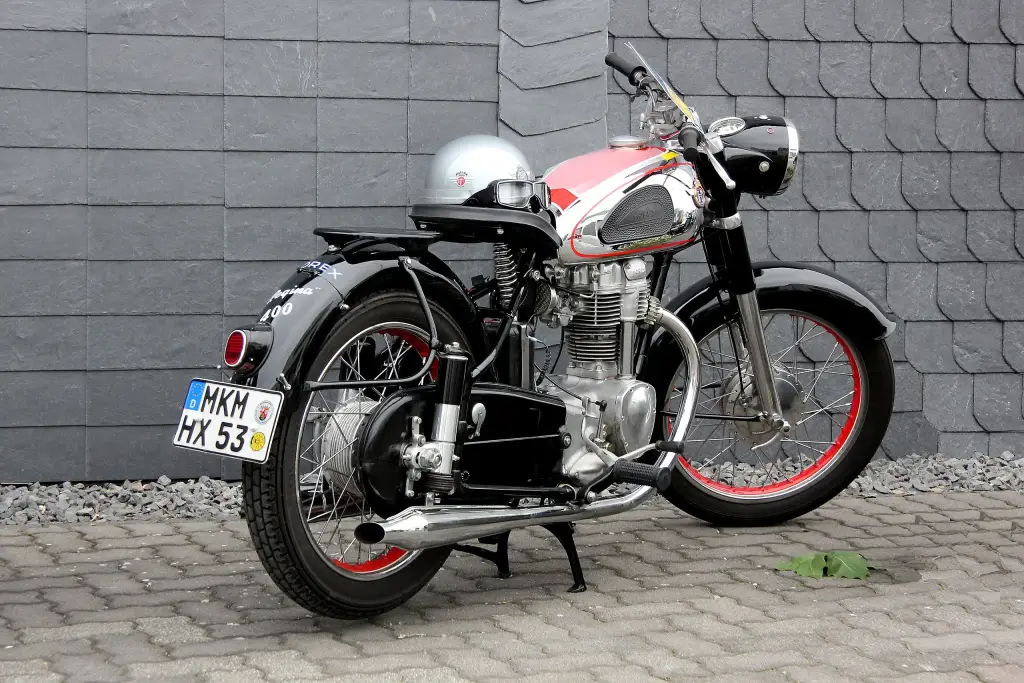
The Horex Regina was the single-cylinder mainstay of the Horex range after the Second World War. Designed by Hermann Reeb from the pre-war SB 35, it was sold from 1949 to 1956 in 250, 350 and 400 cc versions and, in its largest form, gave 22 PS and 130 km/h — enough for a sidecar outfit as well as solo work.
Horex Regina at a glance
| Maker | Horex-Columbus-Werk, Bad Homburg vor der Höhe |
|---|---|
| Production | 1949–1956 |
| Designer | Hermann Reeb, developed from the SB 35 |
| Engine | air-cooled single, pushrod OHV four-stroke |
| Displacement | 342 cc (69 × 91.5 mm); 250 cc and 399 cc added |
| Power | 18 PS at 5,000 rpm (350); 17 PS (250); 22 PS at 5,750 rpm (400) |
| Top speed | 130 km/h solo, 95 km/h with sidecar (400) |
| Gearbox | four-speed, foot rocker shift on the right |
| Final drive | enclosed chain |
| Frame | open-bottom tubular steel |
| Brakes | light-alloy full-hub drums, front and rear |
| Seat | sprung saddle or dual seat |
The Regina has a detailed article only in German Wikipedia; the English Horex article supplies the marque history and production totals.
History of the Horex Regina
A single developed from the SB 35
The Regina was the work of Hermann Reeb, who had already designed Horex engines in the 1930s. He developed the new model from the type SB 35, the 350 cc single with which Horex restarted production in 1948. The first Reginas were built from 1949 in the Horex-Columbus-Werk in Bad Homburg vor der Höhe and were offered at first only with the 342 cc engine, 69 mm bore and 91.5 mm stroke, rated at 18 PS at 5,000 rpm.
Regina 1, Regina 2 and Regina 3
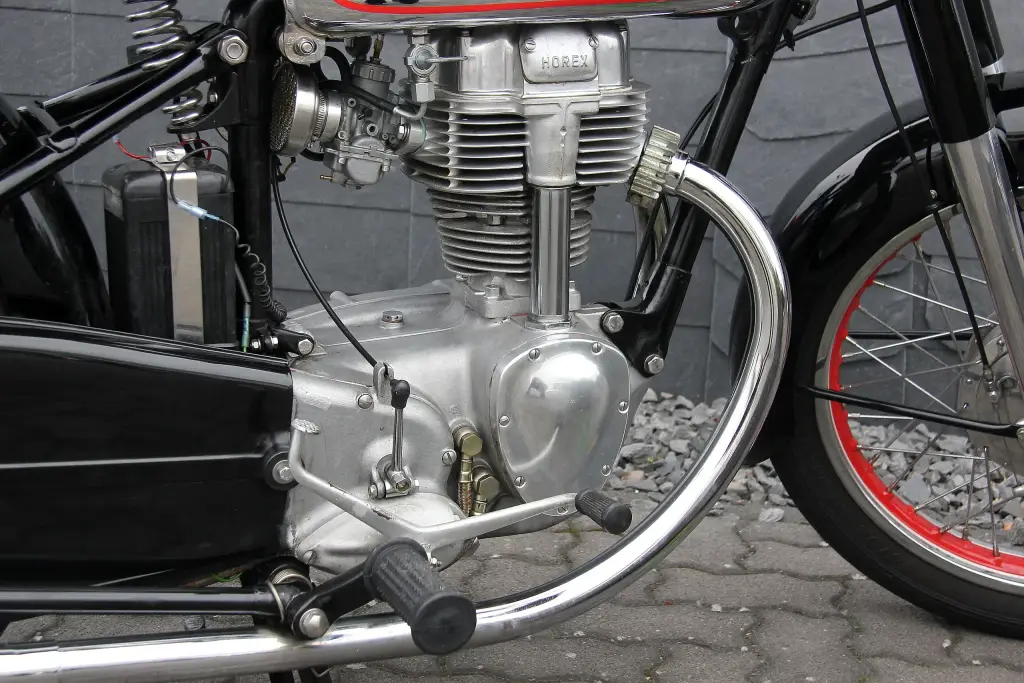
The next version, sold as the Regina 1, brought wider brakes — the linings grew from 35 to 40 mm — and the 18-litre “Büffeltank” (buffalo tank) in place of the flat 12-litre tank. In 1952 Horex added the Regina Sport, with an aluminium cylinder head instead of cast iron, a single exhaust port on the right and two pushrods behind a single tube; with unchanged capacity it made 20 PS at 6,000 rpm, the compression ratio rose to 7:1 and an Amal 27 C 1 BP carburettor with accelerator pump was fitted.
The same year a 250 cc Regina was introduced for export; from 1953 it was sold in Germany as the Regina 2 alongside the 350 cc Regina 3. The small model made 17 PS and was recognised by its single exhaust on the left. From 1953 every Regina had a light-alloy cylinder head.
The 400 and the end of the line
The strongest Regina arrived in 1953: 399 cc from a 74.5 mm bore and the same 91.5 mm stroke, 22 PS at 5,750 rpm. That was good for 130 km/h solo and 95 km/h with a sidecar, and the Regina 4 remained in production until the end of 1956. In 1954 Horex showed a Regina developed by Harald Oelerich for racing riders, with a swinging rear fork, but it never reached series production; the Regina itself was replaced in the range by the Resident in 1955.
Racing and the Red Porsche Killer
From 1950 the Horex test engineer Harald Oelerich and the private racer Friedel Schön built a 350 cc racing single from Regina and S 35 parts with works support. Running on alcohol it made 32 PS at 7,500 rpm, with a cast-iron cylinder and a bronze head, and the 115 kg machine reached 175 km/h. Four 400 cc Regina engines later formed the basis of the Red Porsche Killer, the drag bike campaigned by the cartoonist Rötger Feldmann.
Design and features
- Block engine: crankcase, clutch, gearbox, alternator and ignition shared one housing, a development of the Columbus unit also used in the Victoria KR 35.
- Pushrods, not a camshaft drive: the cover tube on the right of the cylinder looks like a bevel shaft but carries two pushrods to the rockers of the overhead valves.
- Progressive specification: a 12-litre flat tank gave way to an 18-litre Büffeltank, cast iron to aluminium heads, and two exhausts to a single port on the Sport.
- Sidecar-ready frame: an open-bottom tubular steel frame, telescopic fork and full-hub drum brakes were designed with a sidecar in mind.
- Unusual gear change: a foot rocker worked by toe and heel, a layout otherwise seen mainly in racing.
Horex Regina versions
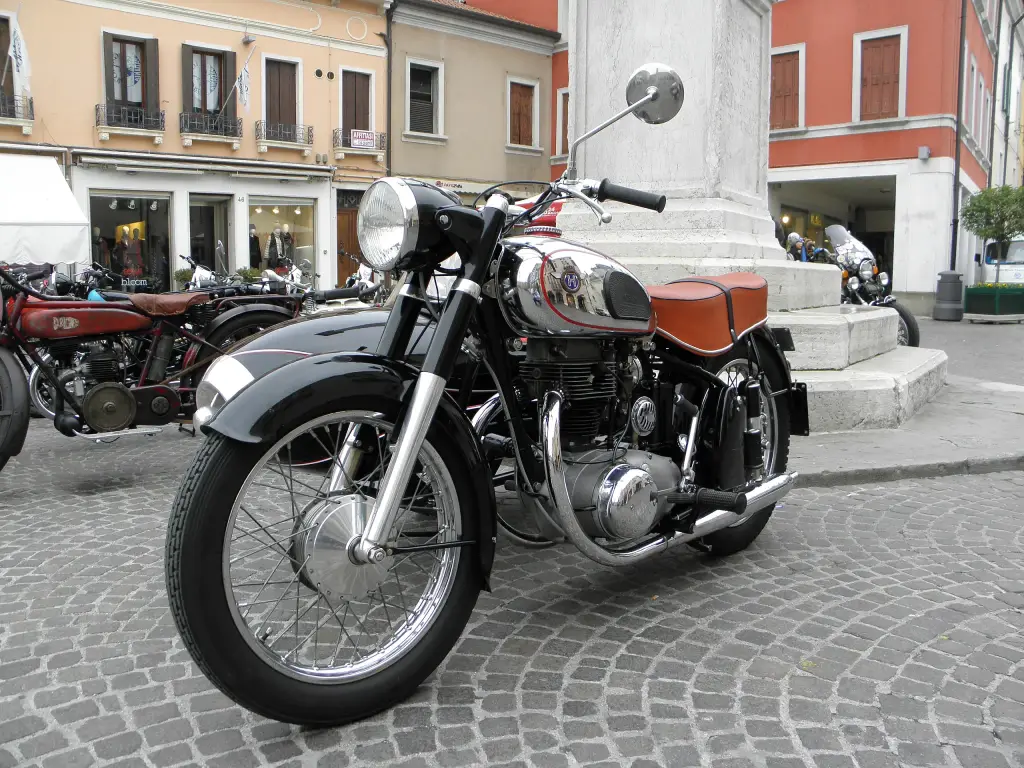
- Regina 350 (from 1949): 342 cc, 18 PS, flat 12-litre tank.
- Regina 1: wider brake linings and the 18-litre Büffeltank.
- Regina Sport (1952): aluminium head, single right-hand exhaust, 20 PS at 6,000 rpm.
- Regina 2 (250 cc): 17 PS, single exhaust on the left, export model from 1952.
- Regina 3 (350 cc): the 350 continued alongside the 250.
- Regina 4 (399 cc, 1953–1956): 22 PS, 130 km/h, the most powerful of the line.
The Regina was joined at the top of the range by the twin-cylinder Horex Imperator, and both are part of the Horex collection.
Video: Horex Regina Probefahrt
Video on YouTube.
Sources
- Horex Regina, German Wikipedia: model history, versions, engine and frame
- Horex, English Wikipedia: production totals, place in the range