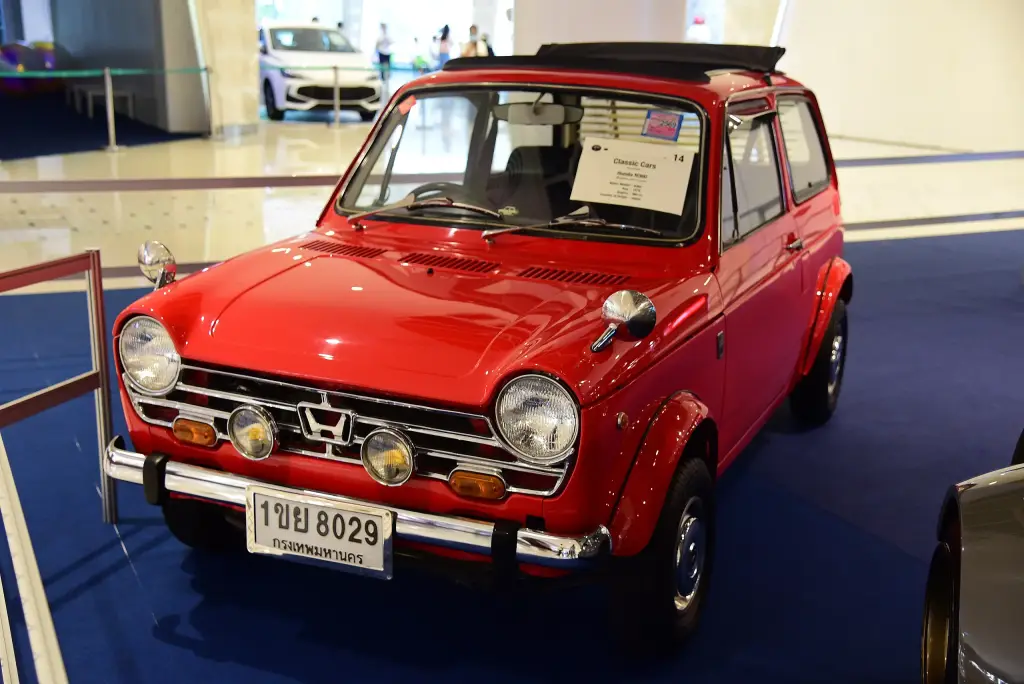
The Honda N360 is a small car manufactured and marketed by Honda from March 1967 to 1972. It was built as a two-door sedan and a three-door wagon, had a front-engine, front-wheel-drive layout and seated four passengers. After a January 1970 facelift it became the NIII 360 and continued until June 1972.
Honda N360 at a glance
| Maker | Honda |
|---|---|
| Production | March 1967 – 1972 |
| Bodies | two-door sedan and three-door wagon |
| Layout | front engine, front-wheel drive |
| Seats | four |
| Engine | 354 cc air-cooled four-stroke two-cylinder |
| Power | 31 PS (23 kW) |
| Valve layout | 360-degree parallel twin |
| 1970 facelift | renamed NIII 360 |
| N600 | larger-engined variant sold to 1973 |
| Name origin | N for norimono, Japanese for vehicle |
| Later homage | Honda N-One of 2012 |
Based on one source, the English Wikipedia article on the N360.
History of the Honda N360
A clean-sheet Honda car
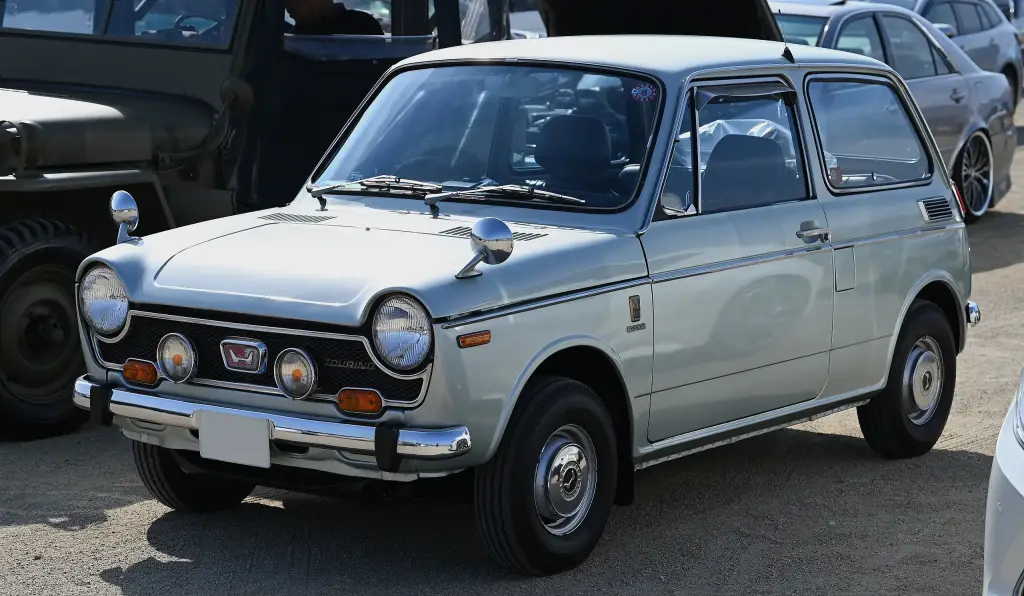
The N360 was an all-new product that did not share its chassis with the Honda Sports roadster or the L700 commercial platform. It opened a new market segment for Honda: an affordable, reliable and easy-to-maintain vehicle with broad appeal to private car owners, where the earlier roadsters and trucks had more specific audiences. The spacious and comparatively powerful N360 became an instant success in Japan, dethroning the Subaru 360 as the best-selling passenger car.
Engine and layout
The car had front-wheel drive and an air-cooled four-stroke 354 cc two-cylinder engine producing 31 PS. Although ultimately derived from Honda’s motorcycle engines, the N360E engine used a 360-degree crankshaft angle, a parallel twin, rather than the 180-degree vertical twin typical of Honda’s motorcycle units. The same engine was used in the Honda Vamos, coupled there with a beam axle and leaf springs.
N600 and legacy
All models used a two-box design that complied with kei car dimensions, though cars with the 401 cc and 598 cc engines exceeded the kei displacement limits and were mainly intended for markets outside Japan. The larger-engined N600 was sold through 1973. The N prefix stood for norimono, Japanese for vehicle, distinguishing the cars from Honda’s motorcycles. In 2012 Honda introduced the N-One, an homage to the 1967–1973 N sedans.
Design and features
- Air-cooled 354 cc twin: Honda’s first mass-market car engine.
- Front-wheel drive: the layout Honda’s cars would keep.
- Kei dimensions: built to Japanese light-car rules.
- N600 for export: a larger engine for foreign markets.
Honda N360 versions
- N360 sedan (1967): the two-door car.
- N360 wagon: the three-door version.
- NIII 360 (1970): the facelifted car.
- N600: the export variant, sold to 1973.
- N-One (2012): the modern homage.
The N360 preceded the Honda Life and the Civic, and shares its small-car engineering with the Acty. More Hondas are in the Honda collection.
Sources
- Honda N360, English Wikipedia: production, engine, layout, N600, legacy