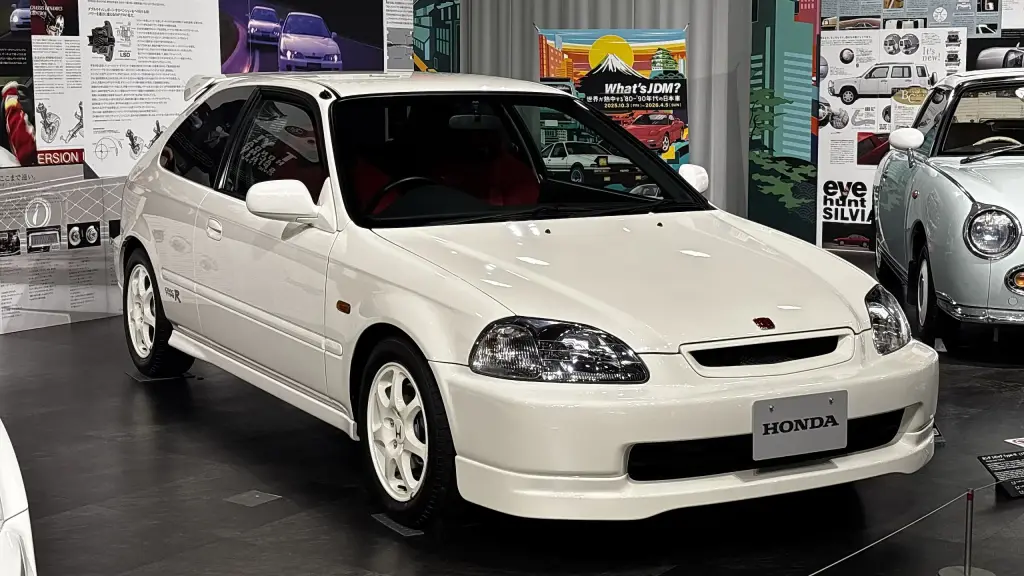
The Honda Civic Type R is a series of hot hatchback and sports saloon models based on the Civic, developed and produced by Honda since September 1997. The first Civic Type R was the third model to receive Honda’s Type R badge, after the NSX and the Integra. In German sources the R stands for racing.
Honda Civic Type R at a glance
| On sale | since September 1997 |
|---|---|
| Layout | front engine, front-wheel drive, manual gearbox only |
| Badge | Honda emblem on a red background |
| EK9 (1997) | 1.6-litre B16B VTEC four, 185 PS; about 16,000 built; Japan only |
| EK9 performance | 0–60 mph in 6.7 seconds, top speed 225 km/h (140 mph) |
| EP3 (2001) | 2.0-litre K20 four, 200 PS in Europe and 215 PS in Japan; built in Swindon |
| EP3 built | 25,798, of which 24,334 for Europe and 1,464 for Japan |
| FD2 (2007) | four-door saloon for Japan, 225 PS at 8,000 rpm; 14,062 built |
| FN2 (2007) | hatchback for Europe, 201 PS at 7,800 rpm |
History of the Honda Civic Type R
The first Civic to carry the Type R name was introduced on 19 August 1997 as the EK9. It was based on the sixth-generation Civic, specifically the Japanese three-door SiR. Like its sibling, the Integra Type R, it was built by refining a base model into a car for the circuit: sound deadening was omitted and other weight-saving measures were taken, the 1.6-litre DOHC VTEC B16B engine was hand-ported, and it had a front helical limited-slip differential and a close-ratio five-speed gearbox. The engine produced 185 PS and 160 N·m from 1,595 cc, one of the highest outputs per litre of any naturally aspirated engine. For the first time a monocoque was strategically seam-welded for rigidity. Inside were red Recaro bucket seats, a titanium shift knob and a Momo wheel, and outside the EK9 had a distinctive grille and red Honda badges. It was sold only in Japan, and so only in right-hand drive.
A 1998 Motor Sports edition came with steel wheels, manual windows and no air conditioning. The Type Rx of 1999 added a CD player, power windows and automatic air conditioning, and was the last EK9. About 16,000 EK9s were built. In 1999 the Honda tuner Spoon Sports designed an N1 racing version whose engine redline was raised from 8,400 to 11,000 rpm.
EP3: from Swindon
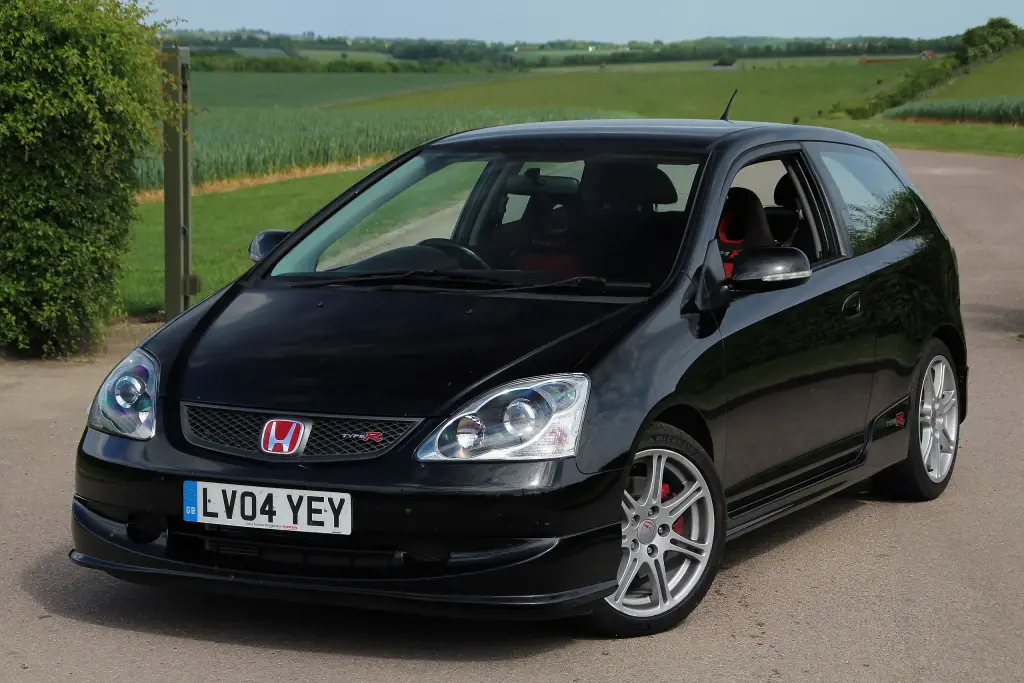
In 2001 Honda introduced the next Civic Type R as a unique three-door hatchback for the UK market, made in Swindon, England. The European car had a 2.0-litre i-VTEC engine of 200 PS, a six-speed gearbox, seam welding and bigger brakes, but not the helical differential or red Recaro seats of the EK9. Honda also marketed a Japanese version, also built in Swindon, that kept the differential and the Recaros and added a more powerful 215 PS engine with a balanced crankshaft, high-lift camshafts and a different intake and exhaust. A facelift in 2003 gave quicker steering, revised suspension, a lighter clutch and flywheel and projector headlamps, in response to criticism of understeer at the limit, numb steering and a lack of low-end torque. A total of 25,798 were built. A 30th Anniversary Edition in 2003 was limited to 300 cars, 100 in each of three colours, and in the final production year, 2005, 132 left-hand-drive cars were painted Vivid Blue Pearl.
FD2 and FN2: two cars for two markets
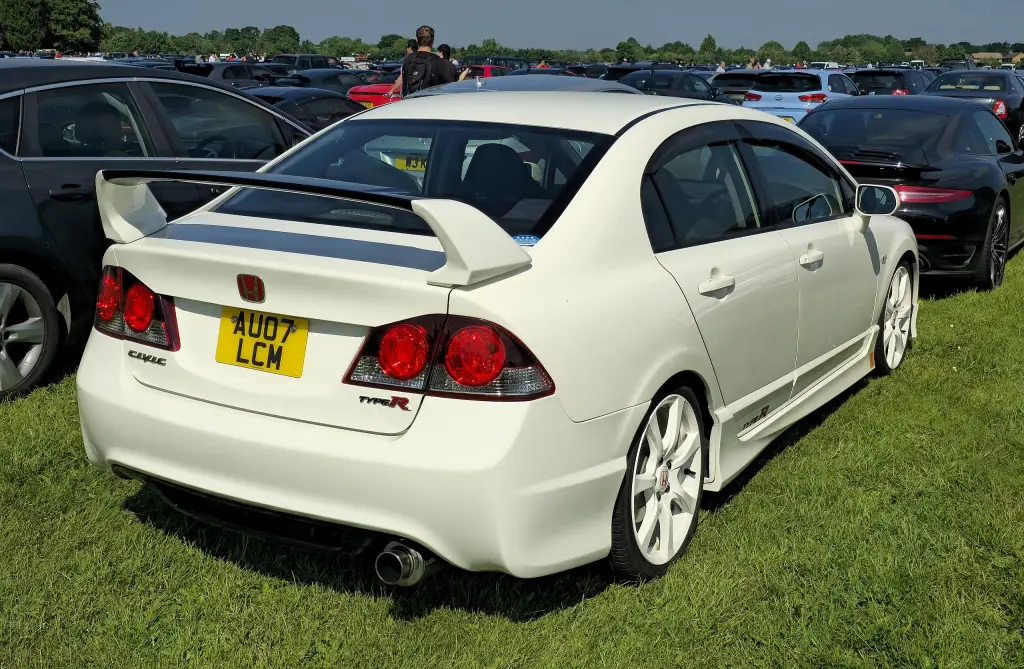
The third generation came as two distinct models. The Japanese FD2 went on sale on 30 March 2007 and was the first Japanese Civic Type R sold as a four-door saloon. It was bigger, wider and heavier than the EP3, with the wheelbase growing from 2,570 to 2,700 mm, and had a 225 PS engine at 8,000 rpm, a six-speed gearbox, a helical differential and 320 mm front discs with four-piston Brembo calipers. It had independent rear suspension, and aluminium was bonded with adhesive to save weight. Honda said the chassis was 50% more rigid than that of the earlier pre-facelift Integra Type R. The red-and-black seats were no longer made by Recaro but by Honda. The European FN2 was a hatchback with a torsion-beam rear axle and 201 PS at 7,800 rpm. In a wet test on the British TV programme Fifth Gear the FD2 was three seconds quicker than the FN2 around Castle Combe.
Production of the FD2 ended in August 2010 after 14,062 cars, because it could not meet upcoming emission requirements. Honda also built 300 Civic Mugen RR cars for Japan in Milano Red, with carbon-fibre bumpers, an aluminium bonnet and 240 PS.
Design and features
- Engine: a high-revving naturally aspirated four with VTEC, in the EK9 one of the highest outputs per litre of its time.
- Chassis: seam-welded body, helical limited-slip differential and a close-ratio manual gearbox.
- Look: red Honda badge, red-and-black bucket seats and Championship White paint.
Honda Civic Type R versions
- EK9 (1997–2000): the Japan-only first Civic Type R.
- EP3 (2001–2005): the Swindon-built hatchback for Europe and Japan.
- FD2 (2007–2010): the Japanese four-door saloon.
- FN2 (2007): the European hatchback.
- Mugen RR (2007): 300 tuned cars for Japan.
The Type R name began on the NSX; see the Honda NSX, and its stablemates the Honda Integra and Honda S2000. For the plain car, see the Honda Civic, and for more, our Honda collection.
Sources
- Honda Civic Type R, English Wikipedia: EK9, EP3, FD2 and FN2 history and figures
- Honda Civic Type R, German Wikipedia: cross-check of the first two generations