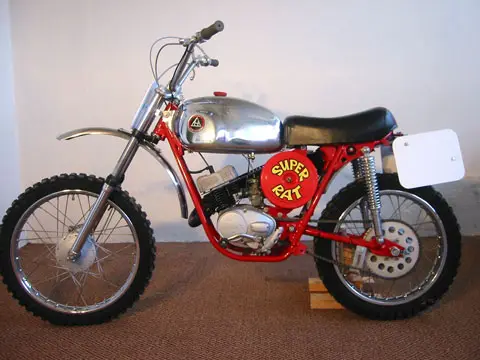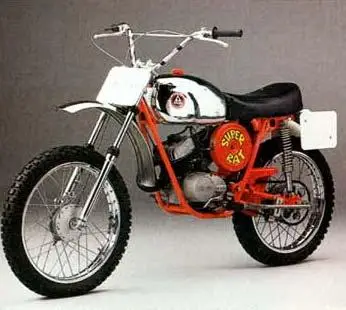
The Hodaka Wombat of 1972 was the small American-Japanese firm’s step up to 125 cm³. With a further increase in power it became the most capable of the marque’s trail bikes, and in 1973 the official United States team for the International Six Days Trial was entered on Hodakas.
Hodaka Wombat at a glance
| Maker | Hodaka, built in Nagoya, Japan, for Pabatco, Athena, Oregon |
|---|---|
| Introduced | 1972 |
| Engine | 125 cm³ single-cylinder two-stroke |
| Place in the range | step up in power from the 100 cm³ models |
| Competition version | Combat Wombat |
| Related racer | Super Combat, a 125 cm³ motocross machine |
| 1973 Six Days | official US team entered on Hodaka |
| 1973 endurance ride | Frank Wheeler, 10,000 miles around Australia in 21 days |
| Maker closed | 1979 |
Based on one source: the German Wikipedia article on Hodaka, the only Wikipedia page on the marque (the English “Hodaka” page is a disambiguation page). No free photographs of the Wombat were found, so the article uses the existing picture.
History of the Hodaka Wombat
A bigger engine for a growing range
Hodaka had begun in 1964 with a single model, the 90 cm³ Ace 90, and had grown by enlarging and developing it: a 100 cm³ Ace arrived in 1968, followed by the Super Rat motocross bike, the Dirt Squirt and the Road Toad. In 1972 a further increase in power produced the Wombat, built around a 125 cm³ engine and the most powerful of the firm’s trail bikes to that point.
Racing and the 1973 Six Days
As with the earlier models, a competition version followed: the Wombat prepared for racing was called the Combat Wombat, and a separate 125 cm³ motocross machine, the Super Combat, was also offered. The results gave the marque enough standing that for the International Six Days Trial held in the United States in 1973 the official American team was entered on Hodakas.
Hodaka was never a large manufacturer. The engines were made and the machines assembled by the Hodaka Engineering Co. in Nagoya, while the design and the testing were done by the importer Pabatco in Athena, Oregon, a company that had begun in 1961 trading fertiliser and grain and had taken up motorcycle imports almost by accident. Production stayed deliberately simple: one basic model at a time, one colour, and no annual model years.
The same year Frank Wheeler rode 10,000 miles around Australia in 21 days on a Hodaka. Sales rose again after these feats, and the company responded by putting more models on the market, including the 250 cm³ ED 250 of 1975 with electronic ignition and light-alloy wheels, and its road-legal derivative, the 250 SL.
The end of Hodaka
Hodaka closed in 1979. It can be argued whether the firm actually started the trail-bike boom, but it certainly brought many people into motor sport with an affordable and competitive machine. Several things went wrong at once: Hodaka failed to adopt new technology and so could not hold out against much larger competitors, while those rivals could subsidise their off-road models from profits on street motorcycles and flood the market. The recession of the late 1970s and an unfavourable exchange rate finally led Shell to end the contract with Hodaka in Japan, and the factory equipment was sold to Daelim in Korea.
Design and features
- 125 cm³ two-stroke single: the largest engine in the Hodaka trail range of the early 1970s.
- Competition derivative: the Combat Wombat was the racing version of the same machine.
- Six Days pedigree: the official US team rode Hodakas at the 1973 International Six Days Trial.
- Proven over distance: 10,000 miles around Australia in 21 days, ridden by Frank Wheeler.
- Simple, cheap formula: the same robust layout and single colour that had built the marque.
Hodaka Wombat versions
- Wombat (1972–): the standard 125 cm³ trail bike.
- Combat Wombat: competition version of the Wombat.
- Super Combat: 125 cm³ motocross machine of the same period.
- Later 125s: the range was extended after 1973 with further models.
The Wombat grew out of the 100 cm³ Hodaka Ace 100, which had replaced the original Hodaka Ace 90. More machines are in the Hodaka collection.
Sources
- Hodaka, German Wikipedia: Wombat and Combat Wombat, 1973 Six Days, Australian ride, later models, closure in 1979