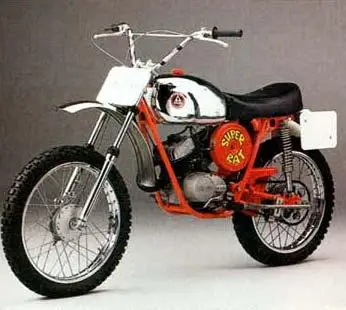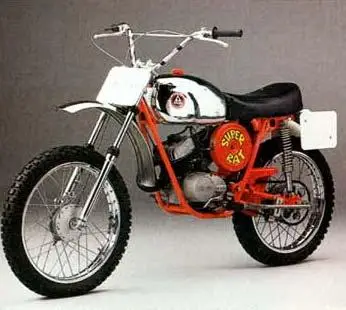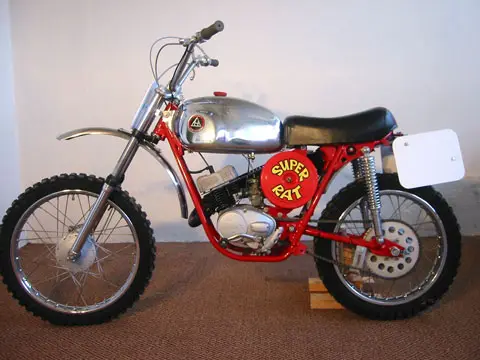
The Hodaka Ace 100 replaced the company’s only model in 1968, the engine growing from 90 to 100 cm³ and the gearbox from four speeds to five. It was the machine with which Hodaka won at Daytona and from which the Super Rat motocross bike was developed.
Hodaka Ace 100 at a glance
| Maker | Hodaka, built in Nagoya, Japan, for Pabatco, Athena, Oregon |
|---|---|
| Production | from 1968 |
| Replaced | Hodaka Ace 90 |
| Engine | 100 cm³ single-cylinder two-stroke |
| Change from Ace 90 | 90 to 100 cm³ |
| Gearbox | five-speed (Ace 90: four) |
| Top speed quoted | over 160 km/h |
| 1968 race result | Harry Taylor won the over-100 cm³ class at Daytona |
| Motocross version | Ace 100 MX, the Super Rat, from 1969 |
| Other 100 cm³ models | Dirt Squirt motocross, Road Toad trail bike |
Based on one source: the German Wikipedia article on Hodaka, the only Wikipedia page on the marque (the English “Hodaka” page is a disambiguation page). No free photographs of the Ace 100 were found, so the article uses the existing picture.
History of the Hodaka Ace 100
From the Ace 90
Hodaka’s first motorcycle, the Ace 90, arrived in 1964 and was the only model the firm offered. Its success in competition and the requests of customers persuaded Hodaka in 1968 to enlarge the engine from 90 to 100 cm³ and to fit a five-speed gearbox in place of the four-speed unit of the original. Because the company still wanted to sell a single model rather than a range, the Ace 100 replaced the Ace 90 completely.
The firm behind the badge was not a conventional motorcycle maker. Pabatco, the Pacific Basin Trade Company, was founded in Athena, Oregon, in 1961 as a branch of the Farm Chemicals of Oregon and traded in fertiliser and grain; it came into motorcycles by importing Japanese Yamaguchi machines to work around currency restrictions on American wheat. When Yamaguchi went bankrupt in 1963, Pabatco turned to the Hodaka Engineering Co. of Nagoya, which had supplied the engines and still had about 300 in stock, and asked it to build complete motorcycles to American ideas of what a trail bike should be. Development and testing were done in Athena, manufacture in Japan, and every machine was painted red to keep parts stocks simple.
Daytona, 1968
The new capacity brought results on the track. In 1968 Harry Taylor won the class over 100 cm³ at the Daytona road races and broke every record in that class. With a top speed of more than 160 km/h he beat even the two-cylinder Yamahas — a striking outcome for a small firm whose machine had been designed as a simple, cheap trail bike.
The Super Rat and the rest of the family
In 1969 Hodaka built the Ace 100 MX, a motocross machine that used the familiar chassis with a further developed engine and improved suspension. It was sold as the Super Rat, was successful in competition and became a strong seller in its own right.
The 100 cm³ engine also served two other models. The Dirt Squirt was a motocross version of the 100, and the Road Toad was a 100 cm³ machine intended for off-road use. The line was widened further in 1972, when a more powerful 125 cm³ engine produced the Wombat, and the firm continued to add models until its closure in 1979.
Design and features
- More capacity: the engine grew from 90 to 100 cm³ for the 1968 season.
- Five-speed gearbox: one more ratio than the Ace 90, useful on the dirt and on the road.
- Proven speed: over 160 km/h in racing trim at Daytona in 1968.
- Competition basis: the same chassis and engine family produced the Super Rat motocross bike.
- Whole family: the 100 cm³ unit also powered the Dirt Squirt and the Road Toad.
Hodaka Ace 100 versions
- Ace 100 (1968–): the standard trail bike, 100 cm³, five speeds, red.
- Ace 100 MX / Super Rat (1969–): motocross machine with a developed engine and better suspension.
- Dirt Squirt: 100 cm³ motocross model.
- Road Toad: 100 cm³ machine for off-road use.
- Successors in the range: the 125 cm³ Wombat of 1972 and its descendants.
The Ace 100 replaced the Hodaka Ace 90, and the 125 cm³ Hodaka Wombat followed it in 1972. More machines are in the Hodaka collection.
Sources
- Hodaka, German Wikipedia: Ace 100 development, Daytona result, Super Rat, Dirt Squirt and Road Toad