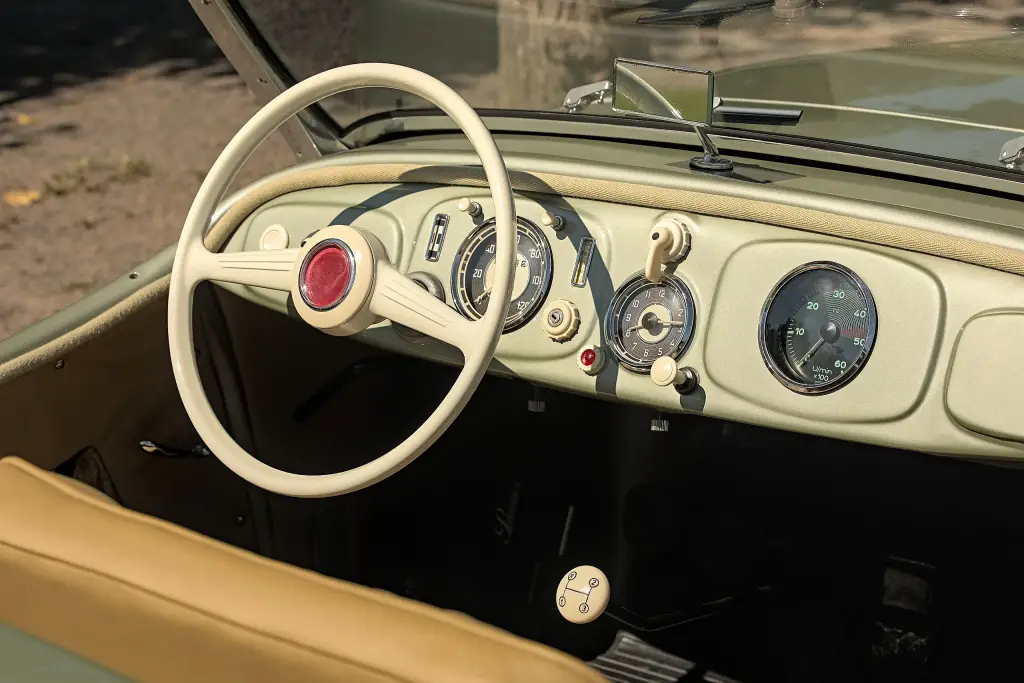
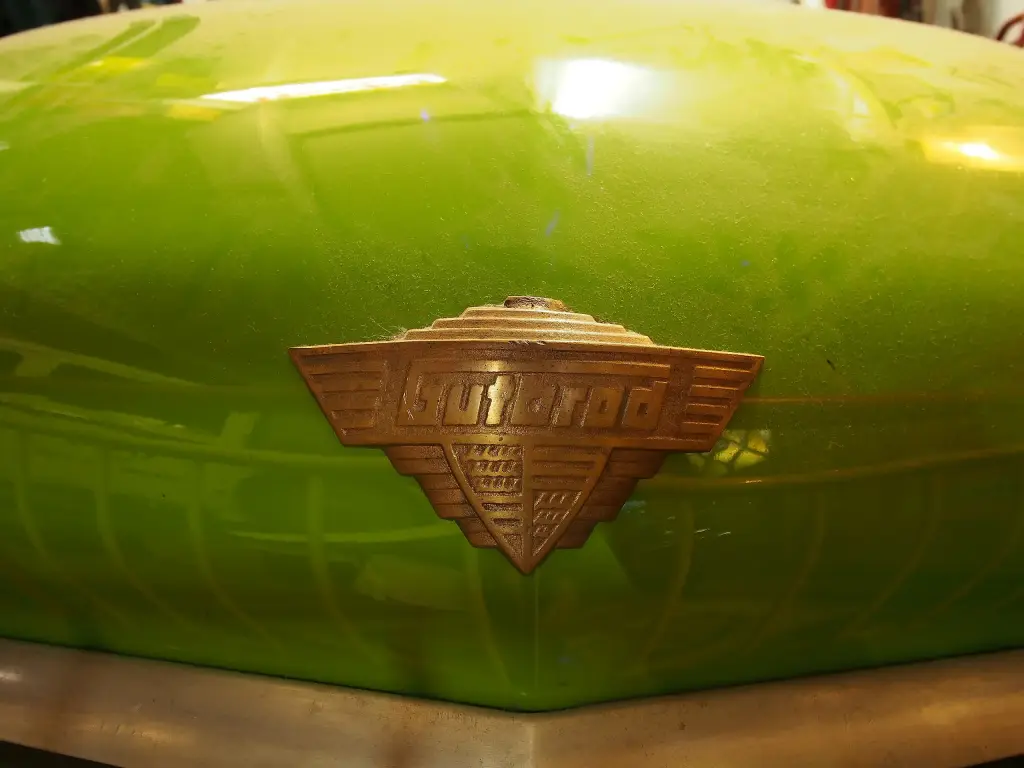
The Gutbrod Superior was a small two-seat car built by the German maker Gutbrod between 1950 and 1954. Its ponton body, front-wheel drive and two-stroke engine were ordinary for the class; what set it apart was a mechanical petrol direct-injection system developed with Bosch, which went into production in 1951.
Gutbrod Superior at a glance
| Maker | Gutbrod Motorenbau, Plochingen and Calw |
|---|---|
| Production | 1950–1954 |
| Built | 6,860 cabriolet saloons and 866 estates (7,726 in all) |
| Body | two-seat ponton cabriolet saloon; three-door estate from 1952 |
| Engine 600 | water-cooled two-cylinder two-stroke, 593 cc, 20–22 PS |
| Engine 700 | 663 cc, 26 PS on a carburettor, 30 PS with direct injection |
| Transmission | three-speed manual, front-wheel drive |
| Chassis | forked central-tube frame, independent suspension |
| Brakes | hydraulic drum brakes on all wheels |
| Top speed | 100–115 km/h |
| Also built | Superior-Sport roadster with Wendler body, twelve cars |
History of the Gutbrod Superior
In November 1949 a pilot series of the cabriolet saloon Superior 600 was built in Plochingen, and in July 1950 regular series production began at the Calw division. The standard model stayed on offer until April 1954. The cabriolet was shown at the 1950 Frankfurt Spring Fair, but the public showed little interest in it. The Superior-Sport, an expensive roadster with a Wendler body, was no more successful despite a price below DM 8,000, and only twelve were built in 1951 and 1952. Of a four-seat saloon announced for 1954 only two prototypes were completed. In April 1954 car production stopped for lack of funds and the Calw and Plochingen divisions were sold to Bauknecht.
Under Hans Scherenberg, Gutbrod worked with Robert Bosch on a mechanical petrol direct-injection system of its own, at the same time as Goliath developed a similar one. Both makers showed injected models at the 1951 Frankfurt motor show and are regarded as the world’s first manufacturers of series-production cars with petrol direct injection. Production of the Superior 700 E began in September 1951.
The ponton body of the small notchback cabriolet saloon sat on a central-tube frame that forked towards the front. There were two seats and at first two doors hinged at the rear; from 1951 the doors were hinged at the front and the interior was carpeted. In the first version the boot could only be reached from inside, later it gained a lid, and in 1952 a three-door estate was added. Karosseriewerke Weinsberg made the cabriolet bodies and Westfalia the estate bodies. All wheels were independently sprung — double control arms, coil springs and telescopic dampers at the front, a swing axle with coil springs and dampers at the rear — and experiments with transverse leaf springs at the front had not given satisfactory results. Hydraulically operated drum brakes were standard.
The 600 had a water-cooled two-cylinder two-stroke engine of 593 cc (71 × 75 mm) mounted longitudinally in front, rated at 20 to 22 PS at 3,250 rpm; the 600 Luxus was the better-equipped version. In 1952 came the 700 Luxus with a 663 cc engine (75 × 75 mm) and 26 PS at 4,300 rpm, and alongside the carburettor engine Gutbrod offered the direct-injection unit at 30 PS and the same engine speed. Every model had a single dry clutch, an unsynchronised three-speed gearbox and front-wheel drive; in 1953 the 700 cc cars received synchromesh on second and third. The 600 used 7.5 litres of two-stroke mixture per 100 km and reached 100 km/h. The 700 Luxus took 7.5 litres with a carburettor and 7.0 litres with injection and a separate autolube system, and its cabriolets ran at 110 and 115 km/h, the estates at 100 and 105 km/h. Production came to 7,726 cars.
Motorsport added to the model’s reputation. In 1953 two Superiors started the first ADAC 1000 km race, the 6 Hours of the Nürburgring, in a field of 51 mostly far more powerful cars. Both lasted the distance and finished 26th and 27th, last but classified, with 37 of 44 laps and 843.6 km covered in 10:34:23 and 10:35:23, an average of 79.8 and 79.7 km/h. In the 48-hour winter drive to Oberstdorf in 1954 Wolfgang Gutbrod and Heinz Schwind finished second in all categories in a Superior and won the ADAC silver cup and a gold medal.
Design and features
- Petrol direct injection: a mechanical Bosch system that made the 700 E one of the first series cars with direct injection, at 30 PS instead of 26.
- Two-stroke twin: a water-cooled 593 or 663 cc engine driving the front wheels through a three-speed gearbox.
- Central-tube frame: a forked backbone chassis with independent suspension and hydraulic drum brakes.
- Small-car bodywork: a two-seat cabriolet saloon from Weinsberg and, from 1952, a Westfalia estate.
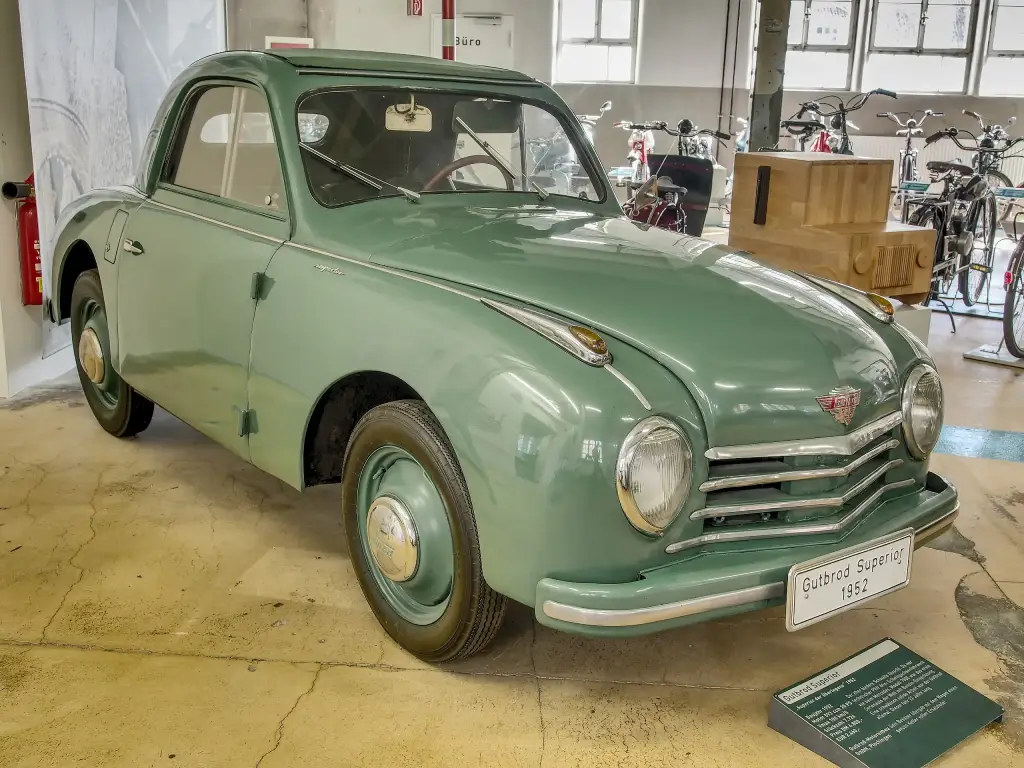
Gutbrod Superior versions
- Superior 600 (1950–1954): the standard cabriolet saloon, 593 cc and 20–22 PS.
- 600 Luxus: the same car with a more luxurious interior.
- 700 Luxus (1952): 663 cc and 26 PS, with synchromesh on second and third from 1953.
- 700 E (from September 1951): the direct-injection version, 30 PS, with separate lubrication.
- Estate (1952): a three-door body built by Westfalia, 100 or 105 km/h.
- Superior-Sport (1951–1952): a Wendler-bodied roadster at under DM 8,000, twelve built.
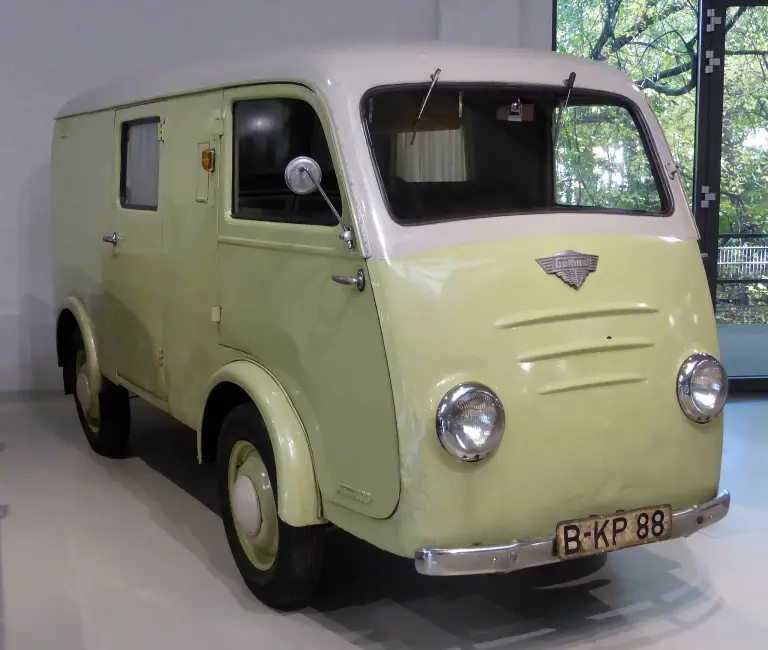
Gutbrod also built the Atlas light van on a separate rear-engined layout. More vehicles are in the Gutbrod collection.
Video: Gutbrod Superior: Durch das Ruhrtal
Video on YouTube.
Sources
- Gutbrod Superior, English Wikipedia: production, body, engines, motorsport
- Gutbrod Superior, German Wikipedia: model history, production total, dimensions