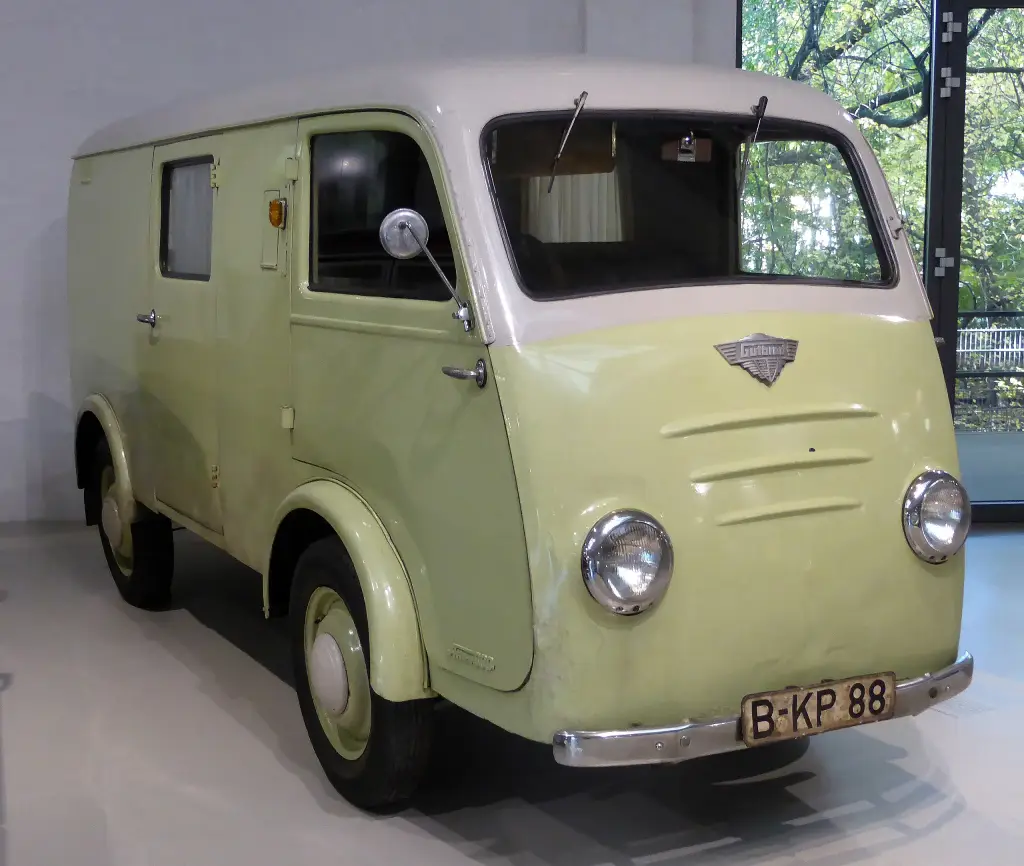
The Gutbrod Atlas was a light panel van and pickup truck built by the Calw division of Gutbrod Motorenbau from 1950 to 1954. Its cab sat over the front axle, the air-cooled two-stroke engine was mounted at the rear, and payload ran from 700 to 1,000 kg depending on the version.
Gutbrod Atlas at a glance
| Maker | Gutbrod Motorenbau, Calw |
|---|---|
| Production | 1950–mid 1954 |
| Built | 10,906 |
| Bodies | pickup, panel van and special bodies |
| Payload | 700, 800 or 1,000 kg |
| Engine | rear-mounted air-cooled two-cylinder two-stroke, 576 cc, later 662 cc |
| Second engine | 987 cc three-cylinder, 28 PS, from February 1953 |
| Power | 16 PS at first, 19 PS from 1953 |
| Top speed | 70 km/h |
| Fuel tank | 27 litres |
| Gearbox | unsynchronised three-speed manual |
| Price in 1950 | 4,980 DM for the pickup |
History of the Gutbrod Atlas
A pilot series was built in late 1949 and regular production began at Calw in 1950. The layout followed the fashion of the period for light commercial vehicles: a steel cab-over cab with a single-piece windscreen and rear-hinged doors, which made the Atlas look much like the Tempo Matador, the Tempo Wiking and the Goliath GV 800. It also competed with the Volkswagen T1. The standard pickup had a load bed 2,600 mm long and 1,750 mm wide, on a vehicle 4,150 mm long with a 2,200 mm wheelbase, and in 1950 it cost 4,980 DM — about 700 DM less than the similarly powered Goliath GV 800.
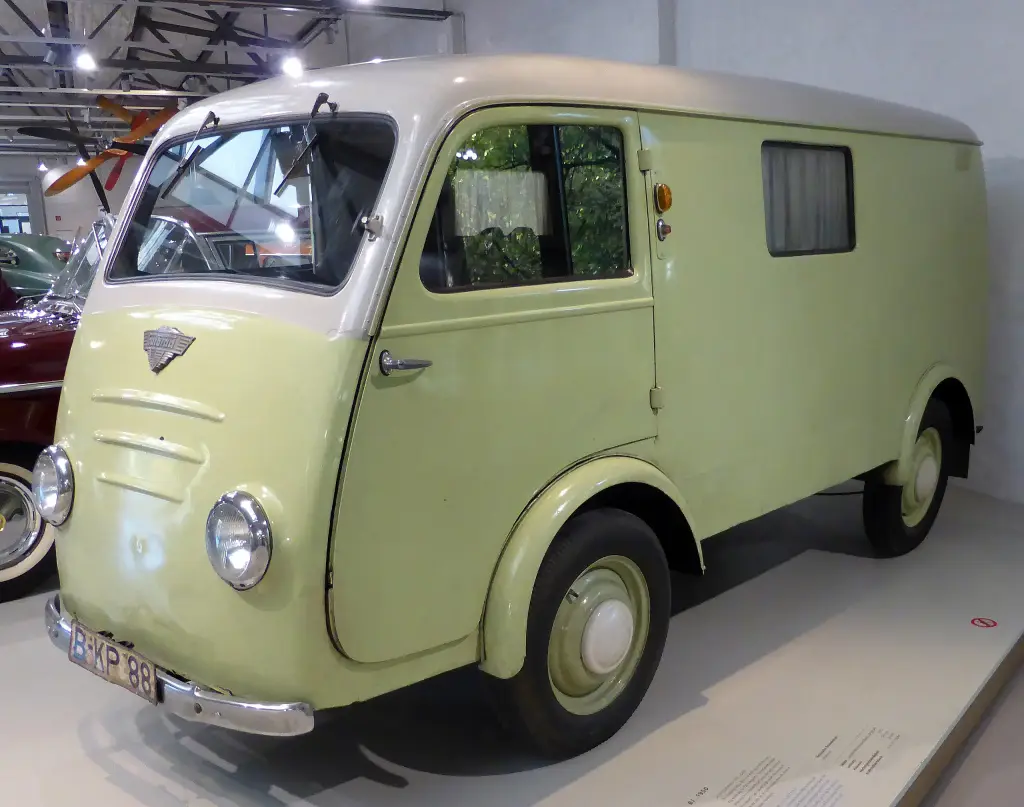
The chassis used a central-tube frame, with double transverse leaf springs at the front and a swing axle on coil springs at the rear. Shock absorbers were fitted at the front only. The track measured 1,300 mm in front and 1,330 mm behind, the tyres were 5.50×16 (6.00×16 on the Atlas 1000), the turning circle 9.6 m, and the 400 mm steering wheel worked at a ratio of 11:1. A 6-volt starter drew on a 75 Ah battery. The first versions had mechanically operated brakes; from February 1953 they were hydraulic.
Power came from a rear-mounted, air-cooled two-stroke engine with reverse scavenging. The original two-cylinder unit, designed by Adolf Schnürle, displaced 576 cc (70 × 75 mm) and gave 16 PS at 3,500 rpm; in 1953 it grew to 662 cc and 19 PS at the same speed. From February 1953 a three-cylinder of 987 cc and 28 PS at 4,000 rpm was also available. Fuel consumption of the twins was about 9.5 to 10 litres per 100 km of mixture at a 1:25 oil ratio, and top speed was 70 km/h. Every Atlas had an unsynchronised three-speed gearbox. Gutbrod’s advertising made much of the engine grouped over the rear axle, which with the forward cab was said to give even weight distribution when running empty and better grip on wet roads and hills, and to save the losses of a long propeller shaft.
The range was revised twice. The Atlas 800 of January 1950 was followed by the 800/H in February 1953 and by the 1000 in June 1951 and the 1000/3 in February 1953; the lighter Atlas 700 arrived in June 1953 and stayed until the end. In April 1954 Gutbrod went bankrupt and vehicle production came to an end, after 10,906 Atlas vans and pickups had been built.
Design and features
- Rear engine: an air-cooled two-stroke mounted behind the rear axle, with no propeller shaft, promoted by Gutbrod for traction and weight distribution.
- Cab-over cab: a steel cab with a one-piece windscreen and rear-hinged doors, in the style of the Tempo Matador and Goliath GV 800.
- Useful load bed: 2.6 m long and 1.75 m wide on the standard pickup, with payloads from 700 to 1,000 kg.
- Simple chassis: central-tube frame, leaf springs in front and a swing axle behind, with brakes upgraded to hydraulic in 1953.
Gutbrod Atlas versions
- Atlas 800 (January 1950–February 1953): the original 800 kg two-cylinder model.
- Atlas 1000 (June 1951–mid 1954): the 1,000 kg version on 6.00×16 tyres.
- Atlas 800/H and 1000/3 (February 1953–mid 1954): revised models with hydraulic brakes and the larger two-cylinder engine.
- Atlas 700 (June 1953–mid 1954): the lightest version, added at the end of the run.
- Bodies: pickup, panel van and various special bodies on the same chassis.
Gutbrod’s passenger car of the same years was the Superior. More vehicles are in the Gutbrod collection.
Video: Gutbrod Atlas 800 Vischer Häuschen
Video on YouTube.
Sources
- Gutbrod Atlas, English Wikipedia: payloads, dimensions, equipment, versions
- Gutbrod Atlas, German Wikipedia: engines, chassis, prices, production