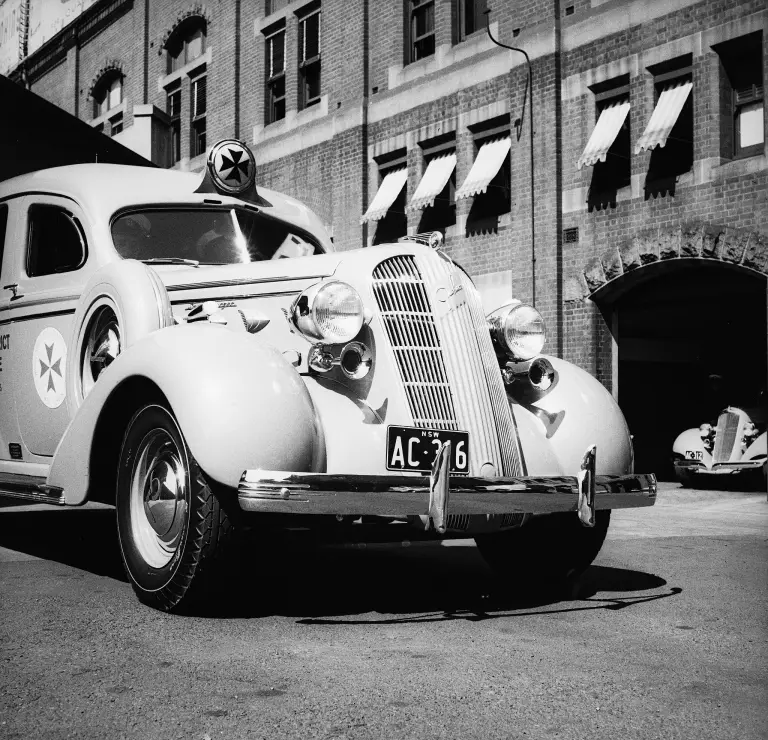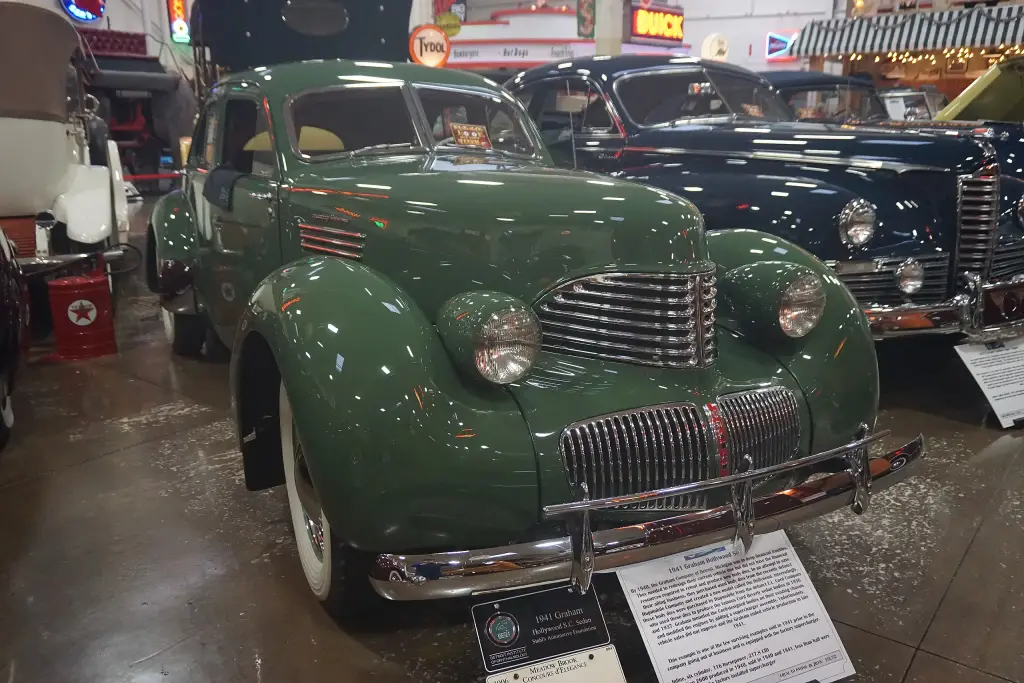
The Graham Hollywood was one of the last automobiles to carry the Graham name. It belonged to the “Spirit of Motion” generation that Graham-Paige introduced for 1938, and like those cars it is frequently and incorrectly said to have used a Continental engine.
Graham Hollywood at a glance
| Maker | Graham-Paige, Detroit, Michigan |
|---|---|
| Company founded | 1927, when the Graham brothers bought Paige-Detroit |
| Model | Graham Hollywood |
| Body | four-door sedan |
| Era | the end of Graham’s “Spirit of Motion” styling period |
| Styling theme | slanted grille, fenders and wheel arches that suggest motion at rest |
| Design origin | the 1938 Graham design begun by Amos Northup of Murray Body |
| Engine | Graham’s own 217 cu in six, not a Continental design |
| Continental’s role | castings for Graham engines; a lesser version of the 217 was built after the war for Kaiser and Frazer |
| Car production ended | 1940 |
| Corporate name until | 1962 |
The Hollywood has no separate Wikipedia article; this page is built from the Graham-Paige brand article in English, German and French, so it covers the model only as far as those pages do. Based on the brand pages alone.
History of the Graham Hollywood
From trucks to cars
The three Graham brothers, Joseph B., Robert C. and Ray A., came to car making through trucks: from 1919 they sold kits that turned Ford Model Ts and TTs into light lorries, then built their own trucks with Dodge engines, sold through Dodge dealers. Dodge bought the truck business in 1925, and when the banking syndicate controlling Dodge looked for a buyer for the company in 1927, the brothers chose to enter the automobile business on their own. They bought the Paige-Detroit Motor Car Company, makers of Paige and Jewett cars, for $3.5 million. Joseph became president, Robert vice-president and Ray secretary-treasurer.
Graham-Paige built most of its own bodies and engines. The brothers solved a long-standing Paige problem by buying the Wayne Body Company in Wayne, Michigan, and expanding it with other body plants. They had no foundry, so Continental supplied castings, and a few models used Continental stock engines; but Graham’s own engineering department designed most of the engines the cars used.
The Spirit of Motion
The design that led to the Hollywood was drawn up for 1938. Amos Northup of Murray Body was hired to create it but died before the work was complete, and Graham-Paige engineers most probably finished it. The car was launched under the slogan “Spirit of Motion”: fenders, wheel arches and radiator grille all leaned forward so that the car looked as if it were already travelling at speed while standing still. The American press and designers praised the shape, and it won the Concours d’Élégance in Paris.
The Hollywood stands at the end of that line. Graham’s automobile production ceased in 1940, and the Hollywood, catalogued as a 1941 model in museum collections, is remembered as one of the company’s final cars. The automotive assets went to Kaiser-Frazer in 1947, while the Graham-Paige name survived as a corporation until 1962.
The engine question
The 1938–1940 Spirit of Motion cars and the Hollywood models are often described as Continental-engined, and the mistake has been repeated so often that it has become the default explanation. In fact Graham designed its own engines and only used Continental for foundry work. After the Second World War, Continental produced a lesser version of Graham’s 217-cubic-inch engine, and that unit went into the post-war Kaiser and Frazer cars — which is probably where the confusion began.
Design and features
- Forward-leaning styling: the Spirit of Motion theme of a grille, fenders and wheel arches that all point the same way.
- Graham’s own six: a 217 cu in engine designed in-house, with Continental supplying castings rather than the design.
- Sedan body: a four-door saloon, the body style in which the Hollywood survives in collections.
- The end of the line: a car from the last years of Graham-Paige as an automobile manufacturer.
Graham Hollywood versions
- Hollywood sedan: the four-door body, the version recorded in museum collections as a 1941 car.
- Spirit of Motion cars (1938–1940): the aerodynamic Grahams that came immediately before the Hollywood.
- Late Graham sixes: cars of the final generation, using the Graham-designed 217 cu in engine.
The supercharged Grahams that preceded the Hollywood are described in Graham Supercharged. More cars of the marque are in the Graham collection.
Video: Dick Raczuk’s 1941 Graham Hollywood
Video by KOUL TOOLS on YouTube.
Sources
- Graham-Paige, English Wikipedia: history, engineering, Spirit of Motion, engine
- Graham-Paige, German Wikipedia: Spirit of Motion design, company history
- Graham-Paige, French Wikipedia: founding, end of production