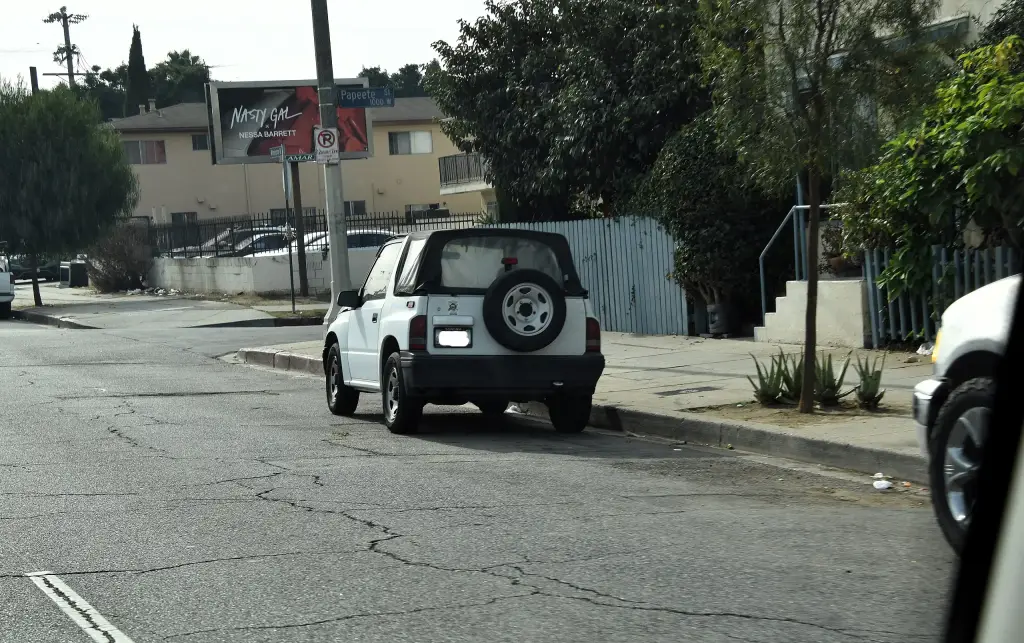
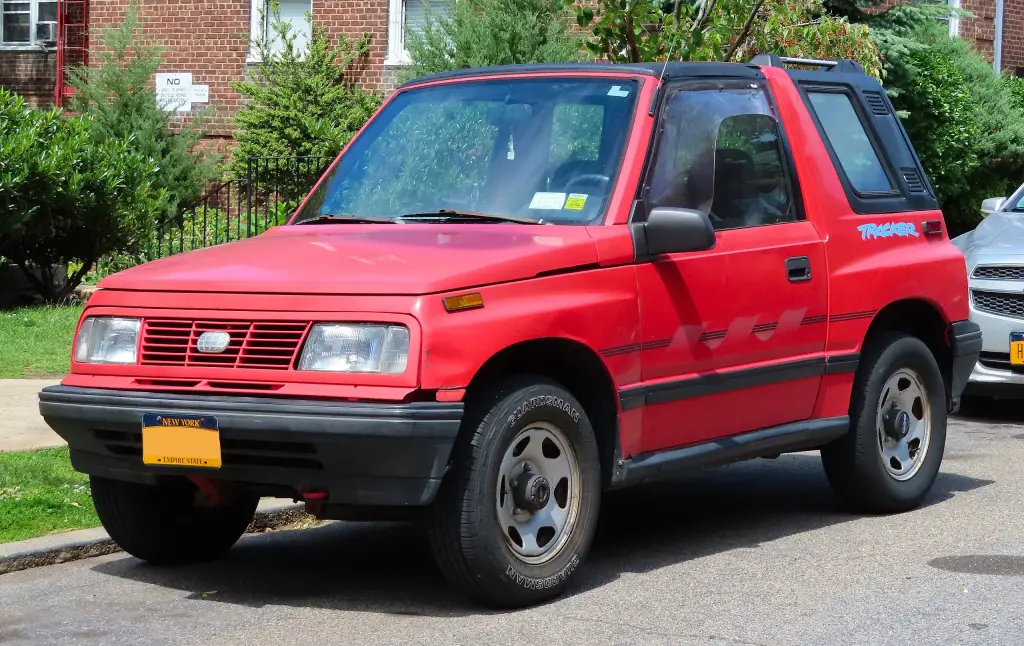
The Geo Tracker was a mini SUV introduced in late 1988 as a 1989 model and built by CAMI Automotive, the joint venture of General Motors of Canada and Suzuki in Ingersoll, Ontario. Essentially the same car as the Suzuki Sidekick, it was sold as a convertible, a two-door hardtop and, from 1996, a four-door wagon, and it was rebadged as a Chevrolet in 1998.
Geo Tracker at a glance
| Maker | Geo (General Motors), built by CAMI with Suzuki |
|---|---|
| Production | 1989–1998 (first generation) |
| Twin model | Suzuki Sidekick (Escudo) |
| Built at | CAMI, Ingersoll, Ontario; early cars in Japan |
| Engine, 1989 | 1.6 L SOHC four-cylinder, 80 hp (60 kW) |
| Engine, 1996 four-door | 1.6 L G16B 16-valve, 96 hp (72 kW) |
| Body styles | two-door convertible, two-door hardtop, two-door XL bed, four-door wagon from 1996 |
| Drive | four-wheel drive; two-wheel drive from 1992 |
| Trim levels, 1989 | base convertible, base hardtop, XL bed, LSi hardtop |
| Nameplate | Geo to 1997, Chevrolet from 1998 |
Based on one source (English Wikipedia); the article covers the whole Tracker line, and this page uses its first-generation section.
History of the Geo Tracker
First generation (1989–1998)
The Tracker was developed by CAMI and introduced in late 1988 as a 1989 model, built alongside its almost identical twin, the Suzuki Sidekick. Nearly all 1989 and some 1990 cars were made in Japan and imported because of delays at the Canadian factory; production in Ingersoll began late in 1989 with about 6,100 Trackers finished and annual output projected at around 200,000. At first every Canadian-made Tracker went to the United States to avoid the 25 per cent Chicken Tax, and Canada was supplied entirely from Japan. The original engine was Suzuki’s 1.6-litre single-overhead-cam four, producing 80 hp (60 kW). The 1989 range was a base convertible, base two-door hardtop, two-door XL bed and LSi hardtop, the LSi adding air conditioning, chrome rally wheels, intermittent wipers, a rear wiper, a spare-wheel cover and a three-speed Turbo-Hydramatic automatic. All Trackers were four-wheel drive until a two-wheel-drive convertible arrived in 1992. The two-door hardtop lasted until 1995, when it made way for the four-door wagon introduced for 1996, now with a 96 hp (72 kW) sixteen-valve 1.6. In 1997 the Geo nameplate was merged back into Chevrolet, and from 1998 every Tracker was a Chevrolet.
Canada: Chevrolet, GMC, Asüna and Pontiac
The Geo brand was not available in Canada when the Tracker arrived, so it was sold there as the Chevrolet Tracker and the GMC Tracker from 1989, in base convertible, base hardtop and CL or SLE hardtop forms, with CL and SLE convertibles added for 1990. The Geo marque reached Canada in 1992 and the Chevrolet Trackers were renamed Geo Trackers, though they kept the Chevrolet bowtie on the grille until production ended in 1998. The GMC Tracker became the Asüna Sunrunner for 1992 and 1993, then the Pontiac Sunrunner from 1994 to 1998, offered in two- and four-wheel drive and in convertible and hardtop bodies but never as a four-door.
Design and features
- Truck foundations: a rugged light-truck chassis certified as a light truck, with a conventional front differential and coil-sprung rear axle.
- Real off-road kit: four-wheel drive with a hi-lo, 2-4 transfer case and recirculating-ball steering.
- Durable: the truck-like underpinnings gave a firm ride but notable durability in harsh conditions.
- Open or closed: convertible and hardtop two-doors, plus a four-door wagon from 1996.
- Canadian-built: most cars came from CAMI in Ingersoll, Ontario, a GM and Suzuki joint venture.
Geo Tracker versions
- Base convertible: the open two-door, four-wheel drive until 1992.
- Base two-door hardtop: sold from 1989 to 1995.
- XL bed: a North America-only two-door with four extra inches at the rear and a sealed cab.
- LSi hardtop: the best-equipped early trim, with air conditioning and automatic transmission.
- Four-door wagon (1996–1998): the longer body with the 96 hp sixteen-valve engine.
The Tracker was the off-roader of the Geo range, sold with the Geo Metro and Geo Prizm. More cars are in the Geo collection.
Video: 1992 Geo Tracker walk around
Video on YouTube.
Sources
- Chevrolet Tracker (Americas), English Wikipedia: first generation, Canadian names, engines, production