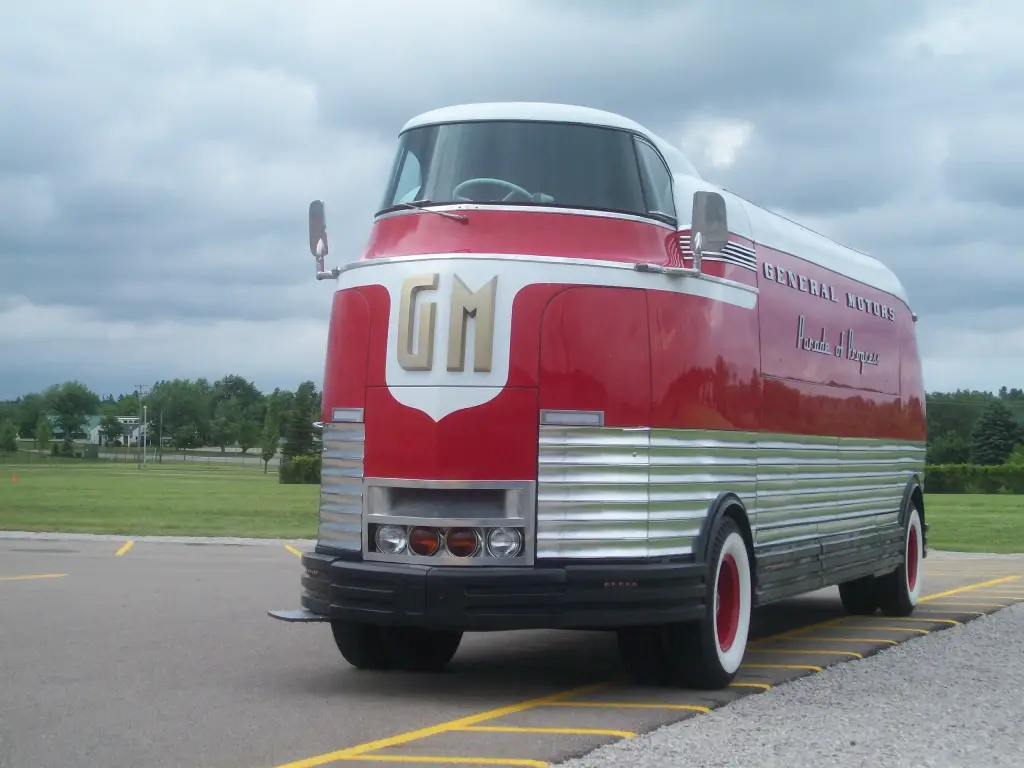
The GM Futurliners were twelve custom vehicles styled by Harley Earl in the 1940s for General Motors. They were the centrepiece of the Parade of Progress, a travelling exhibition that crossed the United States and Canada in 1940–41 and again in 1953–56, promoting future cars and technologies.
GM Futurliner at a glance
| Maker | General Motors |
|---|---|
| Styling | Harley Earl, 1940s |
| Built | 12 |
| Length | 33 ft (about 10 m) |
| Width | 8 ft |
| Height | more than 11 ft |
| Weight | more than 12 tons |
| Original engine | four-cylinder diesel, four-speed manual |
| 1953 engine | GMC straight-six, 302 cu in (4.95 l), 145 hp |
| 1953 transmission | four-speed automatic with gear splitter |
| Top speed (original) | about 40 mph (64 km/h) |
| Parade of Progress | 1940–41 and 1953–56 |
| Survivors | nine known in 2007 |
Based on one source: the English Wikipedia article on the GM Futurliner.
History of the GM Futurliner
Built for the fair, used on the road
The Futurliners were originally manufactured for the 1939 New York World’s Fair and then became the stars of GM’s Parade of Progress, a promotional caravan that travelled a 150-stop route across the United States and Canada. Before them GM had used eight custom Streamliners between 1936 and 1940. The Futurliners, with 32 support vehicles, were driven by 50 college graduates who also staffed the exhibitions along the route.
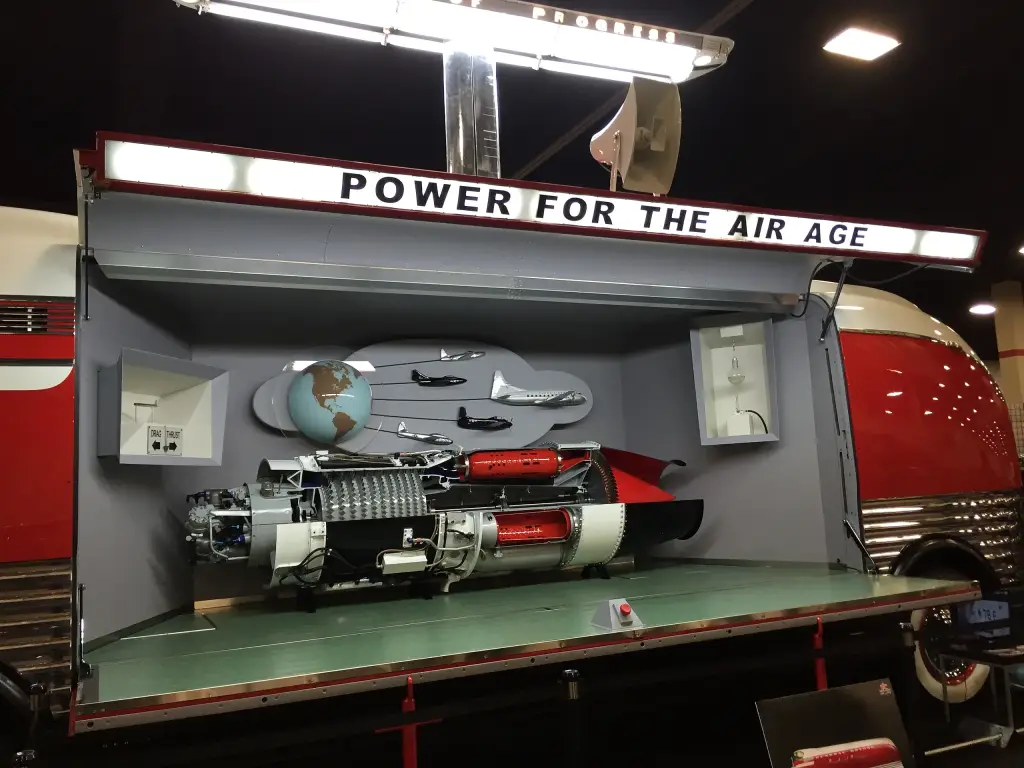
A stage on wheels
At each stop the vehicles were arranged around a large tent and an information kiosk. Every Futurliner had a self-contained stage and a deployable light tower, and each carried an exhibit on a single theme: jet engine technology, agriculture, traffic engineering, stereophonic sound, microwave ovens, television and other innovations. The bodywork was heavily stylized Art Deco streamlining in deep red with a white roof, with large articulated chrome side panels, whitewall tires and a high-mounted driver’s position in the centre of the cab behind a panoramic windshield. Unusually, the front wheels were dual as well as the rear ones.
Interrupted by war, revived in 1953
The parade was interrupted by the Second World War. GM refurbished the vehicles and the Parade of Progress resumed in 1953, starting with rehearsals in Lexington and Frankfort, Kentucky, and premiering in Dayton, Ohio. That tour had 44 vehicles: the 12 Futurliners, 14 trucks and 18 cars. In 1955 a miniature assembly line display called A Car Is Born was built for one of the Futurliners, and a show titled Our American Crossroads, narrated by Parker Fennelly, used an animated diorama of road building from 1902 to 1953. The revived parade ended for the last time in 1956, displaced by network television — one of the very technologies the Futurliners had promoted.
What happened to them
Of the twelve original Futurliners, one was destroyed in a 1956 accident and nine were known to survive as of 2007; the status and location of several are unknown. In 2014 Futurliner #10 was nominated for inclusion in the National Historic Vehicle Register.
Design and features
- Art Deco bodywork: Harley Earl styling, deep red flanks, a white roof and articulated chrome side panels.
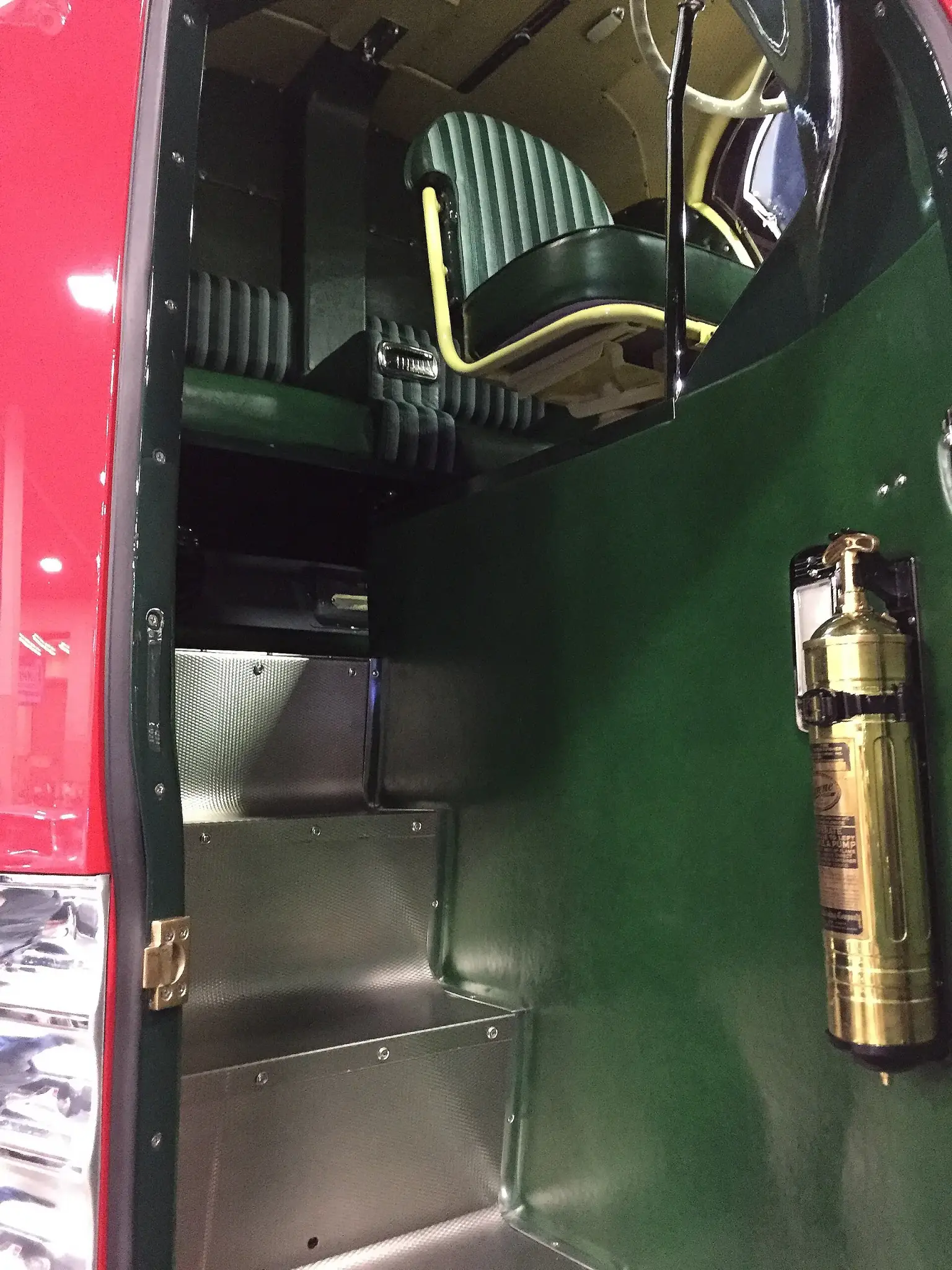
- Command position: the driver sits centrally at the front, with eyes about 10 ft (3 m) above the road, and the cab has room for two passengers.
- Self-contained show: a built-in stage, a light tower and one themed exhibit per vehicle.
- Dual front wheels: a rarely seen technical feature, in addition to the dual rear wheels.
- 1953 refit: six-cylinder engine, automatic transmission, a metal roof over the glass cabin and Frigidaire air conditioning.
GM Futurliner versions
- 1940 original: four-cylinder diesel and four-speed manual, top speed around 40 mph.
- 1953 refurbished: 302 cu in GMC six rated at 145 hp and 262 lb·ft, four-speed automatic with gear splitter, metal roof and air conditioning.
- A Car Is Born (1955): a Futurliner fitted with a miniature automobile assembly line display.
- Our American Crossroads (1955): an animated road-building diorama narrated by Parker Fennelly.
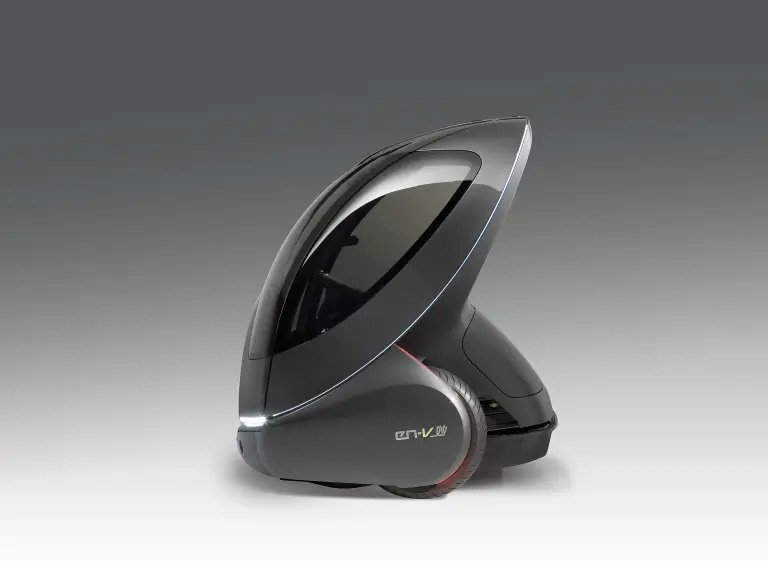
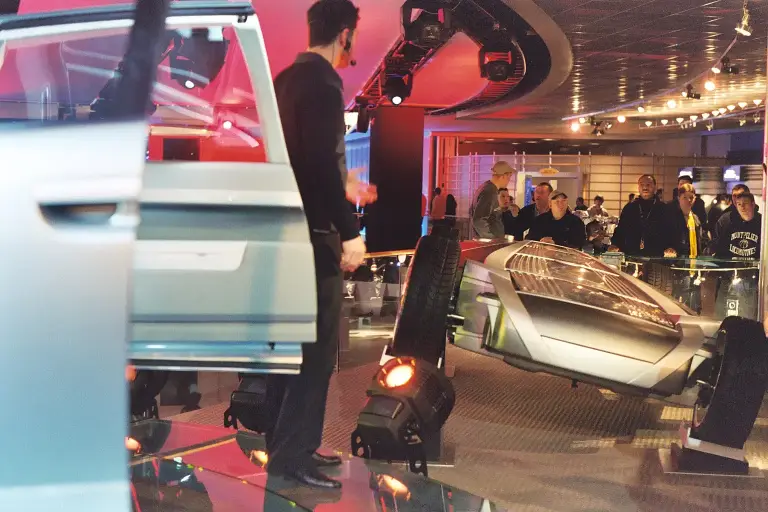
GM’s later technology concepts are described in the articles on the Hy-wire and the EN-V. More General Motors history is in the General Motors collection.
Sources
- GM Futurliner, English Wikipedia: history, dimensions, mechanics, survivors