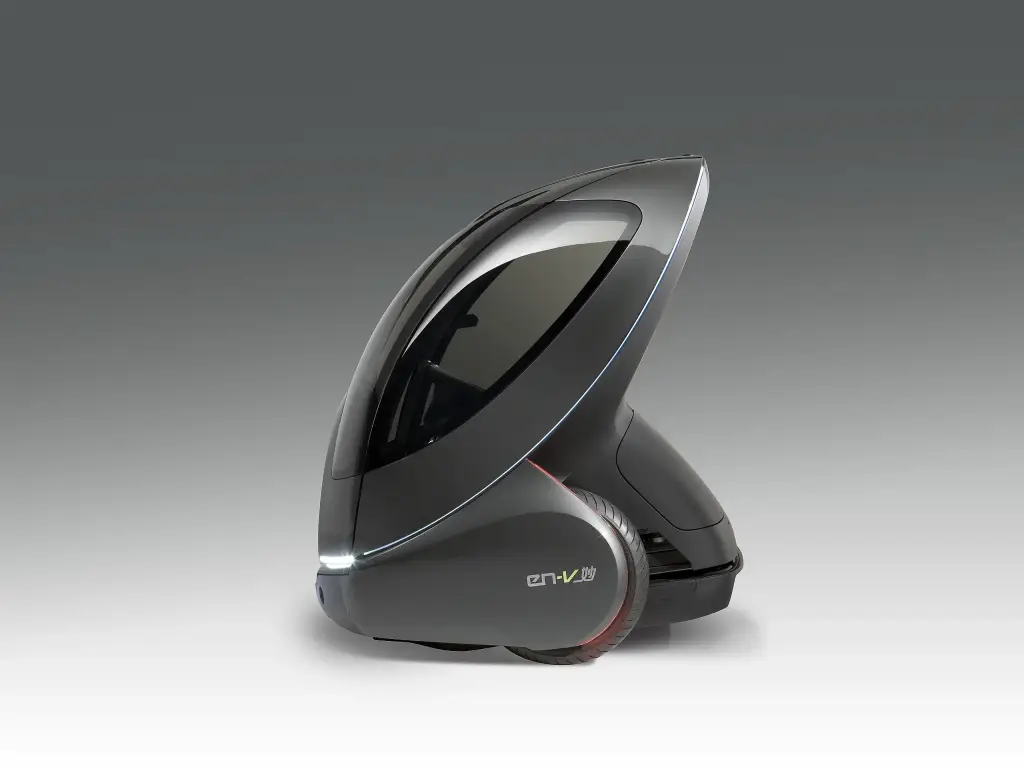
The General Motors EN-V, for Electric Networked-Vehicle, is a two-seat urban electric concept car developed jointly by Segway Inc. and General Motors. It can be driven normally or operated autonomously, and it was unveiled at the joint GM and SAIC pavilion at Expo 2010 in Shanghai.
General Motors EN-V at a glance
| Makers | General Motors and Segway Inc. |
|---|---|
| Unveiled | Expo 2010, Shanghai, 1 May – 31 October 2010 |
| Type | two-seat urban electric concept |
| Seats | 2 |
| Drive | two electric motors, one on each wheel |
| Battery | lithium-ion phosphate |
| Top speed | 40 km/h (25 mph) |
| Range | 40 km (25 mi) |
| Balancing | two-wheeled system developed by Segway |
| Sensors | GPS, short-range radio, optical and ultrasonic sensors, doppler radar |
| Length | 1,500–1,540 mm |
| Width | 1,405–1,425 mm |
| Height | 1,635–1,770 mm |
Based on one source: the English Wikipedia article on the General Motors EN-V. Only one free photograph of the car was available.
History of the General Motors EN-V
From P.U.M.A. to EN-V
The EN-V was designed for urban environments and built around an extrapolation of the P.U.M.A. prototype announced by GM and Segway in 2009. It was unveiled at the joint GM and SAIC pavilion at the Expo 2010 in Shanghai, which ran from 1 May to 31 October 2010.
Three faces, one platform
Three vehicles were shown, sharing the same platform but with unique exteriors and interiors: Xiao (笑, Laugh), Jiao (骄, Pride) and Miao (妙, Magic). Xiao was designed in Australia by the GM Holden Design Studio and is meant to look friendly, at 1,540 mm long, 1,420 mm wide and 1,770 mm high. Miao came from the General Motors Advanced Design Studio in California, with a mysterious, high-tech look, at 1,520 by 1,405 by 1,635 mm. Jiao was designed in Europe by Opel, taking cues from bullet trains and Chinese opera masks, at 1,500 by 1,425 by 1,640 mm.
Driving itself
The most significant feature is autonomous operation. The EN-V can detect and avoid obstacles, including other vehicles, park itself and come when called by phone. This is done with a combination of GPS, vehicle-based sensors and vehicle-to-vehicle communication, an extrapolation of the technology in GM’s autonomous “The Boss” Chevrolet Tahoe built for the 2007 DARPA Grand Challenge. EN-Vs can communicate with each other to form platoons, one or more tagging along behind a leader, and if one detects another close by it can check what that other intends and agree on how to pass safely.
Chevrolet EN-V 2.0
In October 2011 GM announced a second concept EN-V under the Chevrolet badge for field testing and demonstration programmes, starting in Tianjin, China. The Chevrolet EN-V 2.0 kept the small footprint, maneuverability, electric propulsion, connectivity and autonomous capability, and added climate control, personal storage space and all-weather operation. As revealed in 2014 it has four wheels and two doors, one on each side, and testing at the Tianjin Eco-city was due to begin in July 2014. The EN-V also appeared in the Walt Disney Pictures film Tomorrowland and in the queue of the Chevrolet-sponsored Test Track pavilion at Epcot.
Design and features
- Self-balancing: a two-wheeled balancing system developed by Segway keeps the pod upright.
- Autonomous operation: obstacle detection and avoidance, self-parking and summoning by phone.
- Vehicle-to-vehicle talk: platooning behind a leader and negotiation when passing another EN-V.
- Small footprint: about 1.5 m long and 1.4 m wide, with a 40 km/h top speed and 40 km range.
- Two motors: one electric motor in each wheel, fed by a lithium-ion phosphate battery.
General Motors EN-V versions
- Xiao (笑, Laugh): designed by the GM Holden Design Studio in Australia, with a friendly look.
- Miao (妙, Magic): designed at the GM Advanced Design Studio in California, mysterious and high-tech.
- Jiao (骄, Pride): designed by Opel in Europe, with cues from bullet trains and Chinese opera masks.
- Chevrolet EN-V 2.0: the 2011–2014 four-wheel, two-door development for testing in Tianjin.
GM’s earlier technology concepts are covered in the articles on the Hy-wire and the Futurliners. More General Motors history is in the General Motors collection.
Sources
- General Motors EN-V, English Wikipedia: launch, themes, specifications, EN-V 2.0