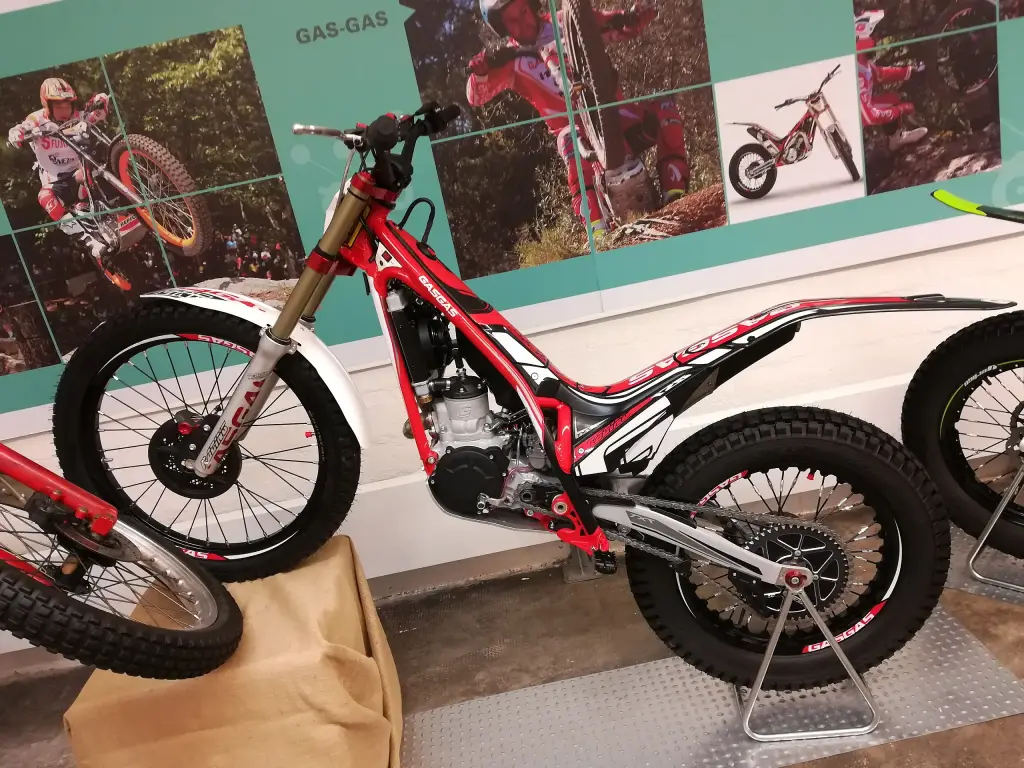
The Gas Gas TXT is the trials machine that has carried the Spanish firm’s name in the sport since 1999. It is a deliberately simple bike: a liquid-cooled two-stroke single in a chrome-molybdenum frame, with disc brakes and conventional trials suspension. Over the years it has been offered from 50 to 300 cc and has won world championships.
Gas Gas TXT at a glance
| Maker | Gas Gas, Salt, Girona, Spain |
|---|---|
| Production | since 1999 |
| Type | trials motorcycle |
| Engine | single-cylinder two-stroke, liquid-cooled |
| Capacities | 50, 70/80, 125, 200, 250, 270/280, 300 and 321 cc |
| Frame | chrome-molybdenum steel, square tubes at first, round tubes from 2008 |
| Suspension | conventional fork in front, monoshock at the rear |
| Brakes | discs front and rear |
| 2002 update | round cradle tubes with elliptical beams, revised fork and rear brake |
| 2008 update | fully round-tube frame, new front mask with round projector |
| World titles | Adam Raga (six titles 2003–2006), Laia Sanz (2012) |
Written from the Italian and Catalan Wikipedia articles on the TXT and the English article on Gas Gas.
History of the Gas Gas TXT
A simple trials machine
The TXT was introduced in 1999, fourteen years after Gas Gas was founded in Salt, Girona, by Narcís Casas and Josep Pibernat. It was designed around a liquid-cooled two-stroke single and a chrome-molybdenum steel frame, with a conventional fork, a rear monoshock and disc brakes. The layout stayed deliberately simple, in the tradition of Catalan trials bikes.
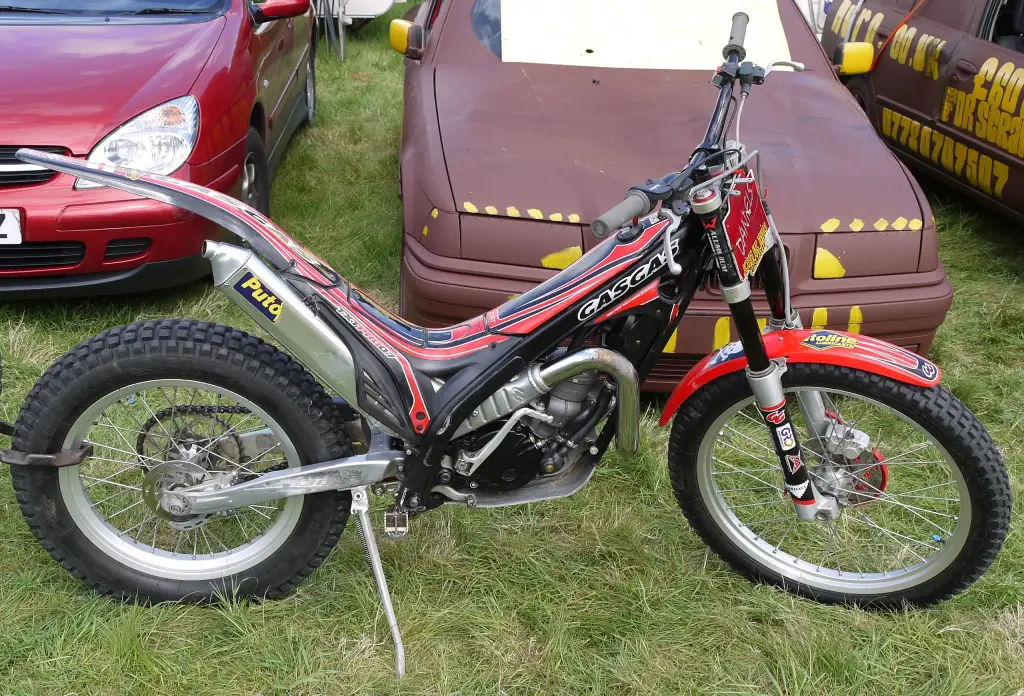
Frame changes of 2002 and 2008
The first frames used square chrome-molybdenum tubes. In 2002 the cradle switched to round tubes with elliptical beams, the forks were updated, and the rear brake changed from a floating two-piston caliper to a single-piston one. A further update came in 2008, when the frame became entirely round-tubed and the front mask changed from a square headlight to a more compact round projector; the tail light was made smaller at the same time.
Many capacities
The model name follows the engine size. The range has included the 50 from 2000, the 70 and 80 Rookie from 2002, the 80 from 2001, the 125 from 1999, the 200 from 1999 to 2005 (with a 64 × 54.5 mm bore and stroke), the 250 from 1999, the 270 of 1999 renamed 280 in 2000, the 300 from 2004 and the 321 from 1999 to 2001 (83.4 × 60 mm). The bigger capacities are the ones most often seen in competition.
Competition success
The TXT became one of the most successful trials bikes of its era. Adam Raga won six world titles with it between 2003 and 2006, counting the outdoor and indoor championships, and Laia Sanz won the women’s world title in 2012. Gas Gas had already taken Jordi Tarrés to three successive world trials championships in 1993–1995 after he left Beta.
Design and features
- Purpose-built trials layout: a light chrome-moly frame, two-stroke single and minimal bodywork.
- Progressive development: square tubes gave way to round and elliptical ones, with brake and lighting updates in 2002 and 2008.
- Wide capacity spread: from a 50 cc machine for young riders to the 300 cc competition bike.
- World championship record: titles with Adam Raga and Laia Sanz.
Gas Gas TXT versions
- TXT 50 and Boy: small-capacity models for young riders, the 50 from 2000.
- TXT Rookie 70/80: introduced in 2002.
- TXT 125, 200 and 250: the core of the range, the 125 and 250 from 1999, the 200 from 1999 to 2005.
- TXT 280: the 270 of 1999 renamed in 2000.
- TXT 300: built from 2004.
- TXT 321: produced 1999–2001 with an 83.4 × 60 mm engine.
The enduro side of the range is covered by the Gas Gas EC, and the four-stroke enduro models by the Gas Gas EC F. More machines are in the Gas Gas collection.
Video: New Gas Gas TXT 2012 by Blackmedia
Video on YouTube.
Sources
- Gas Gas TXT, Italian Wikipedia: frame changes, capacities and production years
- Gas Gas TXT, Catalan Wikipedia: layout, titles, versions
- GasGas, English Wikipedia: company history, trials championships