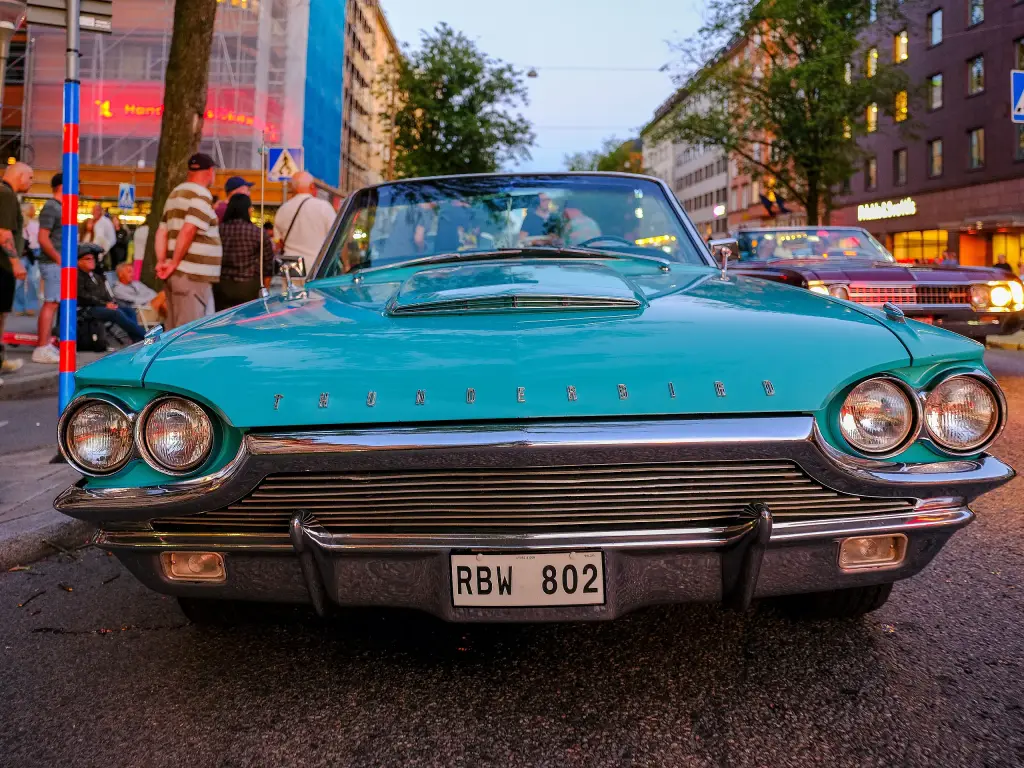
The Ford Thunderbird was a personal luxury car manufactured and marketed by Ford for the 1955 to 2005 model years, with a hiatus from 1998 to 2001. Known as the T-Bird, it began as a two-seat convertible and returned in its final generation in the same form.
Ford Thunderbird at a glance
| Maker | Ford Motor Company |
|---|---|
| Model years | 1955–2005, gap 1998–2001 |
| First form | two-seat convertible |
| 1958 change | rear seat added, creating the personal luxury class |
| Bodies over the years | two- and four-seat, convertible, hardtop, four-door sedan |
| Downsizing | 1977, 1980 and 1983 |
| Production end | 1997 model year |
| Final generation | 2002–2005, two-seat convertible |
| Total built | over 4.4 million |
| Position | upscale and sporty, not a direct Corvette rival |
This page is based on English Wikipedia only.
History of the Ford Thunderbird
A sports car that was not one
The Thunderbird entered production for the 1955 model year, marketed as an upscale, sporty two-seat convertible rather than as a sports car in the strict sense, which kept it out of direct competition with the Chevrolet Corvette. At its launch Ford targeted the two-seat Thunderbird as an upscale model, positioning it above the ordinary Ford range.
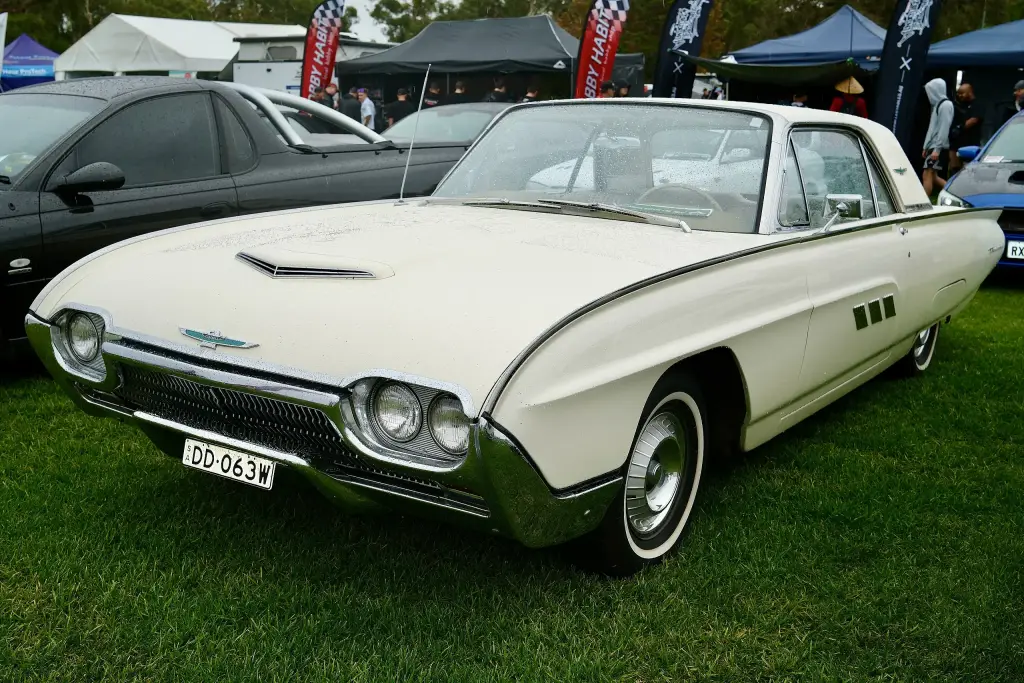
The 1958 car that created a class
The 1958 model introduced a rear seat, and that change arguably marked the expansion of the market segment that became known as personal luxury cars, positioned to emphasise comfort and convenience over handling and high-speed performance. Over the years the Thunderbird was offered in a host of body styles: four-seat hardtop coupe, four-seat convertible, five-seat convertible and hardtop, four-door pillared hardtop sedan, six-passenger hardtop coupe and five-passenger pillared coupe.
Bigger, smaller, gone and back
Subsequent generations became successively larger until the line was downsized, first in 1977, again for 1980 and once more in 1983. By the 1990s the Thunderbird’s core market, the large two-door coupe, had fallen almost completely out of favour, and production ended with the 1997 model year. The car returned from 2002 to 2005 as a smaller two-passenger convertible. From its introduction in 1955 to its end in 2005, production reached over 4.4 million cars.
Design and features
- Two-seat start: an upscale sporty convertible rather than a pure sports car.
- Personal luxury: the 1958 four-seater created the class.
- Many bodies: from two-seat convertibles to four-door sedans.
- 4.4 million cars: a fifty-year production total.
Ford Thunderbird versions
- Two-seat convertible (1955–1957): the original car.
- Four-seat cars (1958 onwards): the personal luxury generation.
- Four-door pillared sedan: the later body style.
- Final convertible (2002–2005): the return of the two-seater.
The Thunderbird lent its styling and V8 engine to the Fairlane of 1955–1956 and its name to the 1957 Skyliner era cars. More Ford vehicles are in the Ford collection.
Sources
- Ford Thunderbird, English Wikipedia: generations, bodies, production