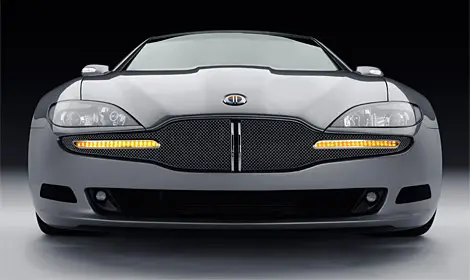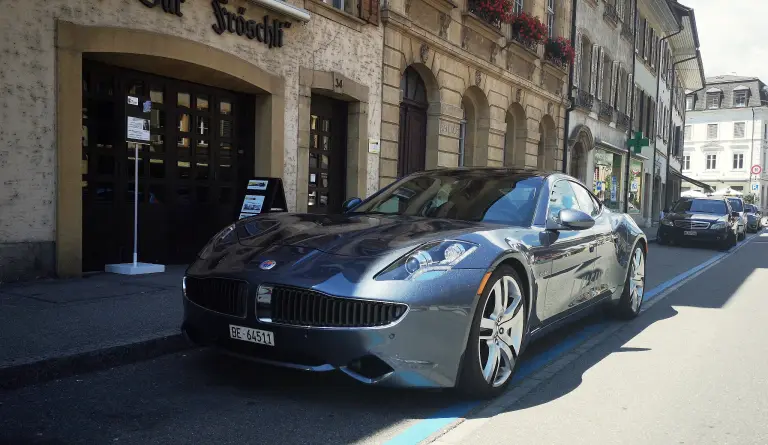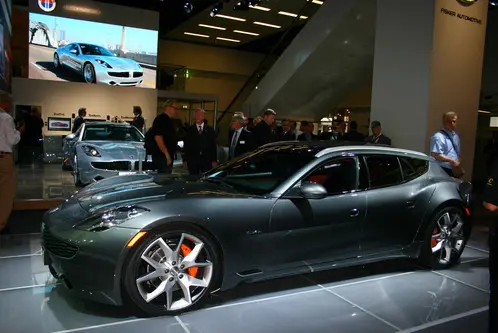
The Fisker Surf was a sports wagon version of the Karma, shown by Fisker Automotive at the Frankfurt Motor Show in 2011, the year the Karma sedan itself went on sale. Apart from the new rear body it differed from the sedan by a three-dimensional honeycomb grille, and it never went into production.
Fisker Surf at a glance
| Maker | Fisker Automotive, Anaheim, California |
|---|---|
| Shown | Frankfurt Motor Show, 2011 |
| Body | four-door sports wagon on the Karma platform |
| Changes from the Karma | modified rear end and a three-dimensional honeycomb grille |
| Powertrain | as the Karma: two electric motors, 20.1 kWh battery, 2.0-litre Ecotec range extender |
| All-electric range | 32 mi (51 km), EPA figures for the Karma |
| Range extender | 260 hp 2.0-litre turbocharged Ecotec four from General Motors |
| Seats | four, the battery runs between the seats |
| Status | on hold from August 2012, never produced |
There is no free photograph of the Surf, so this page has no pictures; it is based on the Karma sections of the English and German Wikipedia articles, where the Surf is described.
History of the Fisker Surf
The Surf was presented at the Frankfurt Motor Show in 2011 as a third body style of the Karma, after the sedan and the short-wheelbase Sunset convertible shown in Detroit in 2009. The rear of the car was completely new, turning the four-door saloon into a sports wagon, and the front received a three-dimensional honeycomb grille. According to Fisker, this body style had been planned from the beginning of the design work on the Karma, so the Surf was not an afterthought but a version the original package had been drawn around.
In August 2012 Fisker announced that both the Sunset and the Surf were on hold, as the company had decided to concentrate on the planned mid-sized Atlantic sedan. The Atlantic never reached the market either: production of the Karma stopped in November 2012 when the battery supplier A123 Systems failed, and Fisker Automotive filed for bankruptcy a year later.
Because the Surf was a body variant of the Karma, its mechanical layout was the same. Two electric motors of 120 kW (161 hp) each drove the rear wheels, taking current either from a 20.1 kWh lithium-ion battery or from a generator turned by a 2.0-litre turbocharged Ecotec four-cylinder engine supplied by General Motors. The battery ran down the centre tunnel between the seats, so the car had four places, and it could be recharged from the mains. The estate body added rear headroom and luggage space without changing the low, long proportions that made the Karma recognisable.
Design and features
- Sports wagon rear: the only body change of substance, giving the Karma a practical tailgate and a longer roof.
- Honeycomb grille: a three-dimensional mesh unique to the Surf, replacing the sedan’s front treatment.
- Planned from the start: Fisker said the wagon body had been part of the Karma design brief from the beginning.
- Unchanged hybrid layout: electric drive with a petrol generator, so the Surf would have driven exactly like the Karma sedan.
Fisker Surf versions
- Fisker Surf (2011): the sports wagon concept, the only version built.
- Fisker Karma sedan (2011–2012): the production car the Surf was derived from.
- Fisker Sunset (2009): a short-wheelbase convertible concept on the same basis.
- Fisker Atlantic: the mid-sized sedan that replaced both projects in the company’s plans in 2012.
The car the Surf was based on is described in Fisker Karma; the coachbuilt roadster from Fisker’s earlier company is in Fisker Tramonto. More cars are in the Fisker collection.
Video: Fisker Surf
Video on YouTube.
Sources
- Fisker Karma, English Wikipedia: the Surf in the history of the Karma, powertrain
- Fisker Karma, German Wikipedia: presentation at the Frankfurt show
- Henrik Fisker, English Wikipedia: the Surf as a four-door hybrid hatchback, never produced