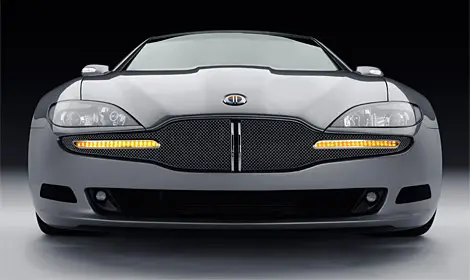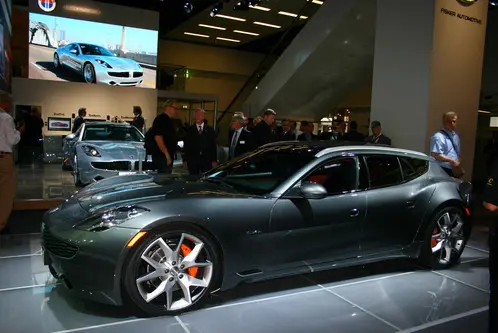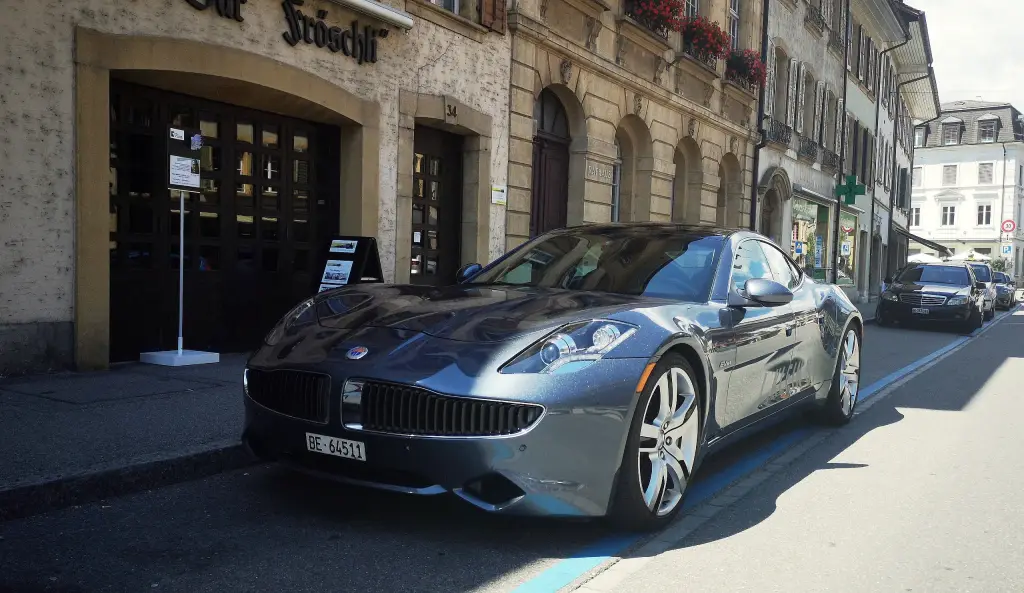
The Fisker Karma was a luxury plug-in range-extended electric sports sedan produced by Fisker Automotive between 2011 and 2012. It was the first car of the Californian start-up founded by the designer Henrik Fisker, and it was built under contract by Valmet Automotive in Finland.
Fisker Karma at a glance
| Maker | Fisker Automotive, Anaheim, California |
|---|---|
| Production | 2011–2012, Valmet Automotive, Finland |
| Class | luxury plug-in range-extended electric sports sedan |
| Motors | two electric motors, 120 kW (161 hp) each |
| Battery | 20.1 kWh lithium-ion, supplied by A123 Systems |
| Range extender | 2.0-litre turbocharged Ecotec four, 260 hp, from General Motors |
| All-electric range | 32 mi (51 km), EPA |
| Fuel economy | 52 MPG-e combined in electric mode, 20 mpg in gasoline-only mode |
| Curb weight | 5,300 lb (2,400 kg) |
| Price in the US | $102,000 EcoStandard, $110,000 EcoSport, $116,000 EcoChic |
| Built | about 2,450 |
The German article quotes 150 kW for each motor and 81 km of electric range on the NEFZ cycle; the figures in the table follow the English article and the EPA ratings.
History of the Fisker Karma
The Karma was revealed at the North American International Auto Show in Detroit in 2008. It was the first car from Fisker Automotive, a new maker based in Anaheim, California, founded on 5 September 2007. Production began in July 2011 and the first two cars were delivered in the United States on 26 July 2011; deliveries to retail customers started in November 2011. In October 2011 the first Karma delivered in Britain was auctioned for the charity Pratham UK and raised a bid of £140,000, around $220,000 at the time.
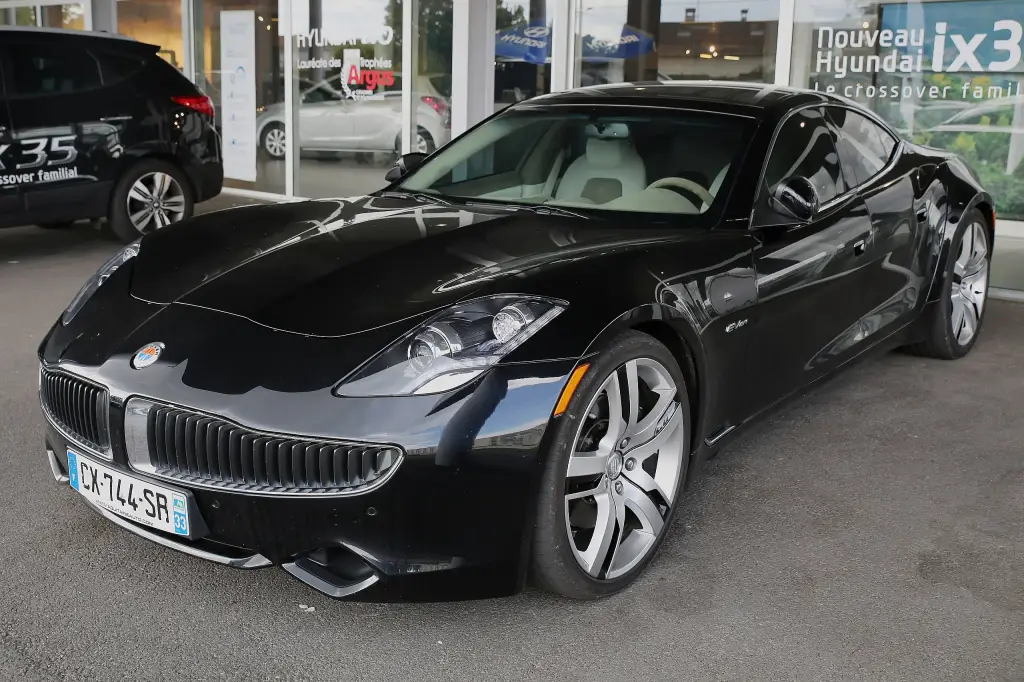
In the United States the range started at $102,000 for the base EcoStandard, $110,000 for the intermediate EcoSport and $116,000 for the top “Animal Free” EcoChic. Around 1,800 cars were delivered in North America and Europe through December 2012, about 1,600 of them in the United States.
Production was suspended in November 2012, when A123 Systems, the only battery supplier to Fisker Automotive, filed for bankruptcy after two battery recalls; without batteries the company could not continue, with about 2,450 Karmas built since 2011. After furloughing its American workers in late March 2013, Fisker Automotive filed for bankruptcy in November 2013, after the United States Department of Energy auctioned its debt and sold it to Hybrid Technology LLC for $25 million. The designs, the rights to the plug-in hybrid powertrain and a factory in Delaware went to the Chinese company Wanxiang, which restarted production in September 2016 under the name Karma Automotive; the car was renamed the Karma Revero.
The Karma is a series hybrid: a pair of 120 kW (161 hp) electric motors drive the wheels, fed by a 20.1 kWh lithium-ion battery from A123 Systems or by a generator. The battery pack runs down the centre of the car between the left and right seats, which is why the car seats four rather than five. When the battery is empty, or when the driver pulls the “Sport” paddle on the steering wheel, a front-mounted 260 hp 2.0-litre turbocharged direct-injection Ecotec four-cylinder engine from General Motors turns a generator that sends electricity to the motors. The battery can also be charged from the grid, which makes the Karma a plug-in hybrid.
Design and features
- Range extender instead of a gearbox: the petrol engine never drives the wheels, it only generates electricity, a layout Fisker called EVer.
- Central battery tunnel: the pack sits between the seats, lowering the centre of gravity but limiting the cabin to four places.
- Solar roof: a panel made by Asola produces about half a kilowatt-hour a day, enough for a few miles a week, and as delivered it recharges the 12-volt accessory battery.
- Ecological interior: the base car used salvaged and reclaimed lumber; the EcoChic version had natural fabric, an ultrasuede dashboard and real leaf fossils embedded in the glass of the doors and console.
- Pedestrian warning sound: emitted automatically at low speed to warn people that the almost silent car is moving.
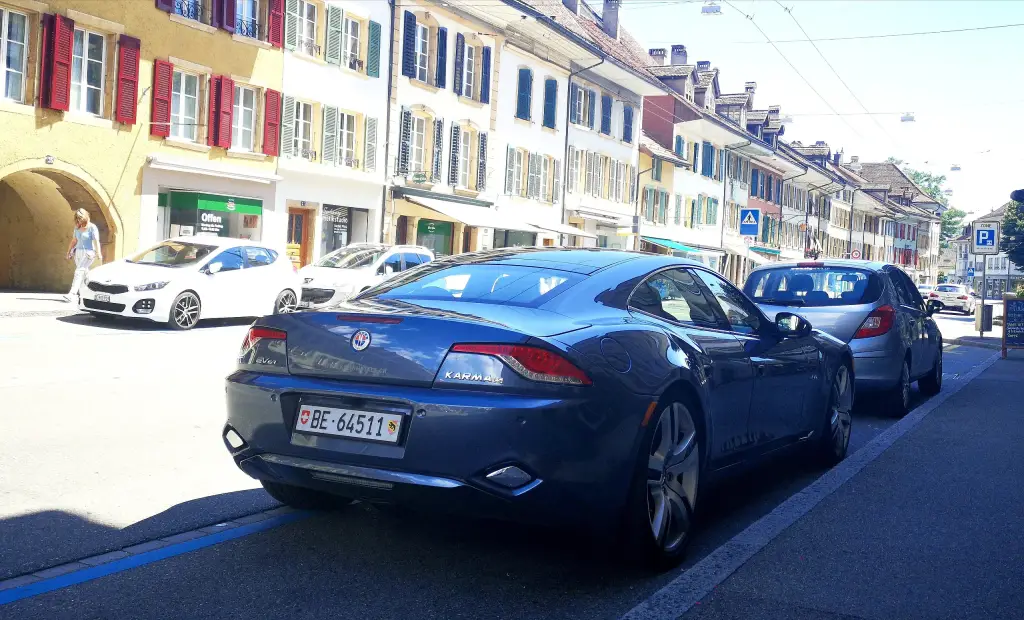
Fisker Karma versions
- EcoStandard ($102,000): the base car with the eco-friendly interior.
- EcoSport ($110,000): the intermediate model.
- EcoChic ($116,000): the animal-free top version with fabric trim and leaf fossils in the glass inserts.
- Fisker Sunset (2009): a short-wheelbase convertible concept shown in Detroit.
- Fisker Surf (2011): a sports wagon version shown in Frankfurt; both the Sunset and the Surf were put on hold in August 2012.
The estate version of the same car is described in Fisker Surf, and the coachbuilt roadster that came before it in Fisker Tramonto. More cars are in the Fisker collection.
Video: Audi S7 vs. Fisker Karma
Video on YouTube.
Sources
- Fisker Karma, English Wikipedia: history, prices, production, powertrain
- Fisker Karma, German Wikipedia: technical data, dimensions, criticism