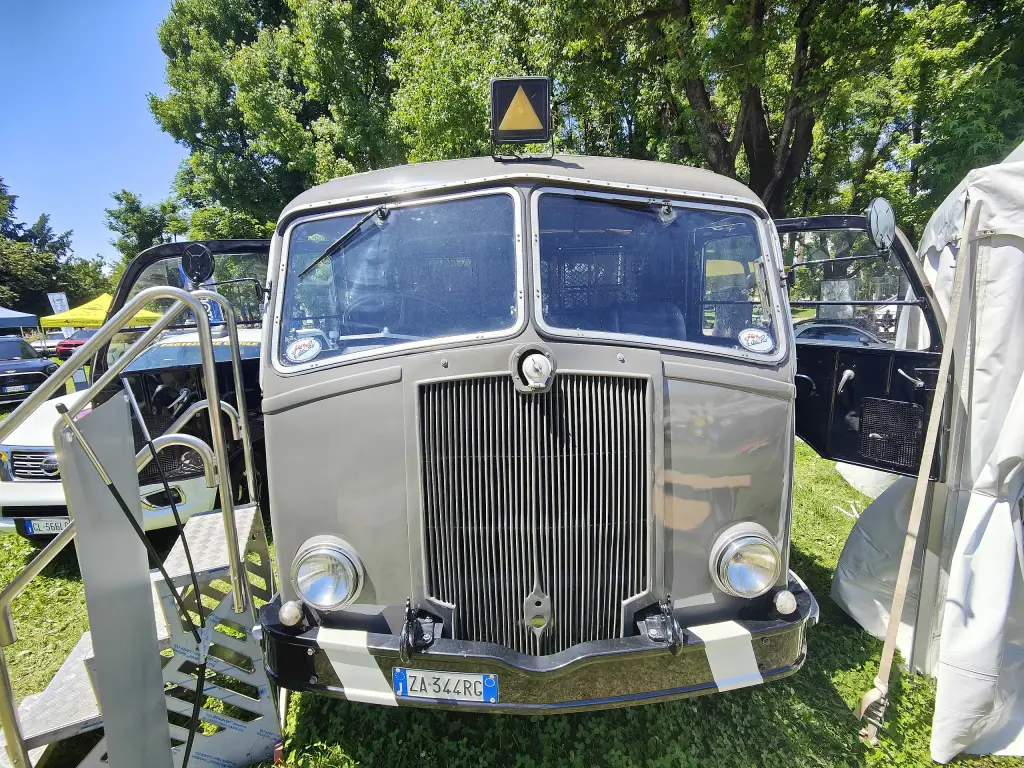
The Fiat 666 was a heavy truck produced by Fiat Veicoli Industriali. Like the medium-sized Fiat 626, it was built from 1940 as a “Unified” truck: since 1937 Italian law had required makers of civilian trucks to use standard features for weight, number of axles, speed and capacity, so that the armed forces could requisition them easily.
Fiat 666 at a glance
| Production | 1940–1945 |
|---|---|
| Replaced | Fiat 632 |
| Layout | forward control, engine inside the cab |
| Chassis | two axles, twin rear wheels |
| Wheelbase | 3.85 m |
| Track | 1.84 m |
| Engine | Fiat 366, 9,365 cc six-cylinder diesel |
| Power | 105 hp at 2,000 rpm |
| Transmission | four speeds plus reverse with reduction gearing |
| Trailer capacity | 6,260 kg, enough for 20 equipped soldiers |
| Total built | 8,000 |
History of the Fiat 666
A unified truck
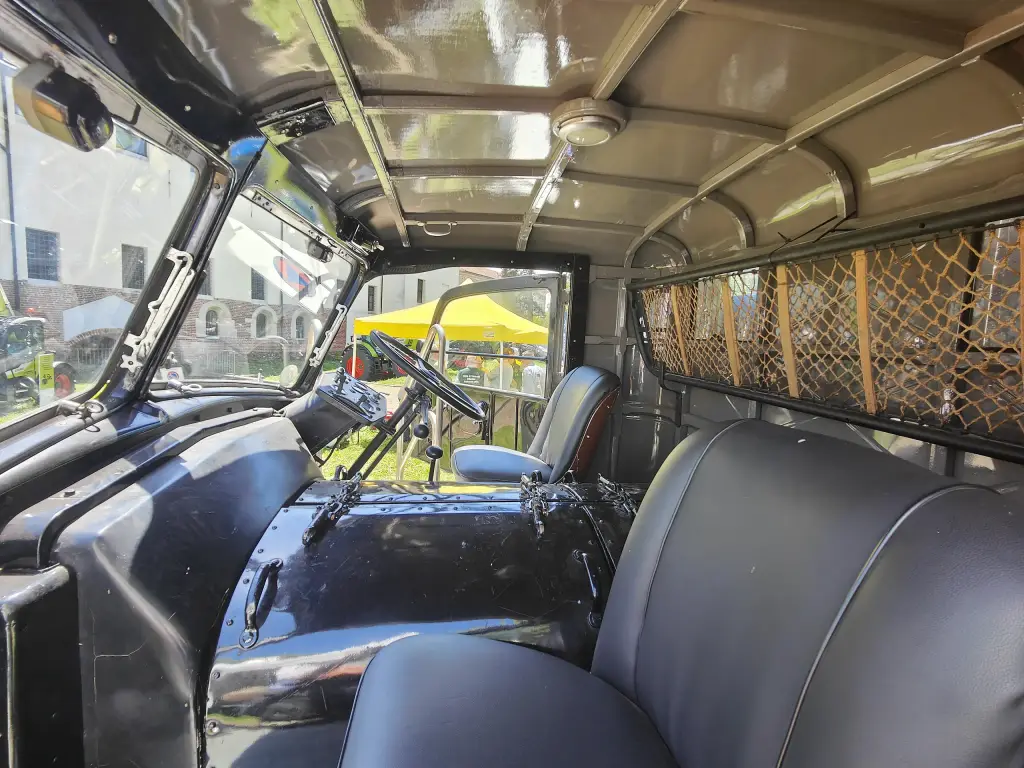
The 666 and the 626 replaced the Fiat 621 and the Fiat 632 on the assembly lines respectively, and were the first Fiat trucks with forward control, with the engine entirely inside the cab. The chassis had longitudinal members on two axles, front-wheel steering and twin rear-wheel drive, with a wheelbase of 3.85 m and a track of 1.84 m. The engine was the Fiat 366, a 9,365 cc six-cylinder diesel of 105 hp at 2,000 rpm, notable for a guide layout that allowed it to be removed quickly and simply from the front. The gearbox had four forward speeds and a reverse, with reduction gearing. Outside, the 666 differed from the 626 only in size, the shape of the windscreen and the body. Its trailers, rated at 6,260 kg, twice the capacity of the 626’s, could carry twenty equipped soldiers.
Civilian and military production
The vehicle was produced from 1940 to 1945 in civilian form and as the 666NM, for nafta militare, a diesel for the armed forces. In 1943 a petrol BM version was approved for military use, but the armistice prevented production. The civilian version, also available as a bus chassis, was a great success and continued after the war as the Fiat 666N7, for a total production of 8,000.
Military use
The 666 was bought in large numbers by the Italian armed forces: the N-RE version for the Royal Italian Army and the N-RA for the Royal Italian Air Force were used with many bodies, including bus, car, tanker, fire engine and troop carrier, and with Viberti and Bartoletti portacarri trailers. After the Armistice of Cassibile, 79 NM examples were built for the Germans who occupied Fiat’s plants in northern Italy. Among the vehicles supplied to the forces of the Italian Social Republic there is evidence of at least one armoured 666, hand-built at the Piacenza arsenal with a turret armed with a 12.7 mm Breda-SAFAT machine gun and issued to the Republican National Guard.
Fiat 665NM
In 1941 Fiat produced a military four-wheel-drive version of the 666NM diesel, keeping maximum commonality with the rear-wheel-drive trucks; it went into production for the armed forces in 1942, and after the armistice two examples were built for the Wehrmacht. In 1942 an armoured personnel carrier version was made, the Fiat 665NM protected or shielded, used first against Yugoslav partisans and then in northern Italy.
Design and features
- Forward control: one of the first Fiat trucks with the engine fully inside the cab.
- Big diesel: 9,365 cc, six cylinders, 105 hp at 2,000 rpm.
- Serviceable engine: guides allowed the unit to be drawn out quickly at the front.
- Trailer work: a 6,260 kg towing capacity, twice that of the 626.
- Military family: the 666NM diesel and the four-wheel-drive 665NM.
Fiat 666 versions
- 666 civilian: lorry and bus chassis, also built after the war as the 666N7.
- 666NM: diesel for the armed forces, with N-RE army and N-RA air force versions.
- BM: petrol military version approved in 1943 but never produced.
- 665NM: four-wheel-drive military truck of 1942.
- 665NM protected: armoured personnel carrier of 1942.
The 666 was the heavy stablemate of the Fiat 626, and the later heavy truck of the range was the Fiat 642. More vehicles are in the Fiat collection.
Sources
- Fiat 666, English Wikipedia: chassis, engine, production, military use and the 665NM