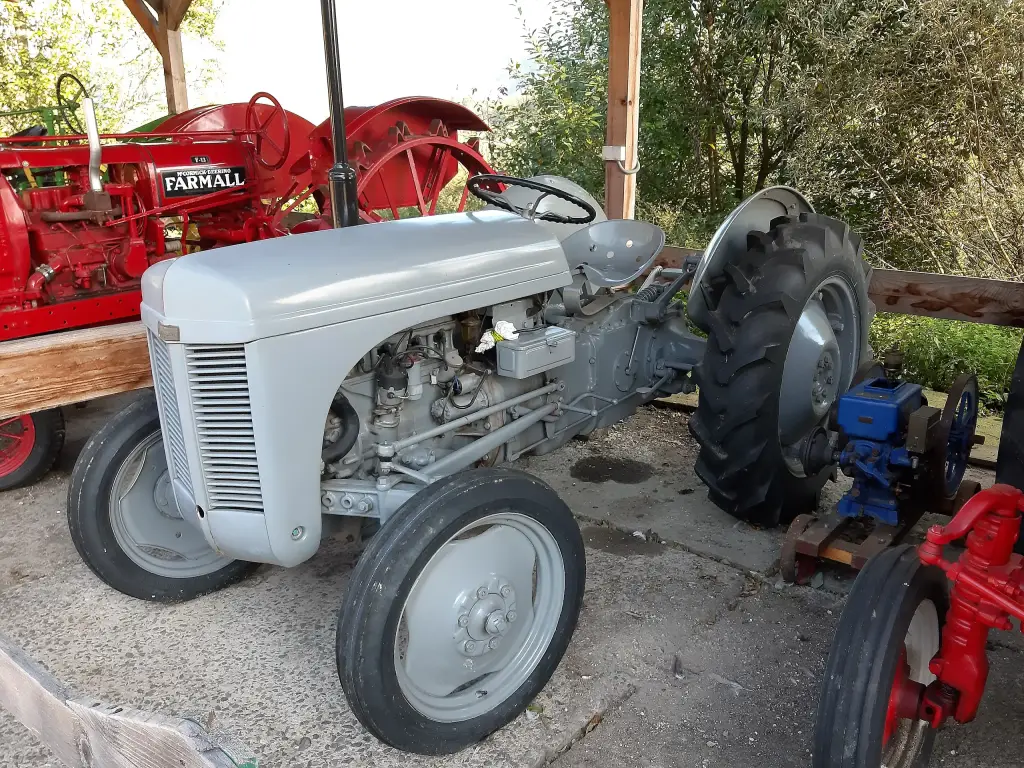
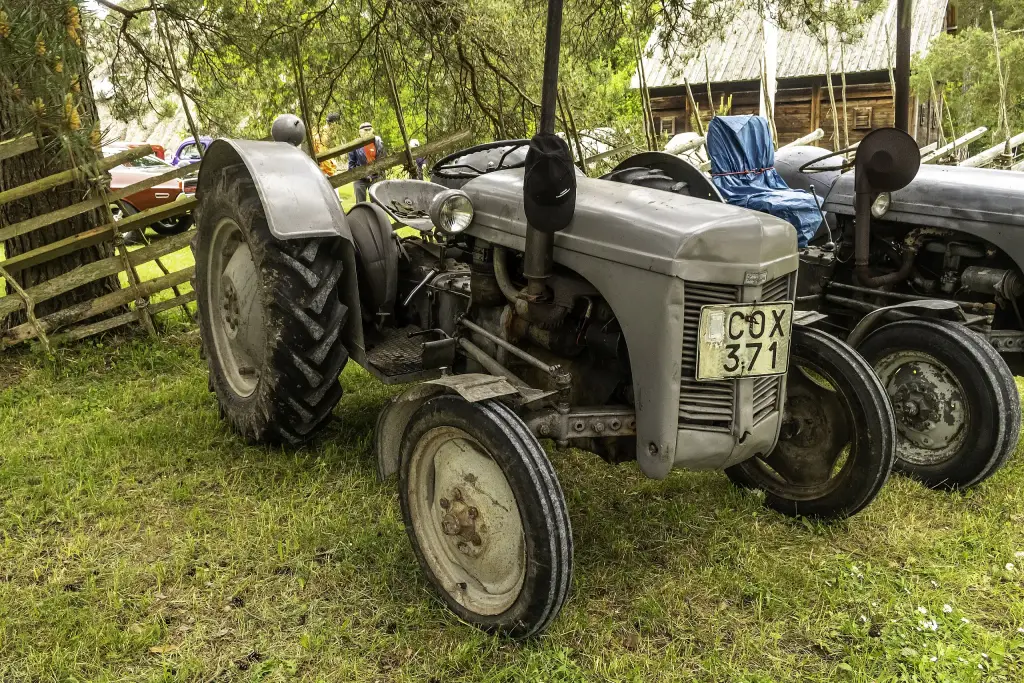
The Ferguson TE20 is the small grey tractor that made Harry Ferguson’s three-point hitch a worldwide standard. Designed by Ferguson and built by the Standard Motor Company in Coventry from 1946 until 1956, it is remembered as the Little Grey Fergie, and in many countries it was the first tractor an ordinary farmer could afford.
Ferguson TE20 at a glance
| Maker | Harry Ferguson, built by the Standard Motor Company, Coventry |
|---|---|
| Production | 1946–1956 |
| Model name | Tractor, England, 20 horsepower (a tax formula, not measured power) |
| Engine, TE20 | Continental Z-120 petrol, imported from the United States |
| Engine, TEA20 | Standard petrol, 1,850 cc, 80 mm bore, about 24 hp |
| From 1951 | 85 mm bore, 2,088 cc, about 28 hp, sometimes called the Ferguson 28 |
| Electrics | 6 volt at first, 12 volt on later Standard-engined tractors |
| Gearbox | four speeds with an integrated differential |
| Hydraulics | Ferguson System three-point linkage with automatic draft control |
| Built | over 500,000 |
History of the Ferguson TE20
Origins of the Ferguson System
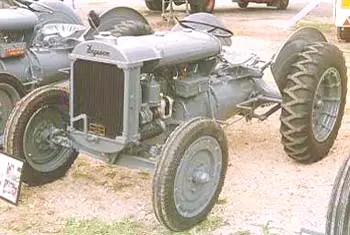
Harry Ferguson had worked on mounted implements and tractor control since 1916. He applied for a British patent in 1925 and it was granted the following year; the converging three-point hitch followed in 1928 and the “suction side” hydraulic valve in 1936. The first production Ferguson tractors were built in Huddersfield in 1936 by the David Brown Company as the Ferguson Model A. In October 1938 Ferguson made his handshake agreement with Henry Ford, and from mid-1939 the Ford-Ferguson 9N was built in Detroit, followed by the 2N in 1942. About 300,000 of these Ford-Fergusons had been made by 30 June 1947.
Standard Motor Company and Coventry
By 1945 Ferguson had an agreement with the Standard Motor Company of Coventry to build his tractor in the former aero-engine shadow factory at Banner Lane. Standard developed a new wet-liner engine for it, also used in its Vanguard car. Production began in the late summer of 1946, nearly a year before the last Ford-Ferguson left Detroit. The break with Ford left Ferguson with implements to sell but no tractors, so more than 25,000 Coventry-built TE20s were shipped to the United States and Canada until the new Detroit plant started work in October 1948. The American TO20 was almost the same tractor with a Continental Z-126 engine.
TE20, TEA20 and the other versions
The name came from Tractor, England, 20 horsepower, a figure taken from a tax formula based on engine size rather than true output. The first TE20s used the imported Continental Z120 petrol engine. In 1948 the TEA20 arrived with a Standard petrol engine of 1,850 cc and about 24 hp, and in 1951 the bore grew to 85 mm and 2,088 cc with about 28 hp; that version was sometimes nicknamed the Ferguson 28. The change to the Standard engine also brought 12-volt electrics. The TED20 ran on tractor vapourising oil, the TEF20 on diesel, and narrow TEB20 and TEC20 versions were made for vineyards and orchards.
Why it mattered
The TE20 was light, small, manoeuvrable and versatile. Its three-point linkage with hydraulic draft control turned tractor and implement into a single machine, an idea marketed as the Ferguson System; by 1950 there were more than 60 official Ferguson implements for it, from ploughs and harrows to loaders, a baler and a mower. Over 500,000 Little Grey Fergies were built between 1946 and 1956, so successful that Ford nicknamed it the “Grey Menace”. Some were used on Sir Edmund Hillary’s South Pole expedition in 1958, and a monument at Wentworth in Australia recalls the fleet of them that built flood banks there in 1956. Production ended in 1956, when the Ferguson 35 took over.
Design and features
- Three-point linkage: Ferguson’s hydraulic hitch linked tractor and implement into one unit and became the international standard.
- Light and small: it was handy enough to replace the draft horse and to work in orchards and small fields.
- Standard wet-liner engine: from 1948 a British petrol engine of 1,850 cc, enlarged to 2,088 cc in 1951.
- Wide implement range: more than 60 official Ferguson implements by 1950, plus machinery from other makers.
- Four-speed gearbox: with an integrated differential and a power take-off for driven equipment.
Ferguson TE20 versions
- TE20 (1946): the original with the imported Continental Z120 petrol engine.
- TEA20 (1948): Standard petrol engine of 1,850 cc and 24 hp, enlarged to 2,088 cc and 28 hp in 1951.
- TED20: petrol-paraffin version running on tractor vapourising oil.
- TEF20: the diesel model.
- TEB20 and TEC20: narrow-track versions for vineyards and orchards.
- TO20: the North American equivalent with a Continental Z-126 engine.
The TE20 was the last tractor sold under Harry Ferguson’s own name before the Ferguson 35, which replaced it in 1956. Its story begins with the Ferguson-Brown Model A of 1936. More tractors are in the Ferguson collection.
Video: Cold starting a 1952 Ferguson TE-20
Video on YouTube.
Sources
- Ferguson TE20, English Wikipedia: development, production, versions
- Ferguson TE20, French Wikipedia: TEA20 engines, bore sizes, electrics
- Ferguson-Brown Company, English Wikipedia: production total, Grey Menace, South Pole