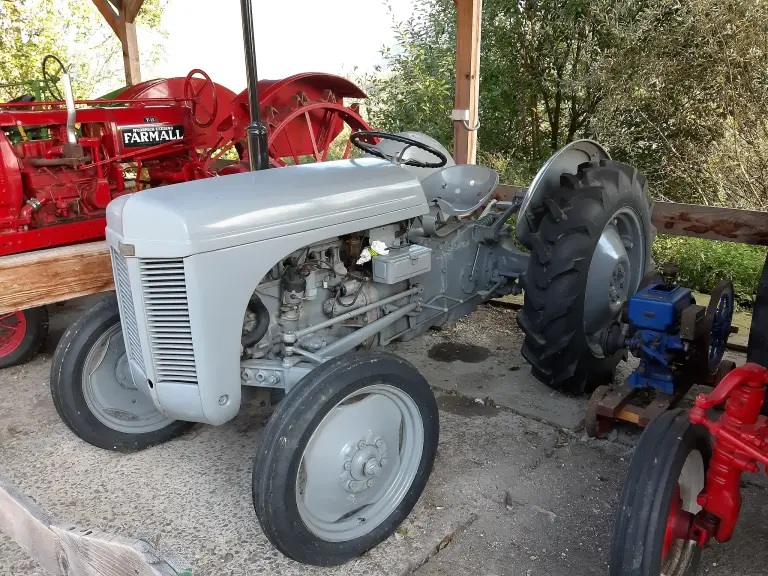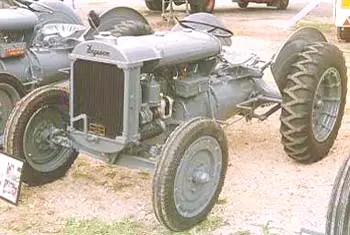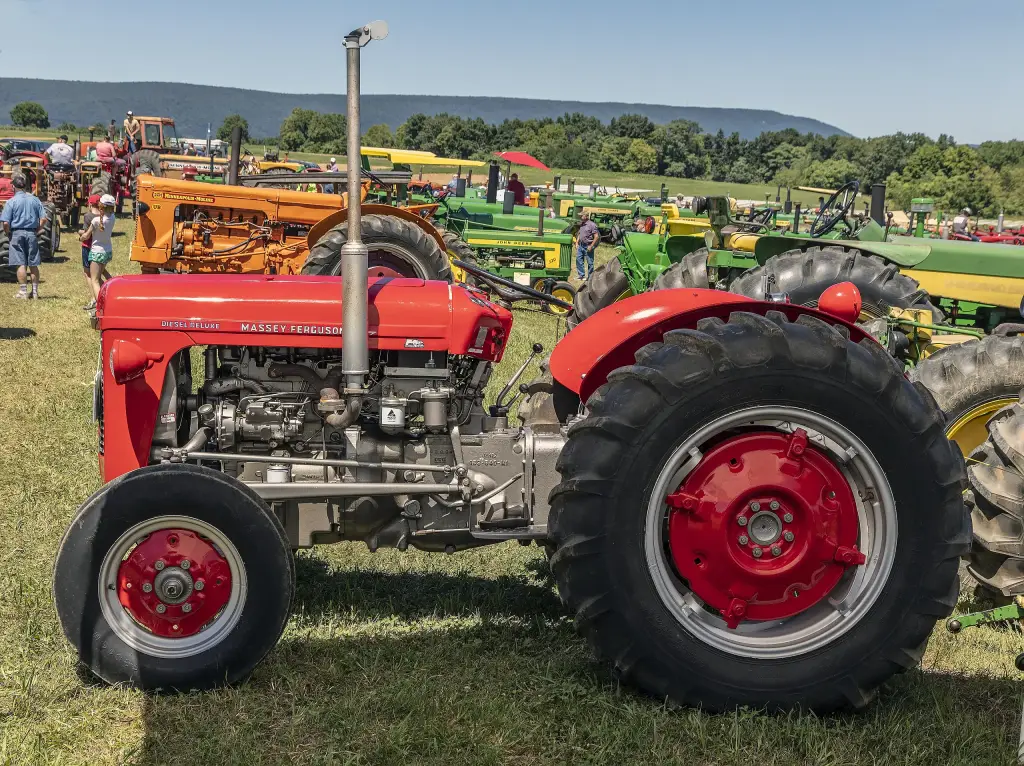
The Massey Ferguson 35 is the tractor that carried the Ferguson name into the Massey Ferguson era. It went on sale in the United States as the Ferguson TO35 in January 1955 and in Britain as the Ferguson 35 in October 1956, and it was built at Banner Lane in Coventry until 1964. Simple, light and cheap to run, it was made under licence in several countries and many are still at work on small farms.
Massey Ferguson 35 at a glance
| Maker | Massey Ferguson, sold as Ferguson in Britain and America at first |
|---|---|
| US launch | 5 January 1955, as the Ferguson TO35 |
| UK launch | 1 October 1956, at Grosvenor House Hotel, London, as the Ferguson 35 (FE35) |
| Built at | Banner Lane, Coventry |
| Predecessor | Ferguson TE20 |
| Successor | Massey Ferguson 135 |
| Engines | petrol at first; Perkins diesel from 1959 |
| Colours | all-grey, then beige and grey from May 1956, red and grey from 1957 |
| UK production | 1956–1964; 388,382 units over the eight-year run |
| 1962 update | MF35X with more power and Multi-Power |
| Licence production | TAFE in India from 1960; IMT in Yugoslavia as the IMT533 and IMT539 |
History of the Massey Ferguson 35
Development in the United States
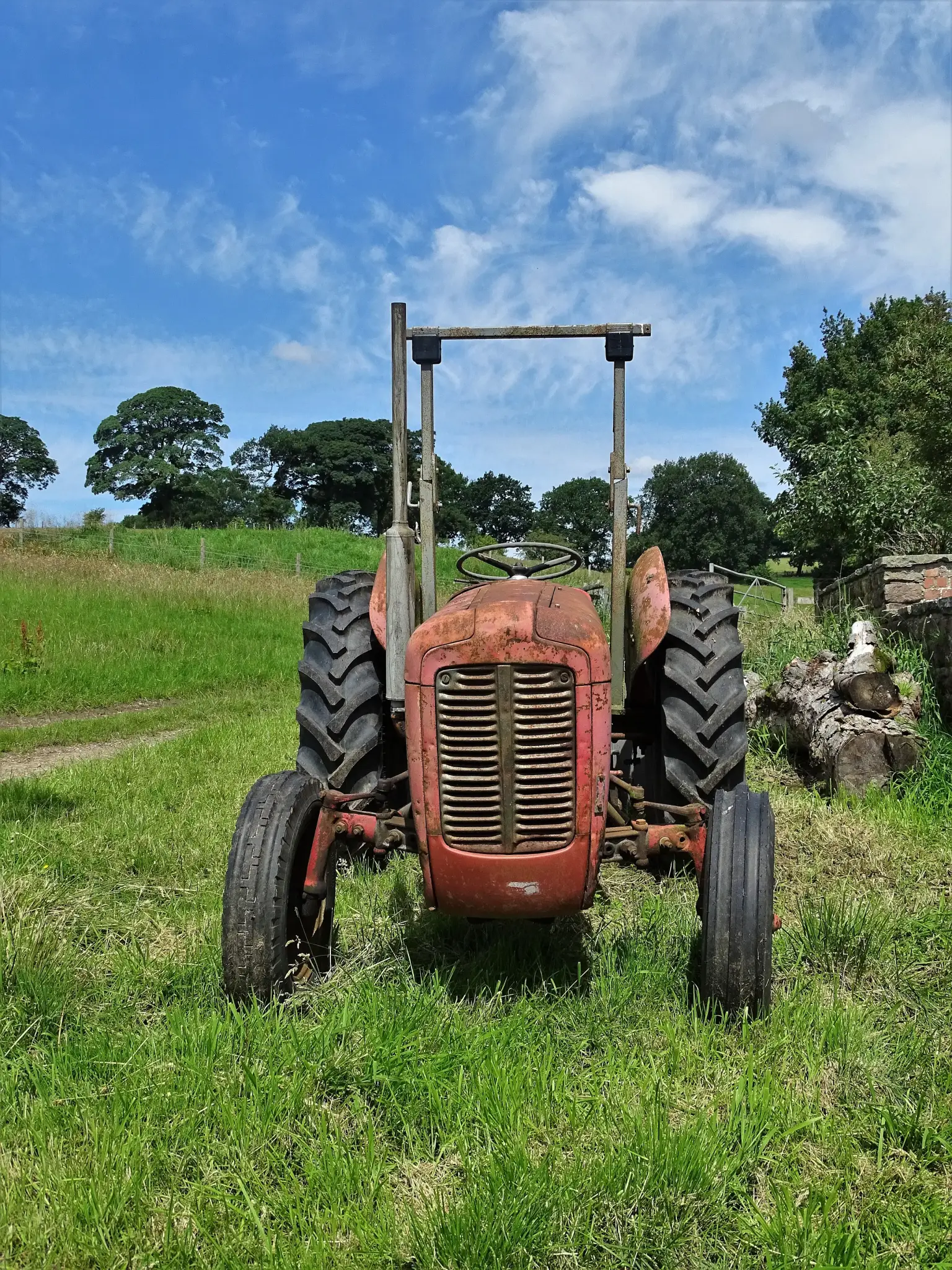
In 1953 a team led by Hermann Klemm began developing a new model for Ferguson, the TO35, to replace the TO30. Klemm wrote to Harry Ferguson that July describing its features, but Ferguson was unhappy with the project and ordered the work stopped. A second letter from Klemm, running to 23 pages, changed his mind and development continued. Although Ferguson had merged with Massey-Harris to form Massey Ferguson in 1953, the TO35 was still marketed under the Ferguson name. It was launched in the United States on 5 January 1955, a year earlier than planned, after a decision at a conference in San Antonio in March 1954. There were standard and deluxe models at first and a utility version from 1956. The colour scheme changed from all-grey to a beige shell and wheels with a grey body in May 1956, and in December 1957 the tractor was rebranded in Massey Ferguson red and grey, although the wording on it remained “Ferguson” until February 1960. American production ended in late 1964.
The British Ferguson 35
In Britain the MF35 was launched on 1 October 1956 at the Grosvenor House Hotel in London and was originally sold as the Ferguson 35, or FE35. It was built at Massey Ferguson’s Banner Lane factory in Coventry, where the first FE35, serial number 1001, had been completed on 27 August that year. The FE35 succeeded the Ferguson TE20, which ceased production in the same year. Where the TE20 had been all grey, the FE35 had grey shell and wheels but a bronze-finished body, which earned it the nickname “Gold Belly”. Three types were built: agricultural, industrial and vineyard, though only a small number of the last. The industrial model was designed to comply with the Road Traffic Act 1947 and had a driving mirror and a high-frequency horn.
MF35 and MF35X
In 1957, after 73,655 units had been produced, the tractor was rebadged as the MF35 and the colour scheme changed to red and grey. In 1959 Massey Ferguson bought Perkins Engines and began using a new Perkins diesel in the MF35. De Luxe models had a dual clutch, which let the driver disengage the rear wheels while keeping the power take-off and hydraulic pump engaged. On 8 November 1962 the company launched the MF35X, with more power and the Multi-Power system that allowed the driver to shift up or down a ratio without using the clutch. British production reached over 45,000 units in 1963 and ended in 1964, when the Massey Ferguson 135 took over. Over its eight-year run 388,382 units were produced.
Later life
The Banner Lane factory continued to supply kits to foreign manufacturers until 24 December 2002; by then 3,307,996 tractors or kits had been built there. TAFE in India bought a licence to build MF35s in 1960 and kept making them until 2002, and the Yugoslav firm Industry of Machinery and Tractors sold the tractor as the IMT533 and IMT539. In 2014 variants were still being built in India, Pakistan and Turkey, and in 2015 Agco, the owner of the Massey Ferguson brand, relaunched the MF35 in East Africa as the “People’s tractor”.
Design and features
- Perkins diesel: adopted in 1959 after Massey Ferguson bought Perkins Engines, it made the 35 a cheap tractor to run.
- Multi-Power: from the 1962 MF35X, a shift up or down a ratio without the clutch.
- Dual clutch: De Luxe models could stop the rear wheels while the power take-off and hydraulics kept working.
- Industrial version: built to the Road Traffic Act 1947 with a driving mirror and high-frequency horn.
- Gold Belly styling: the British FE35’s bronze body panels are still its best-known feature.
Massey Ferguson 35 versions
- Ferguson TO35 (1955): the American model, standard, deluxe and later utility.
- Ferguson 35 / FE35 (1956): the British tractor with the bronze “Gold Belly” body.
- MF35 (1957): the rebadged version in red and grey.
- MF35X (1962): more power and the Multi-Power transmission.
- Industrial and vineyard types: road-legal industrial and a small number of narrow vineyard tractors.
- IMT533 and IMT539: Yugoslav licence-built versions of the MF35.
The 35 replaced the Ferguson TE20 in 1956 and was itself replaced by the Massey Ferguson 135 in 1964. The line began with the Ferguson-Brown Model A of 1936. More tractors are in the Ferguson collection.
Video: PLOUGHING WHITH FERGUSON 35
Video on YouTube.
Sources
- Massey Ferguson 35, English Wikipedia: development, launch, colours, production, licence building
- Massey Ferguson 35, French Wikipedia: production years and model designations