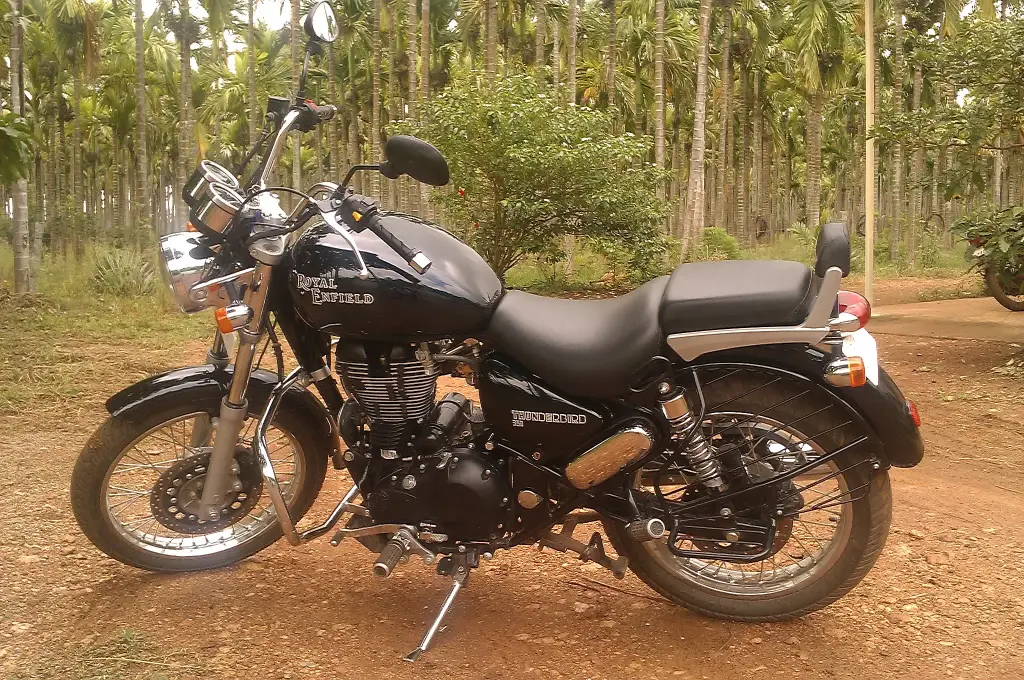
The Royal Enfield Thunderbird was a cruiser-style motorcycle built by Royal Enfield in India from 2002 to 2020 and sold in export markets as the Royal Enfield Rumbler. It grew out of the Lightning 535 and went through AVL and unit-construction engines before a 2012 facelift gave it a 20-litre tank and disc brakes at both ends.
Royal Enfield Thunderbird at a glance
| Production | 2002–2020, Royal Enfield, India |
|---|---|
| Export name | Royal Enfield Rumbler |
| Predecessor | Royal Enfield Lightning 535 |
| First engine | 350 cc AVL lean-burn, five-speed |
| Carburettor | constant-vacuum Mikuni-UCAL |
| Engine change | 2009, 346 cc unit-construction twin-spark |
| 2012 facelift | 350 and 500 cc, 20-litre tank, front and rear discs |
| Thunderbird 500 | fuel injection; discontinued 2020 |
| Thunderbird X | 2018, 350 and 500 cc, anti-lock brakes |
| Final drive | moved to the right side with the new engine |
Based on one source, the English Wikipedia article on the Thunderbird.
History of the Royal Enfield Thunderbird
From the Lightning to the first Thunderbird
The Thunderbird followed the Royal Enfield Lightning 535, a cast-iron engine with a four-speed Albion gearbox and the gear lever on the right, sold in India from 1997 and built in that form until about 2002. The Thunderbird arrived in 2000 with a 350 cc AVL lean-burn aluminium engine and a five-speed gearbox with the lever on the left, and it was the first Royal Enfield to leave the factory with a constant-vacuum Mikuni-UCAL carburettor. Early bikes carried ‘MIKUNI UCAL’ in three dimensions on the carburettor; later ones were fitted with UCAL units.
AVL engines, 2000–2009
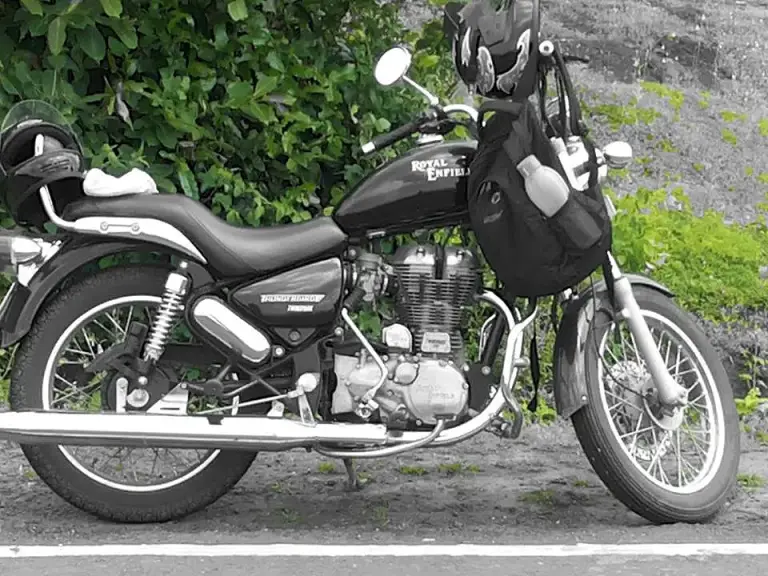
AVL — Anstalt für Verbrennungskraftmaschinen List, the Austrian consultancy — supplied the aluminium engine that Royal Enfield also used in the Electra and the Machismo. The first AVL engines of 2000 had a four-speed gearbox and a right-side lever; from 2002 the five-speed version with a left-side lever was used, and that engine stayed in the Thunderbird until 2009. Compared with the old cast-iron unit it had higher compression and a shorter stroke but kept the manual decompression lever. The first generation, built from 2002 to 2005, used CDI ignition alone and would start without a battery; the second generation of 2005 to 2009 added TCI and so needed one.
Unit construction from 2009
In 2009 the AVL semi-unit engine gave way to the 346 cc unit-construction engine, and the bike was renamed Thunderbird Twinspark after its two spark plugs. The frame was made lighter to improve performance, at some cost in strength, and the final-drive chain moved to the right side. The first unit-construction Thunderbirds kept the 14.3-litre tank, mudguards and 19-inch wheels of the AVL model.
2012 facelift and the end
In October 2012 Royal Enfield launched new 350 and 500 cc versions with a facelift: disc brakes front and rear, a 20-litre teardrop tank, a split seat, a digital speedometer with fuel gauge, projector headlamps and LED tail lights, plus an 18-inch rear wheel. The 500 used fuel injection, the 350 a carburettor. A Thunderbird X with a different riding position followed in 2018 in both capacities, with anti-lock brakes. The Thunderbird 500 was discontinued in 2020, ending the line.
Design and features
- Cruiser stance: the Thunderbird was Royal Enfield’s cruiser, with a low seat and wide bars rather than the Bullet’s upright sit.
- AVL aluminium engine: higher compression and a shorter stroke than the cast-iron unit, with a decompression lever.
- Battery-free starting: early CDI models would run without a battery, unlike later TCI and unit-construction bikes.
- Twenty-litre tank: the 2012 facelift brought a teardrop tank, split seat and projector headlamp.
- Fuel injection on the 500: the larger model used injection while the 350 stayed on a carburettor.
Royal Enfield Thunderbird versions
- Thunderbird 350 (2000–2002): four-speed AVL engine, right-side gear lever.
- First-generation AVL (2002–2005): five-speed, CDI ignition, no battery needed.
- Second-generation AVL (2005–2009): CDI plus TCI, battery required.
- Thunderbird Twinspark (2009–2012): 346 cc unit-construction engine, right-side final drive.
- Thunderbird 350 and 500 (2012–2020): 20-litre tank, disc brakes, digital instruments.
- Thunderbird X (2018–2020): 350 and 500 cc, anti-lock brakes, altered riding position.
The Thunderbird’s engine family also served the Royal Enfield Bullet line, and the firm behind it is described in Royal Enfield in India. More motorcycles are in the Enfield collection.
Video: Royal Enfield Thunderbird 500: Review
Video on YouTube.
Sources
- Royal Enfield Thunderbird, English Wikipedia: engines, generations, 2012 facelift