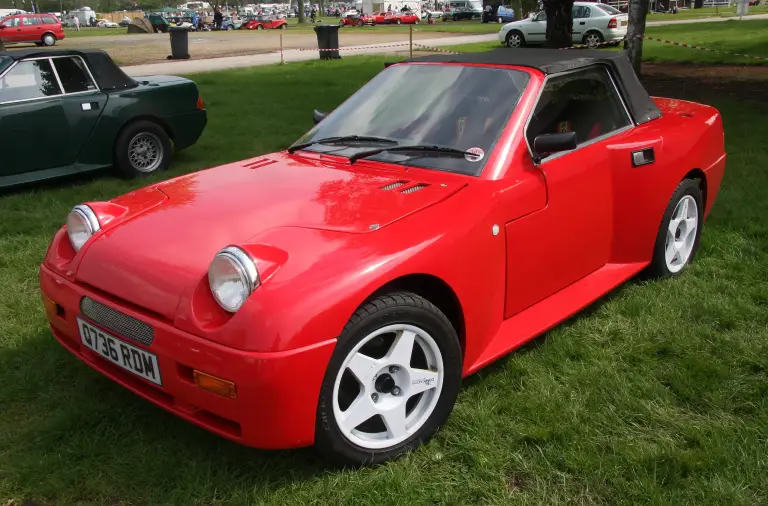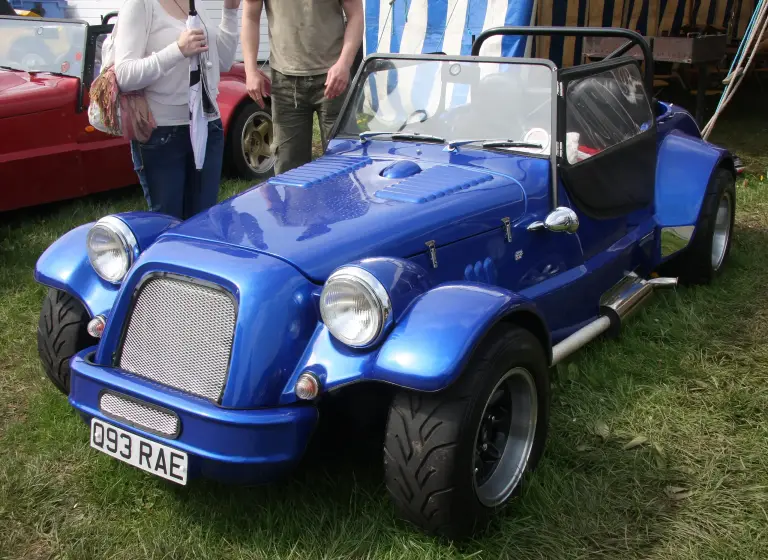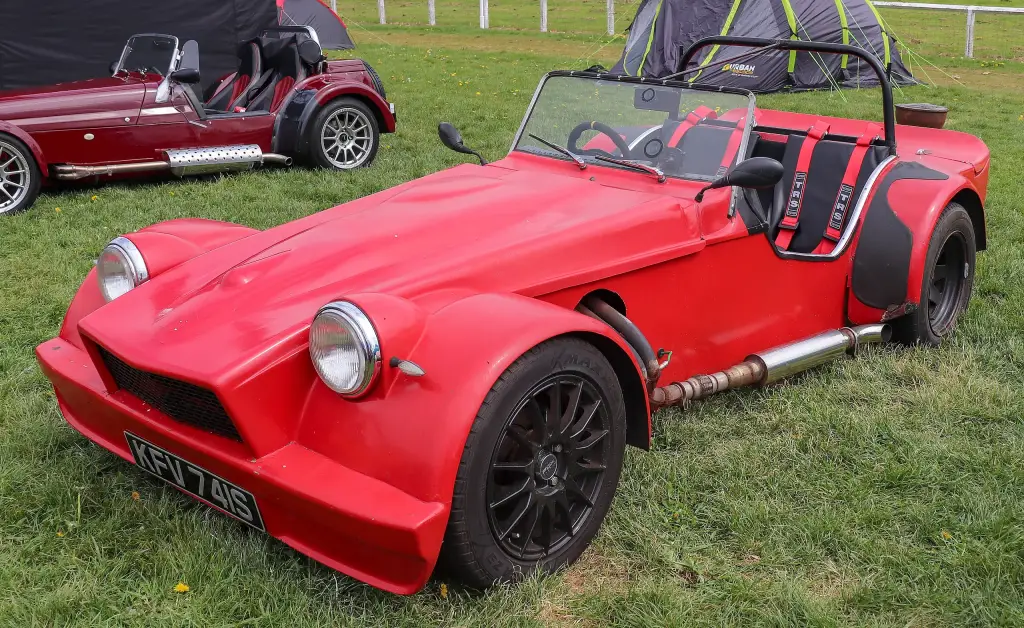
The Dutton Phaeton was the best-known model of Dutton Cars, the Worthing kit-car maker that built more kits than anyone else in the world. It appeared in 1977 as an updated version of the Malaga B+ and stayed in production, through four series, until 1989.
Dutton Phaeton at a glance
| Maker | Dutton Cars, Worthing, Sussex, England |
|---|---|
| Production | 1977–1989, four series |
| Origin | updated Dutton Malaga B+, itself developed from the B-Type |
| Series 1 | 1977–1981 |
| Series 2 | 1980–1982, rear suspension on Cortina springs |
| Series 3 | 1981–1986, chassis modified for Ford Escort components |
| Series 4 | 1986–1989, modified body with integral bumpers |
| Chassis | steel ladder frame, as on most Duttons |
| Body | glass-fibre |
| Engine, factory-built cars | 1.6-litre Ford Crossflow, 84 hp (63 kW) |
| Sold as | kit, or as a fully built-up car |
| Built by | Dutton Cars, founded by Tim Dutton-Woolley |
Based on one source: the English Wikipedia article on Dutton Cars, where the Phaeton is covered in the list of models and in the description of the company.
History of the Dutton Phaeton
Dutton Cars was founded by Tim Dutton-Woolley and began in a small workshop with a series of cars named P1. In October 1971 the B-Type appeared with a more or less standard specification and was based on Triumph Herald components; the company then moved to a larger factory in Tangmere, Chichester. The B-Type eventually evolved into the Phaeton, which became the model most closely associated with the marque.
Four series
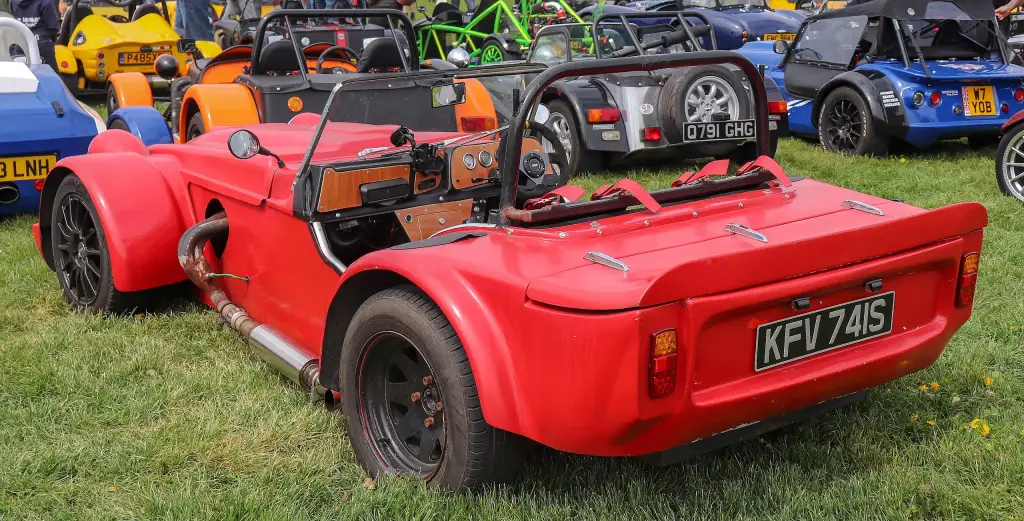
The Phaeton arrived in 1977 as an updated Malaga B+ and was built as Series 1 until 1981. Series 2, made from 1980 to 1982, changed the rear suspension to use Cortina springs. Series 3 of 1981–1986 had a modified chassis that took Ford Escort components, and the final Series 4 of 1986–1989 carried a modified body with integral bumpers. Later versions were Escort-based and were produced until 1989. They were also available as fully built-up cars, in which case they received a 1.6-litre Ford Crossflow engine with 84 hp (63 kW).
The company in the 1980s
Most Duttons depended on a ladder-frame chassis built from steel profiles, which held the various parts taken from the donor car. After originally using Triumph Herald parts, most Dutton kits used Ford Escort Mk 1 or Mk 2 components. A further move to larger premises back in Worthing was made in 1982, with glass-fibre body making at a separate works in Lancing. By 1984, 80 people were employed across four factories and a large showroom in Worthing, and production topped 1,000 cars a year. In terms of the number of kits produced, Dutton was the largest kit-car manufacturer in the world.
The end of the line
By 1989 Tim Dutton had become bored with the kit-car scene and all the designs were sold. Early Dutton kits are now hard to obtain: most cars have already been assembled and are only available second-hand, usually in need of restoration. Anyone buying a Dutton in kit form needs a donor car to provide the engine, gearbox and many other essential components, and Fords are the most common donors.
Design and features
- Ladder-frame chassis: steel profiles carrying the mechanical parts of the donor car.
- Glass-fibre body: light and easy to repair, and made in Dutton’s own works at Lancing from 1982.
- Escort mechanicals: later series used Ford Escort Mk 1 or Mk 2 components rather than Triumph Herald parts.
- Factory-built option: a 1.6-litre Ford Crossflow engine with 84 hp (63 kW) for cars assembled by Dutton.
- Constant development: four series over twelve years, each with a chassis, suspension or body change.
Dutton Phaeton versions
- Series 1 (1977–1981): the updated Malaga B+.
- Series 2 (1980–1982): rear suspension modified to use Cortina springs.
- Series 3 (1981–1986): modified chassis for Ford Escort components.
- Series 4 (1986–1989): modified body with integral bumpers.
- Fully built cars: assembled by Dutton with the 1.6-litre Crossflow engine.
The Phaeton chassis was used again for the Dutton Melos, and the last sports car of the range, the Legerra, followed in 1988. Dutton returned in 1995 with the amphibious Mariner. More cars are in the Dutton collection.
Video: Dutton Phaeton going sideways
Video on YouTube.
Sources
- Dutton Cars, English Wikipedia: company history, models and production