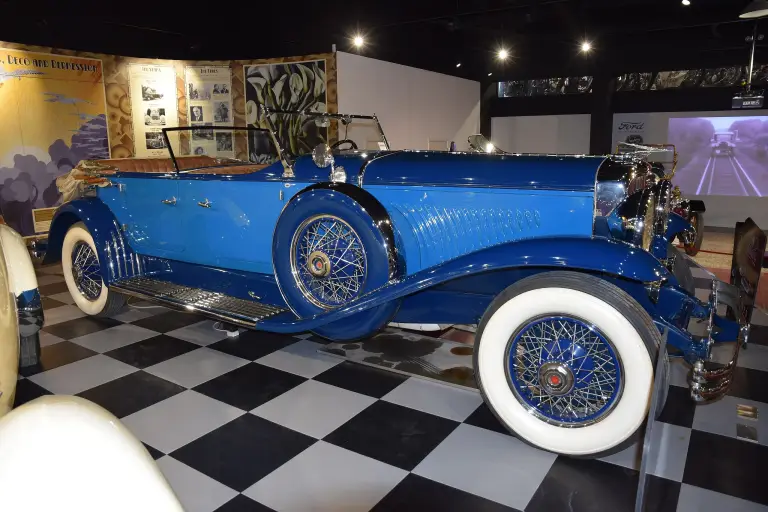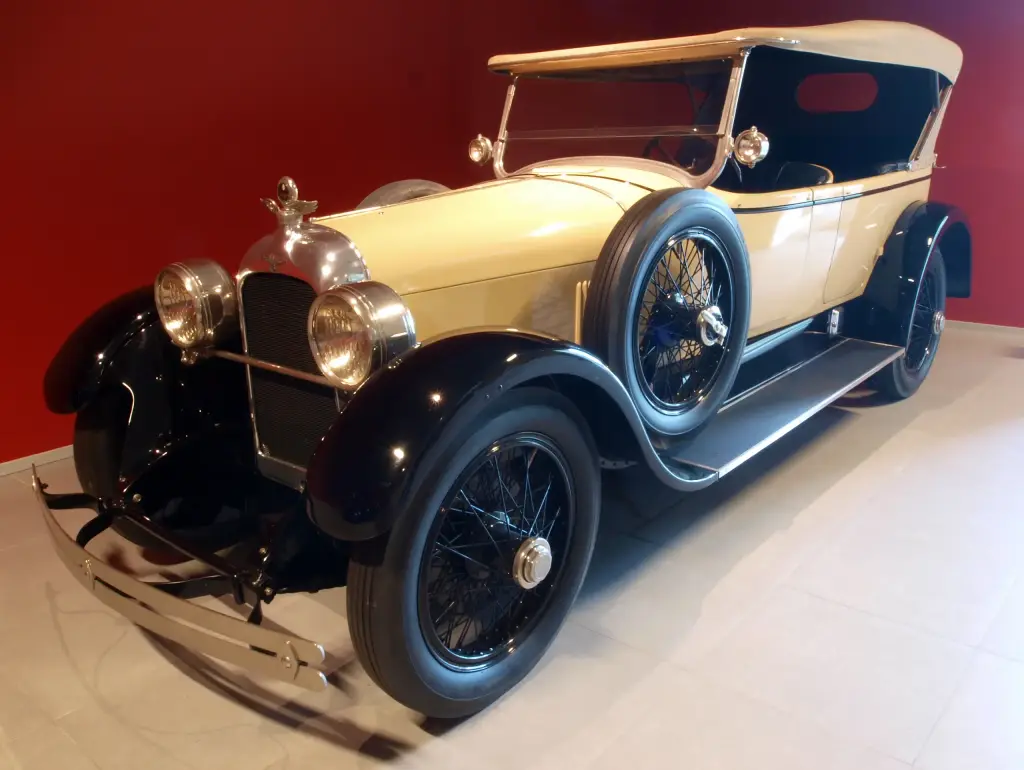
Duesenberg Automobile & Motors Company was an American racing and luxury car maker founded in Indianapolis in 1920 by the brothers Fred and August Duesenberg. It popularised the straight-eight engine and four-wheel hydraulic brakes, won the French Grand Prix and the Indianapolis 500, and at its peak built the most prestigious passenger cars in America.
Duesenberg at a glance
| Founded | 1920, Indianapolis, Indiana |
|---|---|
| Founders | Fred and August Duesenberg |
| Known for | straight-eight engines, four-wheel hydraulic brakes |
| First model | Model A, 4.3-litre straight eight, 88 hp |
| Racing first | first American car to win the French Grand Prix, 1921 |
| Indianapolis 500 wins | 1922, 1924, 1925 and 1927 |
| Owner from 1926 | Errett Lobban Cord |
| Flagship | Model J of 1929, 265 hp |
| Production ended | 1937 |
| Last original car | completed in 1940 for Rudolf Bauer |
| Later revivals | 1966 concept, SSJ 1970-1974, Duesenberg II from 1978 |
History of the Duesenberg
Racing origins
Fred and August Duesenberg began designing engines in the early 1900s, after Fred became involved in bicycle racing. They built a vehicle in 1905 and formed the Mason Motor Car Company in Des Moines, Iowa, in 1906. After the Maytag family sold its stake in 1912 the brothers moved to Saint Paul, Minnesota, and set up the Duesenberg Motors Company in 1913. Eddie Rickenbacker drove a Duesenberg-designed car at the Indianapolis 500 in 1914, finishing tenth, and during the First World War the brothers built aircraft engines in New Jersey.
Model A and the move to Indianapolis
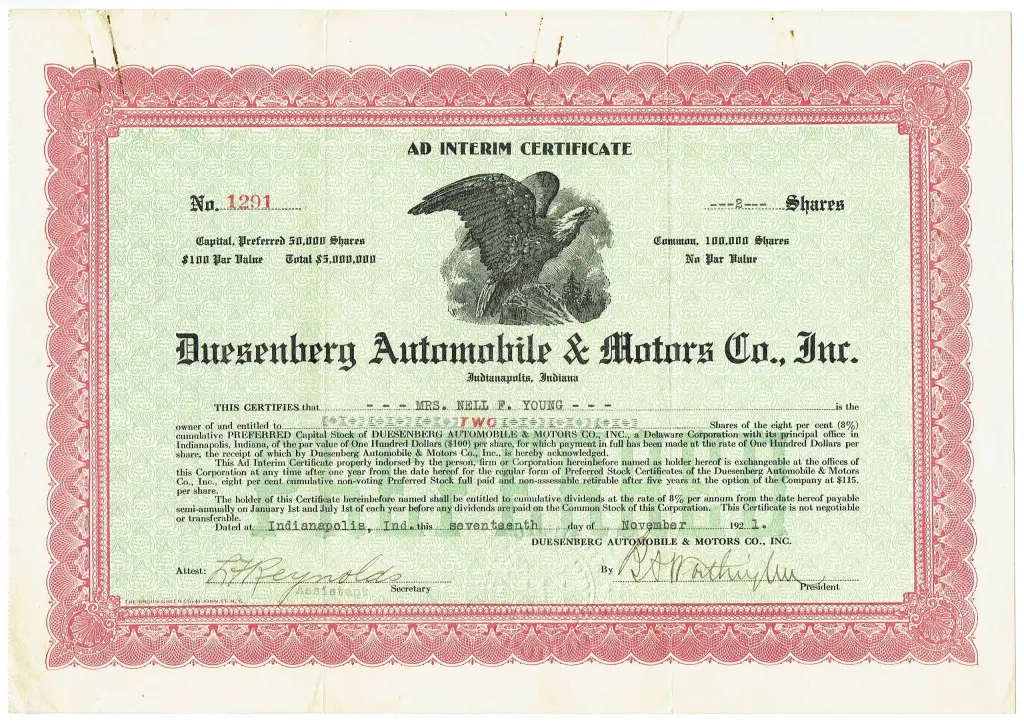
In 1920 the brothers founded Duesenberg Automobile & Motors Company in Indianapolis and began building the Model A. Its 260-cubic-inch (4.3-litre) straight eight produced 88 horsepower, the largest engine in a commercially available car at the time, and it was the first car with hydraulic brakes on all four wheels. A Duesenberg won the 1921 French Grand Prix in the hands of Jimmy Murphy, the first American car to do so, and Duesenbergs won at Indianapolis in 1922, 1924, 1925 and 1927.
Cord ownership and the Model J
The company struggled after 1921 and went into receivership in 1924; Errett Lobban Cord bought it in 1926. Two years later Cord had the Duesenbergs design a car to outclass every other American model, and in 1929 the company began selling the Model J with a 265-horsepower straight eight. Bodies were custom-built by coachbuilders, and prices ran from $14,000 to $20,000. Duesenbergs became a status symbol for film stars, royalty and the wealthy, and historian Donald Davidson called them the most prestigious passenger car in American history.
The end and later revivals
Cord sold the company and it was dissolved in 1937. The last Duesenberg built by the original firm was completed in 1940 for the German artist Rudolf Bauer. August Duesenberg failed to restart the company in 1947, and an attempt by his son Fritz with the designer Virgil Exner ended after one concept car in 1966. Between 1970 and 1974 Bernard Miller’s Duesenberg Corporation built eight SSJ cars, and from 1978 Elite Heritage Motors made the hand-built Duesenberg II in Wisconsin, each taking over 5,000 man-hours.
Design and features
- Straight-eight engines: the layout Duesenberg helped make popular in America, from the 4.3-litre Model A to the 6.9-litre Model J.
- Hydraulic brakes on all wheels: a first for a production car, fitted to the Model A of 1921.
- Racing success: victory in the 1921 French Grand Prix and four Indianapolis 500 wins in the 1920s.
- Custom coachwork: chassis and engine were sold separately, with bodies by Derham, LeBaron, Murphy, Rollston and others.
- Prestige: at its peak the marque was compared to Rolls-Royce as the finest American luxury car.
Duesenberg versions
- Model A (from 1921): the first production Duesenberg, with a 4.3-litre straight eight.
- Model X (1926): developed from the Model A.
- Model J (1929): the 265 hp flagship with custom bodies.
- Model SJ (1932): supercharged version of the J.
- SSJ (1970-1974): revival model based on the 1935 SSJ La Grande, eight built.
- Duesenberg II (from 1978): hand-built modern replica with air conditioning and automatic transmission.
The most famous Duesenberg is described in the article on the Duesenberg Model J; more luxury cars of the period are in the Classic Cars collection and the Duesenberg collection.
Sources
- Duesenberg, English Wikipedia: history, models, racing, revivals
- Duesenberg, German Wikipedia: company history, Model J and SJ, survival