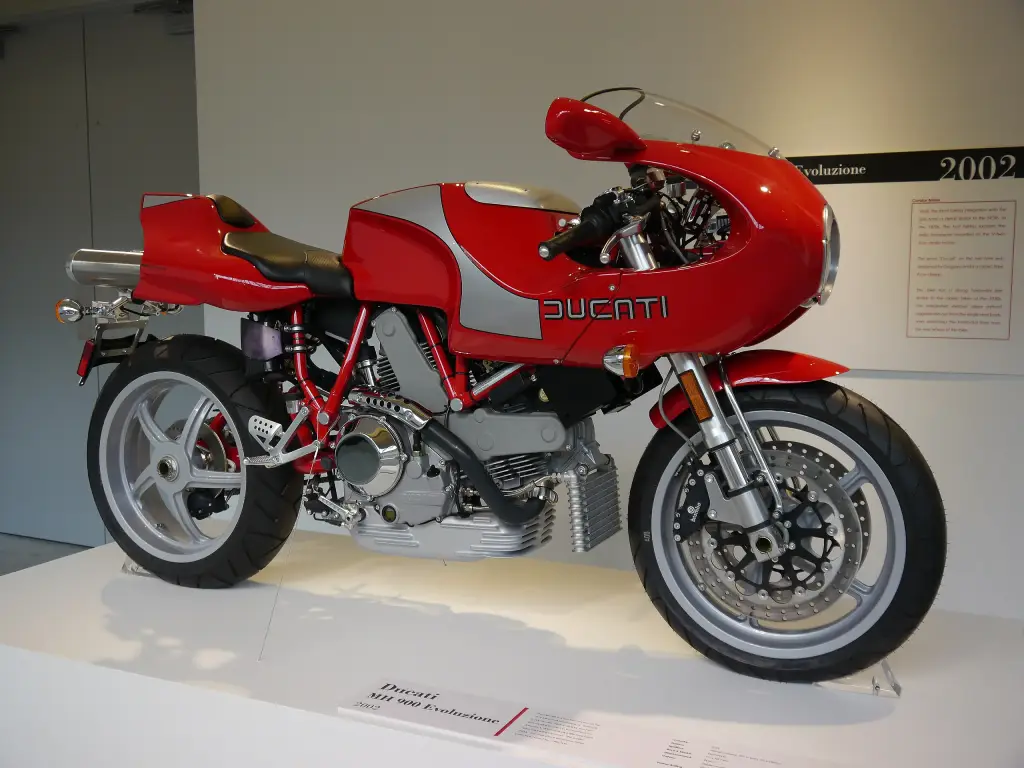
The Ducati MH900e, or Evoluzione, is a retro sport motorcycle made by Ducati in 2001 and 2002 in a limited production run of 2,000 units. It was designed by Pierre Terblanche as an homage to Mike Hailwood’s 1978 racing motorcycle. In 1984 Ducati had made the 900 MHR street bike, also an homage to Hailwood’s 1978 bike.
Ducati MH900e at a glance
| Maker | Ducati, Borgo Panigale |
|---|---|
| Production | 2001–2002 |
| Units | 2,000, hand-built |
| Designer | Pierre Terblanche |
| Homage to | Mike Hailwood’s 1978 Isle of Man TT winning bike |
| Sketch shown | September 1998, Intermot show in Munich |
| Orders opened | 1 January 2000, 00:01 GMT |
| Price | €15,000 |
| First 1,000 sold | 31 minutes |
| Buyers from | 20 countries |
| Build rate | 4–5 motorcycles per day |
History of the Ducati MH900e
A tribute to Hailwood
The concept by the Ducati designer Pierre Terblanche was a homage to the racing motorcycle Mike Hailwood rode to win the 1978 Isle of Man TT. In MH900e, MH stands for Hailwood’s initials and the e for evoluzione, Italian for evolution. The sketch was presented to the public in September 1998 at the Intermot show in Munich.
Two thousand, decided by a questionnaire
Ducati posted a questionnaire on its website to test the interest of MH900e fans. Federico Minoli and Massimo Bordi, then general manager of Ducati, produced a limited run of 2,000 hand-built bikes. The first 1,000 would be produced in 2000 and the second 1,000 in 2001. Ducati decided to sell the new bike directly to the consumer exclusively via the internet.
Sold out in half an hour
The Ducati website opened for orders on 1 January 2000 at 00:01 GMT at a price of €15,000. The first 1,000 units were sold out in 31 minutes, and the remaining bikes went over the next few weeks. Buyers came from 20 countries; the estimated breakdown was 30% from Europe, 30% from the United States and 39% from Japan.
Hand-built in Bologna
Production was originally to be sourced to Bimota from the summer of 2000, but the collapse of that small company meant Ducati kept it in-house. The bike was hand-built in a corner of the Bologna factory at a rate of four or five a day. The late start pushed the first bike to December 2000, a year after the introduction, and production continued into 2002, so the VIN years are 2001 and 2002.
The Hailwood lawsuit
In 2001 Pauline Hailwood, Mike Hailwood’s widow, sued Ducati for using her late husband’s name in connection with the MH900e. Mike Hailwood never rode the MH900e, and Ducati defended that the motorcycle was “inspired by the Ducati motorcycle that Mike Hailwood rode at the Isle of Man TT race in 1978”. The case was settled with a retroactive licence.
Design and features
- Internet sales: the first Ducati sold only through the factory website, without dealers.
- Demand: the first 1,000 motorcycles sold in 31 minutes at €15,000 each.
- Hand-building: four to five bikes a day in a corner of the Bologna factory.
- Registered in two years: the delay in production split the VINs between 2001 and 2002.
Ducati MH900e versions
- MH900e 2001: the first 1,000 motorcycles.
- MH900e 2002: the remaining 1,000, built after production slipped.
- 900 MHR (1984): Ducati’s earlier street tribute to Hailwood’s 1978 racer.
The MH900e shares its retro theme with the later Ducati SportClassic range, also designed under Pierre Terblanche. More Ducatis are in the Ducati collection.
Sources
- Ducati MH900e, English Wikipedia: concept, internet sales, production, lawsuit