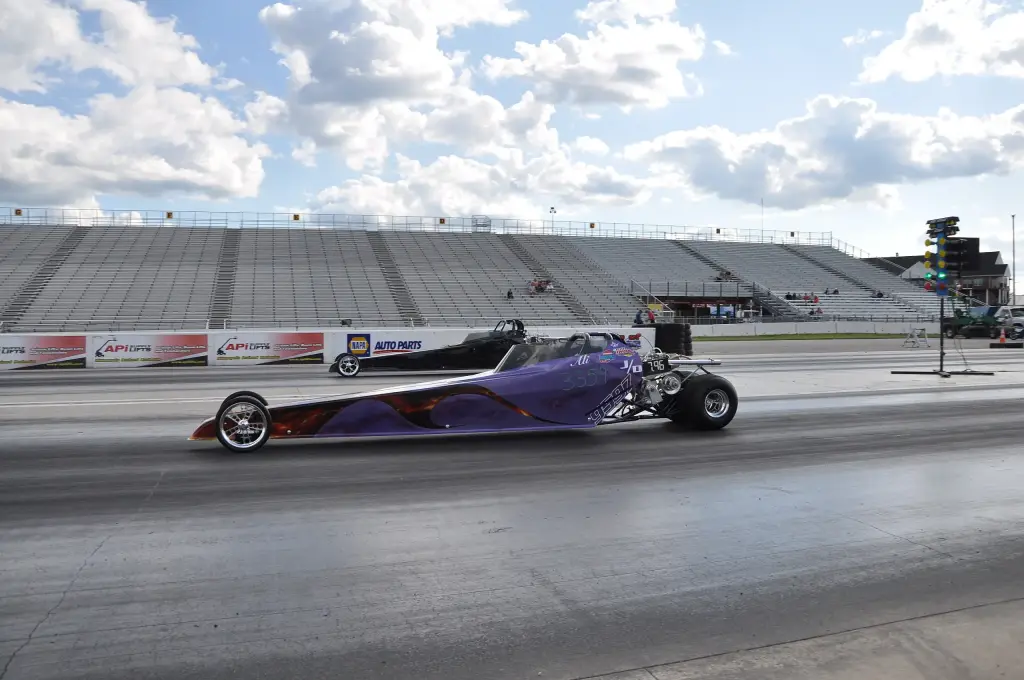
The Junior Dragster, or Jr. Dragster, is a scaled-down version of a Top Fuel dragster built for young drivers. It was developed in New Zealand in 1988, and the National Hot Rod Association in the United States began sanctioning the class in 1991 through its Junior Drag Racing League.
Junior Dragster at a glance
| Developed | New Zealand, 1988, with classes by the New Zealand Hot Rod Association |
|---|---|
| NHRA sanction | from 1991, through the Junior Drag Racing League (JDRL) |
| Drivers | from 6 years to compete, up to 20 years old |
| Jr. Dragster wheelbase | 90–150 inches |
| Jr. Roadster | Corvette or Toyota Supra body on the Jr. Dragster chassis |
| Engine | single-cylinder Briggs & Stratton of five brake horsepower |
| Jr. Comp wheelbase | 150–190 inches |
| Jr. Comp engine | motorcycle or personal watercraft engine |
| Track length | 1/16 mile (330 ft) or 1/8 mile (660 ft) |
| Quickest ET | 7.90 seconds at 85 mph for drivers of 13 and over |
| Jr. Comp limit | 6.900 seconds at 109.99 mph |
Based on one source: the English Wikipedia article on the Junior Dragster.
History of the Junior Dragster
New Zealand origins
The Junior Dragster was developed in New Zealand in 1988, with classes worked out by the New Zealand Hot Rod Association. The idea was a scaled-down Top Fuel dragster, or a roadster built on the same rules and called a Junior Roadster. The National Hot Rod Association in the USA began sanctioning the class in 1991, with the Junior Drag Racing League, which now consists of three vehicle categories: two based on the traditional Jr. Dragster, and the larger Jr. Comp.
The three categories
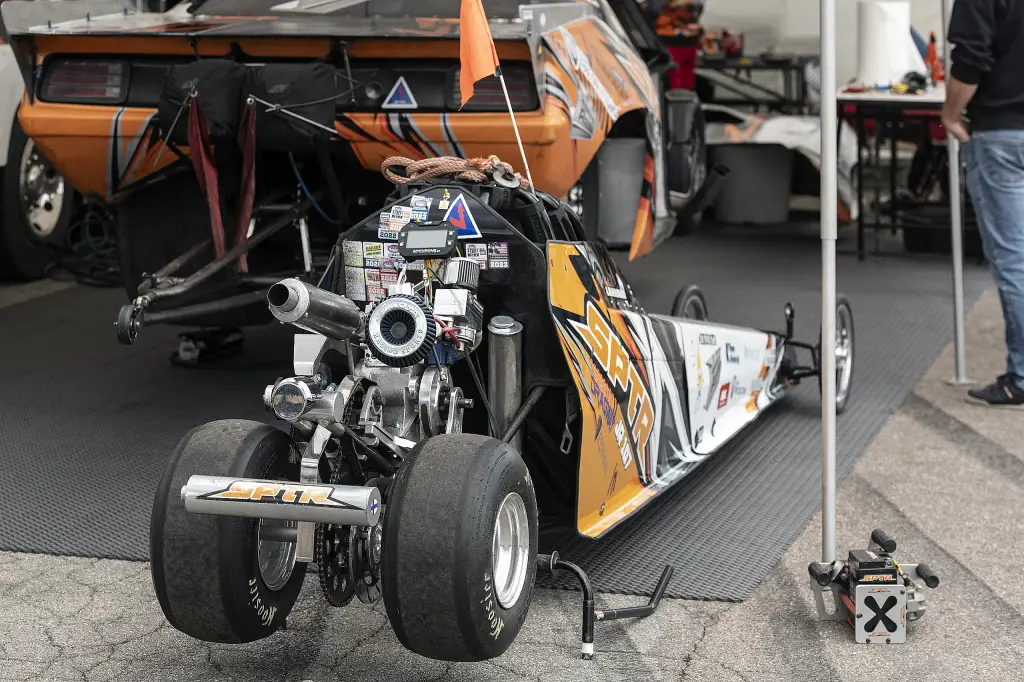
The traditional Jr. Dragster has a wheelbase of between 90 and 150 inches. The Jr. Roadster uses the same chassis with a Chevrolet Corvette or Toyota Supra body. Both use a single-cylinder Briggs & Stratton engine of five brake horsepower. The Jr. Comp dragster is larger, with a wheelbase of 150 to 190 inches, and uses a motorcycle or personal watercraft engine. Racers may take part in programmes run by the NHRA, the IHRA, the Australian National Drag Racing Association or an unsanctioned track.
Who may drive
Drivers may be male or female. They must be at least five years old to test and six to compete, and no older than 20 on 31 December of the competition year. Tracks are 1/16 mile or 1/8 mile long, and the class is run either as a bracket race or as a heads-up start on a five-tenths sportsman tree. The elapsed time a driver is allowed depends on age: a five-year-old may only make single-car test passes and no faster than 20.00 seconds, while drivers of six and seven are limited to 13.90 and must start heads-up. Drivers of eight and nine are limited to 11.90, those of ten to twelve to 8.90, and drivers of 13 and over may run up to 7.90 at 85 mph. Drivers of 14 to 20 may race in Jr. Comp, limited to 6.900 seconds at 109.99 mph. No driver over 18 may compete against a driver of 17 or under.
Racing and the way up
Racers compete almost every weekend, in points series at their home tracks or at larger events, and in the NHRA they choose between the Eastern and Western Conference Finals. There is also the Outlaw class, run heads-up on a four-tenths pro tree to the 330-foot cone, where series rules restrict engine combinations and weights so that cars stay inside the 4.10-second limit the NHRA sets for junior dragsters over that distance. In the UK there are more than thirty racers. The next step up is Jr. Comp and then the full-size categories, with Competition Eliminator or Super Street recommended. A Master division now lets parents take part with their children, sharing one car or running their own class alongside them.
Design and features
- Scaled-down chassis: a small dragster with a 90–150 inch wheelbase, or 150–190 inches for Jr. Comp.
- Small engine: a five-horsepower single-cylinder Briggs & Stratton, with a slide valve to cut power for the youngest drivers.
- Body options: an open dragster or the Jr. Roadster with a Corvette or Toyota Supra shell.
- Short tracks: races of 1/16 or 1/8 mile, so the cars are suited to small local strips.
- Age-based limits: the permitted elapsed time and speed rise with the driver’s age, from 20.00 seconds at five to 7.90 seconds at thirteen and over.
Junior Dragster versions
- Jr. Dragster: the traditional open car, 90–150 inch wheelbase, five-horsepower Briggs & Stratton engine.
- Jr. Roadster: the same chassis with a Chevrolet Corvette or Toyota Supra body.
- Jr. Comp: the larger car, 150–190 inch wheelbase, motorcycle or personal watercraft engine, down to 6.900 seconds.
- Outlaw: a heads-up class run to the 330-foot cone under series rules.
- Master division: a class for parents racing alongside their children.
The full-size cars are described in the article on the Dragster, and more photographs are in the Dragster collection.
Video: New Track Record in Junior Dragster
Video on YouTube.
Sources
- Junior Dragster, English Wikipedia: origins, classes, driver ages, time limits, racing