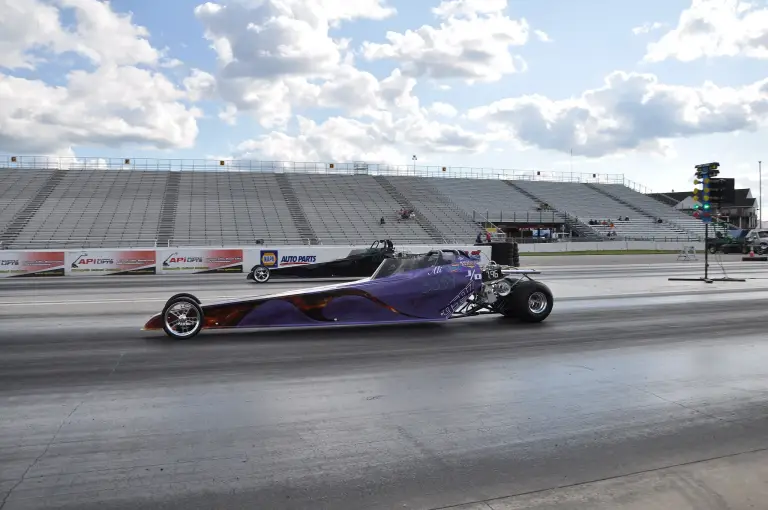
The dragster is the purest machine of drag racing: a very long, very light, open-wheeled car whose only purpose is to cover a short straight in the smallest possible time. In its professional form it is driven by a supercharged V8 burning nitromethane and can reach more than 500 km/h within a quarter of a mile.
Dragster at a glance
| Type | purpose-built or heavily modified drag racing car |
|---|---|
| Origin | United States, races from the 1930s |
| Standard distance | 1/4 mile (402.34 m); Top Fuel runs 1,000 ft (304.8 m) |
| Engine | OHV V8 with two valves per cylinder; about 8 litres supercharged, over 14 litres unblown |
| Maximum engine speed | about 8,000–9,000 rpm |
| Fuel | petrol, methanol or up to 85–90 percent nitromethane |
| Top Fuel output | 8,000–13,000 hp |
| Acceleration | 0–160 km/h in under 1 second; 400 m in under 5 seconds |
| Terminal speed | over 500 km/h |
| Braking | a parachute |
| Noise | about 150 dB |
History of the Dragster
Origins in America
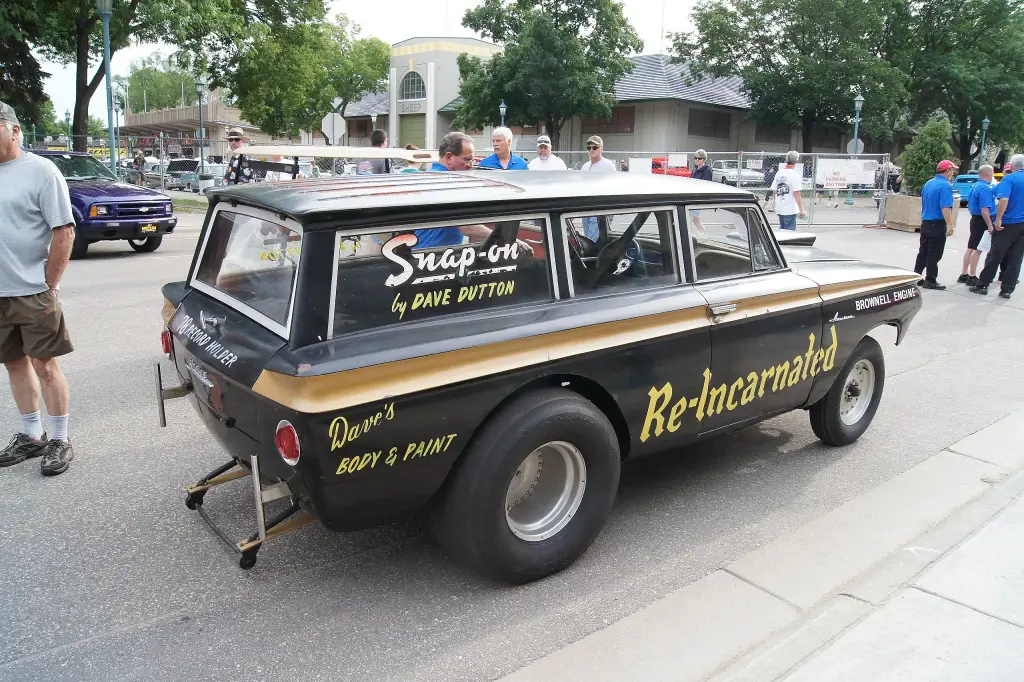
Drag racing began in the United States in the 1930s as a straight-line contest between modified road cars. It became very popular in the 1960s and later spread to other countries, including Japan and Australia. In France the first drag racing championship was held in 1980. From a competition between road cars the sport grew two kinds of machine: the doorslammer, which keeps working doors and a recognisable body, and the dragster, in which the bodywork and mechanics are simplified as far as possible for speed.
The professional classes
In Europe the rules of the FIA for the professional classes were largely taken over from the American NHRA. Professional dragster engines are restricted to stock-block designs: conventional eight-cylinder OHV engines with a camshaft in the block and two valves per cylinder, of the kind used in American sports cars and muscle cars of the 1960s and 1970s. Supercharged engines displace about 8 litres, while naturally aspirated ones can exceed 14 litres. They are long-stroke by racing standards, which gives high torque at low engine speeds, and they run to about 8,000–9,000 rpm. The enormous power comes from mechanical supercharging and from special fuels such as methanol or nitromethane. A Top Fuel engine is estimated at 8,000 to 13,000 hp; it cannot run at full power for more than about ten seconds, so the figure is calculated from fuel consumption rather than measured directly.
The amateur classes
Below the professional ranks the cars are more varied. Super Comp (Quick Rod outside NHRA and FIA events) accepts any car engine, with turbochargers and Roots-type blowers allowed, running on petrol, a petrol-alcohol mix, methanol or nitrous oxide. The class is run to a time index of 8.90 seconds for the quarter mile. The highest amateur class, Competition Eliminator, admits long-wheelbase dragsters, roadsters and doorslammers; a dragster with a V8 must weigh at least 612 kg, with a six-cylinder 454 kg and with a four-cylinder 386 kg. A typical car uses a supercharged 4.6-litre V8 of up to 1,500 hp, and the lightest cars can run the quarter mile in under seven seconds at more than 300 km/h.
How a run works
Two cars of the same class line up side by side. Each performs a burnout, spinning the rear tyres to heat the rubber and lay down grip for the start. The start is given by the electronic device known as the Christmas tree: a vertical column of lights counting down through a series of ambers to the green, with a red light for a jump start. The cars are stopped at the end of the run by a parachute, which is compulsory on cars. In elimination racing the loser of each pair is out and the winner goes forward until only one driver remains; in index classes a driver who goes quicker than the class index is disqualified, so races are often decided by thousandths of a second.
Design and features
- Elongated layout: a very long wheelbase and a flat, low body give the stability needed at high speed, with small light front wheels and huge rear slicks.
- Stock-block V8: two valves per cylinder, pushrod valve gear, a large supercharger and very short exhausts without filters.
- No cooling system: the engine runs for only a few minutes between rebuilds, so radiators are unnecessary.
- Direct drive: the most powerful cars use no gearbox at all; others have a three- or four-speed unit and a multi-stage clutch.
- Parachute braking: the bodywork and mechanics are simplified to the minimum to reach maximum speed.
Dragster versions
- Top Fuel dragster: the fastest class, with a supercharged nitromethane V8 and a 1,000-foot race distance.
- Funny Car: a full-bodied car with a dragster-type chassis and the same fuel rules.
- Pro Stock: two-door coupés with working doors, a 500 cu in (8,193 cc) limit and no supercharging.
- Pro Mod: doorslammers with heavily modified bodies and engines of over 2,500 hp.
- Competition Eliminator dragster: the quickest amateur cars, with a long wheelbase and any permitted engine.
- Junior Dragster: a scaled-down dragster for young drivers.
The scaled-down cars for young drivers are described in the article on the Junior Dragster, and more photographs are in the Dragster collection.
Video: Alcohol Funny Car/Dragster Maple Grove 2012
Video on YouTube.
Sources
- Dragster, English Wikipedia: definition of the dragster as an open-wheeled car
- Dragster, German Wikipedia: engines, classes, weights, competition rules
- Dragster, Italian Wikipedia: power, fuel, construction, acceleration figures
- Dragster, French Wikipedia: distances, history, conduct of a run