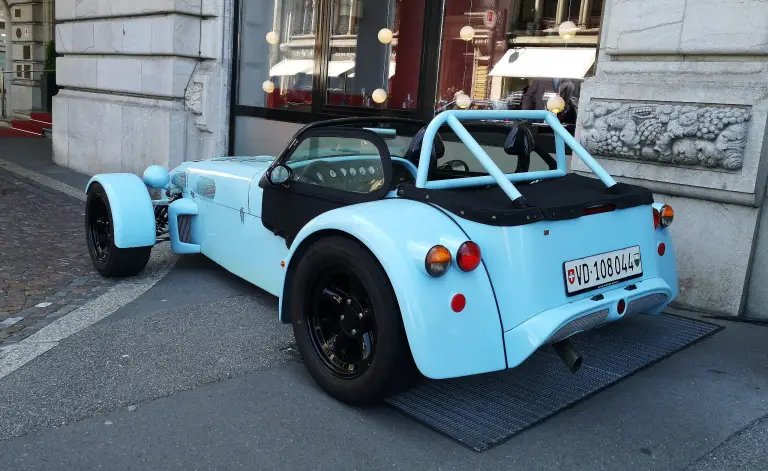
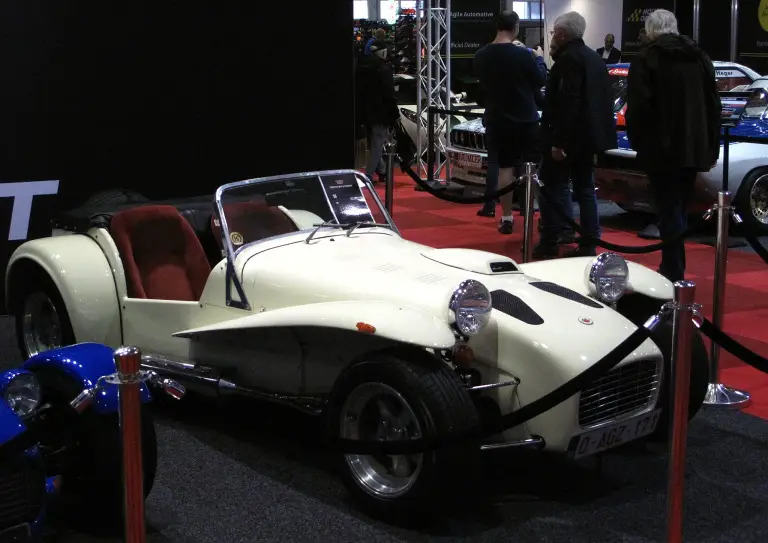
The Donkervoort S7 was the first car built by Joop Donkervoort, who had started his company in 1978 as a kit car importer. When the imported kits turned out to need extensive modification to be road-legal in the Netherlands, he began building cars of his own on a design derived from the Lotus Seven, in a shed in Tienhoven. The S7 was made from 1978 to 1982 and was replaced by the S8 in late 1983.
Donkervoort S7 at a glance
| Maker | Donkervoort Automobielen, Tienhoven, Netherlands |
|---|---|
| Production | 1978–1982 |
| Design basis | derived from the Lotus Seven |
| Engines | 1.6 L Ford Crossflow OHV; 2.0 L Ford OHC |
| Power | 90 PS (66 kW); 110 hp (82 kW) |
| Gearbox | four-speed manual |
| Front axle | Triumph |
| Rear axle | Ford Escort |
| Top speed | 170 km/h (106 mph) |
| Replaced by | Donkervoort S8, late 1983 |
| Built at | a shed in Tienhoven |
The S7 has no article of its own; this page is based on one source, the company article on English Wikipedia and its S7 section.
History of the Donkervoort S7
From importer to manufacturer
Joop Donkervoort founded the company in 1978 as a kit car importer. Learning that the assembled kit cars needed significant modifications to be street legal, he began building the first S7 cars himself, using a design derived from the Lotus Seven. The work was done in a shed in Tienhoven, and in 1983 the firm moved to a larger production facility in Loosdrecht. The company is still controlled by the Donkervoort family: Joop retired in 2019 and his son Denis became managing director in 2021.
A light car with a mixed parts bin
The S7 is an ultra-lightweight sports car. Motivation came from Ford: either a 1.6-litre Crossflow OHV engine with 90 PS (66 kW) or a 2.0-litre Ford OHC unit with 110 hp (82 kW), both driving through a four-speed manual gearbox. The chassis used a Triumph front axle and a Ford Escort rear axle, a mixture of off-the-shelf parts typical of low-volume British-style roadsters of the period. The top speed was 170 km/h (106 mph).
End of the line
Production of the S7 ended in 1982 and the model was replaced by the Donkervoort S8 in late 1983. The S8 kept the same dimensions as the Donkervoort Super Seven but was the first Donkervoort of real notice, with the “Eight” implying an improvement over the Lotus Seven. The house philosophy was already in place and is still summed up by the company motto “No Compromise”: cars are built without electronic aids such as ABS, ESP or power steering.
Design and features
- Lotus Seven genes: the S7 was designed on a Lotus Seven-derived layout, the starting point of every Donkervoort since.
- Ford power: a 1.6-litre Crossflow or a 2.0-litre OHC engine, both with a four-speed manual gearbox.
- Parts-bin running gear: a Triumph front axle and a Ford Escort rear axle.
- Light and quick: an ultra-lightweight body and a 170 km/h top speed.
- No electronic aids: in keeping with the company motto “No Compromise”.
Donkervoort S7 versions
- S7 1.6 (1978–1982): Ford Crossflow OHV engine, 90 PS (66 kW).
- S7 2.0 (1978–1982): Ford OHC engine, 110 hp (82 kW).
- S7 (1978–1982): four-speed manual gearbox in both versions.
The S7 was replaced by the Donkervoort S8 in late 1983, and the line continued with the Donkervoort D8. More cars are in the Donkervoort collection.
Sources
- Donkervoort, English Wikipedia: company history and the S7 section: production years, engines, axles, top speed