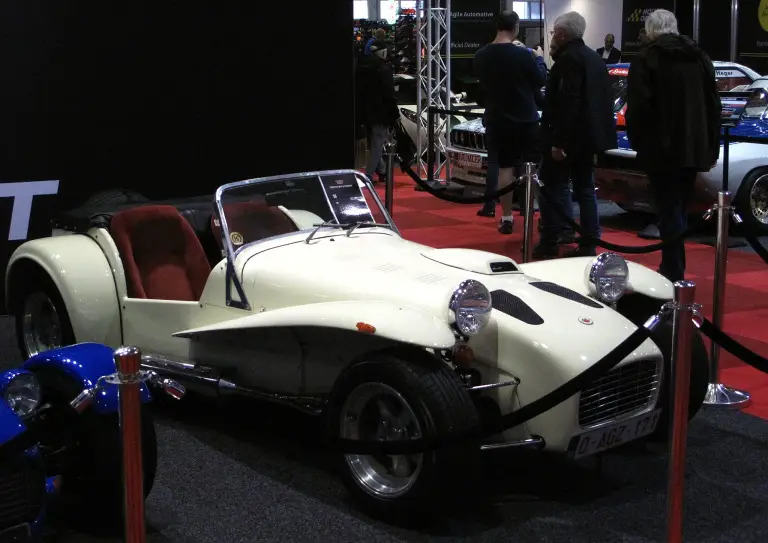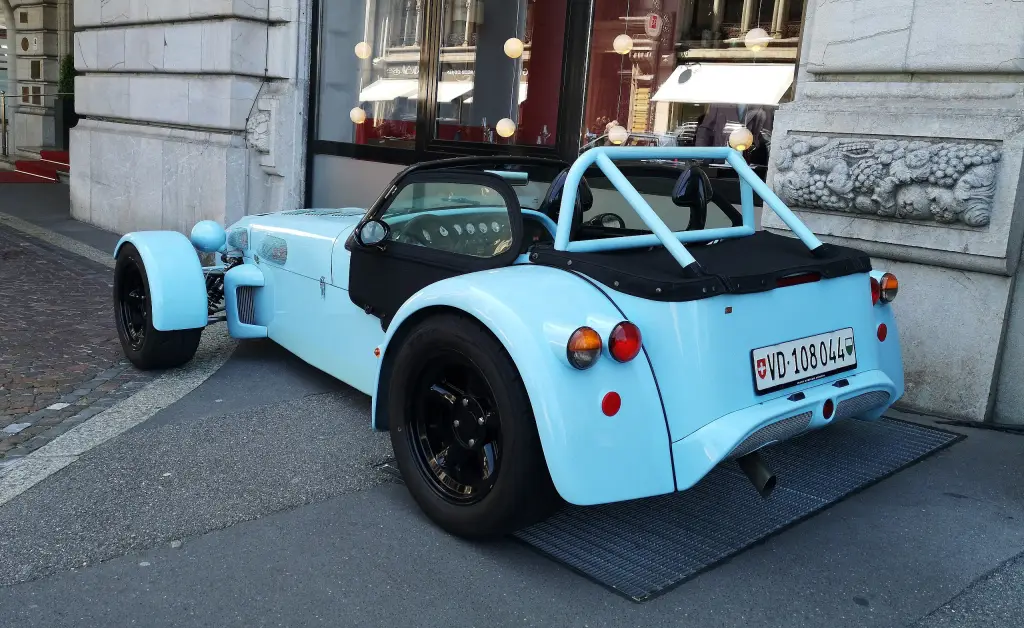
The Donkervoort D8 is a series of ultra-lightweight sports cars built by Donkervoort in Lelystad since 1993. It began with Ford Zetec power, switched to Audi turbocharged engines in 1999, and grew into the five-cylinder D8 GTO before the last Individual Series cars were delivered in 2022. More than any other model, the D8 marked the firm’s departure from being merely a Super Seven copy.
Donkervoort D8 at a glance
| Maker | Donkervoort Automobielen, Lelystad, Netherlands |
|---|---|
| Production | 1993–2022 |
| First engines | Ford Zetec 1.8 and 2.0, 1993–1998 |
| Cosworth version | 2.0 turbo Cosworth YB, 220 or 280 hp, from 1995 |
| Audi engines | 1.8T 20V, 1999–2012 |
| Audi outputs | 150, 180, 210 and 270 hp |
| Weight (Audi cars) | 630 kg |
| 0–100 km/h (Audi cars) | 3.8 to 5.2 seconds |
| Nordschleife record | D8 RS, 2004, by 15 seconds |
| Record edition | D8 2-69 RS, 25 cars |
| Hardtop | D8 GT, from 2007 |
| Final version | D8 GTO Individual Series, 2021–2022 |
History of the Donkervoort D8
Ford Zetec and Cosworth (1993–1998)
From 1993 the new D8 was built, continuing the departure from the Lotus Seven layout. The first D8s were the last Donkervoorts to use Ford engines: 1.8 and 2.0-litre units from the Zetec family, in a car that replaced the S8AT. In 1994 the Zetec Sport arrived with weight cut by swapping some metal body parts for carbon fibre, downsizing the battery and replacing the cast-iron clutch housing with an aluminium one. The Classic can be told by its long front fenders running from the front wheel to the door, while the Sport wore cycle fenders over the front wheels only. From 1995 the D8 was also offered with the turbocharged 2.0-litre Cosworth YB engine, familiar from the Sierra and Escort RS Cosworth, with 220 or 280 hp (164 or 209 kW), a 235 km/h top speed and 0–100 km/h in 4.1 to 4.8 seconds.
Audi power and the Wide Track (1999–2012)
During 1999 Donkervoort switched from Ford to Audi’s 20-valve turbocharged 1.8-litre four, first with a choice of 150 or 180 hp. In 2003 came the Wide Track with an electronic throttle (“E-gas”) version of the same engine, and the D8 Sport received a 211 PS version that year. Cars were sold as Touring, Sport and Race models and often carried their output as a designator, so the D8 150 was the original Audi-engined car and the D8-e210 the E-gas model with 210 hp. The chassis was new, using lessons from the 20 D project, and at 630 kg the cars reached 100 km/h in 3.8 to 5.2 seconds depending on the version.
The Nordschleife record and the 270
In 2004 a Wide Track-based D8 RS broke the lap record for street-legal cars at the Nürburgring Nordschleife by 15 seconds. To celebrate, Donkervoort built a limited series of 25 D8 2-69 RS cars with 270 hp; the D8 2-69 then went into regular production in 2008. In 2011 it was the seventh fastest production car on the Nordschleife with a lap of 7:14.9. The 270 is recognised by a revised nose and grille shaped around a larger cooler and an extra side radiator.
GT, GTO and the end (2007–2022)
The first Donkervoort hardtop, the D8 GT, appeared at the Geneva Motor Show in 2007 with butterfly doors, a revised headlamp housing, a track widened by 8 cm at the front and 4 cm at the rear and 30 cm more length on an unchanged wheelbase; carbon fibre in the roof, rear, doors and fenders kept the weight gain small, and output was 180, 210 or 270 hp, with production limited to 50 cars a year from 2008. The next-generation D8 GTO was announced in December 2011, larger and slightly heavier, powered by Audi’s five-cylinder 2.5T 20v engine. The GTO range ran from 2013 to 2021 and included the Premium, the Bilster Berg Edition, the RS, the all-carbon Bare Naked Carbon Edition and the JD70 specials. The D8 GTO Individual Series of September 2021, built to each customer’s specification from €162,900, marked the end of D8 production; it reached the United States in July 2022 from US$240,000.
Design and features
- Two engine eras: Ford Zetec and Cosworth units until 1998, Audi 1.8T 20V engines from 1999.
- Carbon fibre: used from the 1994 Zetec Sport onwards to keep weight down.
- Track record: the D8 RS took the street-legal lap record at the Nordschleife in 2004.
- Hardtop option: the D8 GT of 2007 with butterfly doors and a longer body.
- Five-cylinder finale: the GTO of 2013–2022 used Audi’s 2.5T 20v engine.
Donkervoort D8 versions
- D8 Zetec (1993–1998): Ford 1.8 and 2.0 Zetec engines, Classic and Sport body styles.
- D8 Cosworth (1995–1998): turbocharged 2.0 Cosworth YB, 220 or 280 hp.
- D8 Audi (1999–2003): 1.8T 20V with 150 or 180 hp.
- D8 Wide Track / E-gas (2003–2012): electronic throttle, up to 270 hp, new nose and lights.
- D8 2-69 RS (2004) and D8 270 (2008–2012): 270 hp, 25 record-edition cars first.
- D8 GT (2007–): hardtop with butterfly doors, 180, 210 or 270 hp.
- D8 GTO (2013–2022): Audi 2.5T five-cylinder, from GTO to RS, JD70 and Individual Series.
The D8 followed the Donkervoort S8 and the original S7, and it was the last Donkervoort to use a Ford engine before the firm moved over to Audi power. More cars are in the Donkervoort collection.
Video: Donkervoort D8 GTO: The Lotus Seven you always wanted – XCAR
Video on YouTube.
Sources
- Donkervoort D8, English Wikipedia: versions, engines, Nordschleife record, GT and GTO
- Donkervoort, English Wikipedia: Ford-to-Audi switch, company background