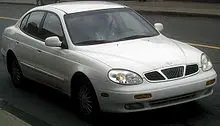
The Doninvest Kondor was the Russian name for the Daewoo Leganza built at the Taganrog car plant. It was the largest of the three Korean-derived cars that the Doninvest group assembled there from 1998, and the only one with an executive-class body and a two-litre engine.
Doninvest Kondor at a glance
| Maker | Doninvest, assembled at TagAZ, Taganrog |
|---|---|
| Also known as | Daewoo Leganza (V100) |
| Class | executive car (E-segment) |
| Body | four-door sedan, front-wheel drive |
| Assembly in Taganrog | from 1998, from Korean kits |
| Design | Italdesign, Giorgetto Giugiaro |
| Engine | 2.0-litre D-TEC four-cylinder, Holden-sourced |
| Gearbox | five-speed manual; four-speed automatic |
| Drag coefficient | Cd 0.32 |
| Equipment | below the Korean Leganza; airbags not offered even as an option |
| Platform code | V100 |
The Doninvest Kondor is described in a short section of the English and Russian Wikipedia articles on the Daewoo Leganza; this page uses those sections and the material about the Korean car.
History of the Doninvest Kondor
The Daewoo Leganza
The Leganza was one of three cars with which Daewoo replaced its General Motors-derived range in the late 1990s, alongside the smaller Lanos and Nubira. Development began at the end of 1993 and was led by Dr Ulrich Bez, formerly of Porsche and BMW; the car was ready for production in February 1997 after a programme of about 30 months. Styling came from Giorgetto Giugiaro of Italdesign, who reworked themes from his 1990 Jaguar Kensington concept, and the body achieved a drag coefficient of 0.32. Engines came from GM Australia and transmissions from ZF. The Leganza was sold as a single generation, internally coded V100, from 1997 to 2002.
Assembly at Taganrog
The Taganrog automobile plant opened on 12 September 1998 and began assembling the three Daewoo models from kits. The Lanos became the Doninvest Assol, the Nubira the Doninvest Orion, and the Leganza the Doninvest Kondor. Daewoo’s own marketing described assembly of the Leganza in Russia, Ukraine, Poland, Romania and Uzbekistan as CKD or SKD work only: every car was effectively built at Daewoo’s Bupyong plant in Korea and then put together locally.
Equipment
The Kondor was marketed only briefly and was noticeably poorer equipped than the Leganzas sold elsewhere. According to the English Wikipedia article on the Leganza, airbags were not available on the Russian car even as an option, while the Korean and European versions offered twin airbags and, in the higher trim, anti-lock brakes, climate control and traction control. The saving was in the specification rather than the bodyshell: the Kondor used the same Giugiaro-designed four-door body as the imported car.
Design and features
- Giugiaro body: the same Italdesign shape as the Korean Leganza, with a drag coefficient of 0.32.
- Two-litre engine: the Holden-sourced D-TEC four-cylinder, with a five-speed manual or a four-speed automatic.
- Reduced specification: the cheapest version of the Leganza, without airbags even as an option.
- Kit assembly: cars arrived from Korea in knocked-down form and were put together in Taganrog.
Doninvest Kondor versions
- Doninvest Kondor: the Russian-assembled Leganza, sold from 1998.
- Daewoo Leganza SE, SX and CDX: the Korean and European trim levels, with progressively more equipment.
- 1999 revision: the Korean car gained a 2.2-litre engine option, an electronically controlled automatic gearbox, 15-inch alloy wheels and a revised suspension.
The Kondor was the largest of the Taganrog trio; the smaller cars were the Doninvest Assol and the Doninvest Orion. More cars are in the Doninvest collection.
Video: 144. Dateline 2000 IIHS Offset Crash Test
Video by testdrivejunkie.com on YouTube.
Sources
- Daewoo Leganza, English Wikipedia: development, styling, equipment, Doninvest Kondor
- Daewoo Leganza, Russian Wikipedia: Tagaz assembly, Doninvest Kondor