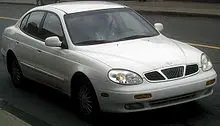
The Doninvest Assol was the Russian-assembled version of the Daewoo Lanos, built at the Taganrog car plant from 1998. It was the smallest and cheapest of the three Korean-derived models that the Doninvest group put together there, and its production run was the shortest: it ended in 2000.
Doninvest Assol at a glance
| Maker | Doninvest, assembled at TagAZ, Taganrog |
|---|---|
| Also known as | Daewoo Lanos (T100) |
| Class | compact car |
| Body | four-door sedan, three- and five-door hatchback (base car) |
| Assembly in Taganrog | 1998–2000 |
| Pilot batch | Krasny Aksai plant, 1998 |
| Design | Italdesign, Giorgetto Giugiaro |
| Engines | 1.3, 1.5 and 1.6-litre E-TEC four-cylinders |
| Gearbox | five-speed manual; four-speed automatic |
| Suspension | from the Daewoo Nexia, derived from the Opel Kadett E |
| Platform code | T100 |
The Doninvest Assol is described in a short section of the Russian Wikipedia article on the Daewoo Lanos; the rest of the page uses the English and Russian articles on the Korean car.
History of the Doninvest Assol
The Daewoo Lanos
The Lanos was developed after Daewoo parted company with General Motors at the end of 1992 and decided to build its own range. The programme started in autumn 1993 with a study of twenty rival models, among which the Toyota Tercel, Opel Astra and Volkswagen Golf were judged the toughest competitors. Four design studios submitted clay models and Giorgetto Giugiaro’s proposal was chosen, with Italdesign finishing the exterior and interior. Suppliers included Porsche for suspension, brakes and structural work, GM Powertrain for the automatic gearbox and PARS for airbags. The sedan went on sale in Korea in November 1996, with the three- and five-door hatchbacks added during 1997; the European launch came at the Geneva show in 1997. The car replaced the Nexia and was itself replaced by the Kalos.
Assembly at Taganrog
The Taganrog automobile plant opened on 12 September 1998 and began assembling the Lanos, Nubira and Leganza from Korean kits under the names Doninvest Assol, Orion and Kondor. The Russian Wikipedia article on the Lanos adds that in 1998 a small pilot batch was also built at the Krasny Aksai plant, another Doninvest enterprise, to work out the production process. Assembly of the Assol in Taganrog stopped in 2000, the shortest life of the three.
Engines and chassis
The Lanos used the E-TEC family of four-cylinder engines: a 1.3-litre unit of 1,349 cc and 75 PS, a 1.5-litre SOHC engine of 1,498 cc and 86 PS, and a 1.6-litre DOHC engine of 1,598 cc and 106 PS. The 1.6 versions had larger front brake discs of 256 mm and stiffer front springs to carry the heavier engine. The suspension was taken from the Nexia, itself derived from the 1984 Opel Kadett E, which kept the car simple and cheap to maintain.
Design and features
- Giugiaro styling: the Lanos shape was chosen from four proposals and finished by Italdesign.
- E-TEC engines: 1.3, 1.5 and 1.6-litre four-cylinders, with five-speed manual or four-speed automatic gearboxes.
- Simple chassis: suspension carried over from the Nexia and originally from the Opel Kadett E.
- Short run: assembled in Taganrog from 1998 to 2000, after a pilot batch at Krasny Aksai.
Doninvest Assol versions
- Doninvest Assol: the Taganrog-assembled Lanos sedan, built from 1998 to 2000.
- Daewoo Lanos Romeo and Juliet: the three-door and five-door hatchbacks sold in Korea.
- Lanos II (2000): the revised version with a new front end and a redesigned saloon rear.
The Assol sat below the Doninvest Orion and the Doninvest Kondor in the Taganrog range. More cars are in the Doninvest collection.
Sources
- Daewoo Lanos, English Wikipedia: development, engines, chassis
- Daewoo Lanos, Russian Wikipedia: Tagaz assembly, Doninvest Assol, Krasny Aksai